

Bring two magnets together and something almost theatrical happens: they snap into place, or they push apart as though an invisible barrier has appeared between them. Turn one around and the result changes. One of our editors remembers being fascinated by that simple experiment as a child, especially when the same invisible force was put to work in LEGO trains. It remains an excellent starting point for a story about toy design.
A magnetic train coupling seems almost effortless from the outside. Roll a carriage towards another, let the ends meet, and the train becomes one longer vehicle. Yet a good coupling has to do more than attract: it must work reliably, fit the building system and survive years of handling. Looking closely at how LEGO approached those challenges reveals a surprisingly varied family of parts, from colour-coded railway magnets to the cargo-handling systems of M:Tron and the enclosed magnetic elements introduced in LEGO City decades later.
1967: when railway play met magnetic couplings
LEGO’s first movable brick-built train arrived in 1964, according to the company’s official train history. Battery-powered 4.5-volt trains followed in 1966, running on the now-familiar blue rails. The track, motors and rolling stock were developing quickly, and the connections between vehicles needed to be convenient for children who were constantly changing their train formations.
Magnetic couplings joined the train range in 1967. The benefit was easy to see: attaching a wagon no longer depended on lining up a small mechanical hook. The magnetic force did the work at the final moment, and carriages could be separated just as easily during shunting and loading games.
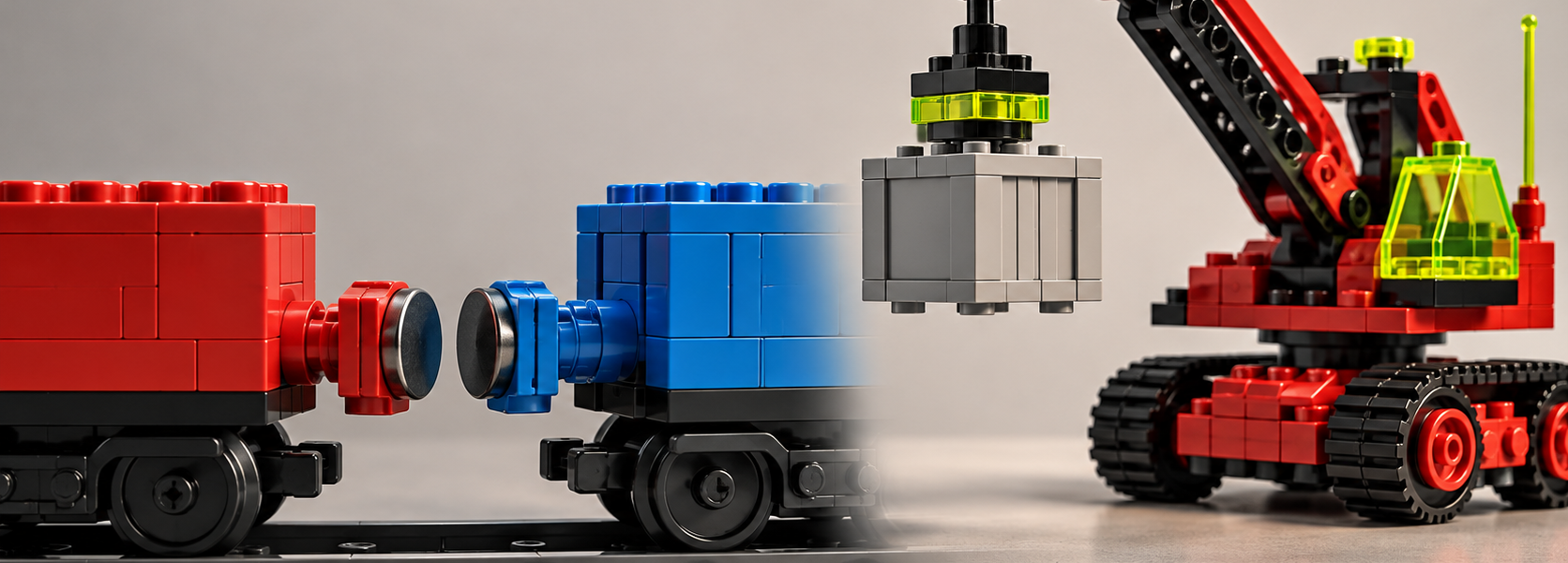
The earliest system was not completely automatic, however. Some couplings were produced in red and blue, indicating different magnetic orientations. Matching the wrong ends could leave the wagons repelling one another. The colours were markers for the parts, not the source of the magnetic force. It was an elegant play feature with a built-in lesson about polarity.
For collectors, an early example is BrickLink part x547b, listed in red and blue and associated with sets from 1967 to 1977. BrickLink also distinguishes related mould versions such as x547a, so apparently similar vintage couplers are not always identical. The colour, casing and exact type all matter when restoring a specific train.
The real design problem: opposite poles must meet
A permanent magnet has two poles, conventionally called north and south. Opposite poles attract; like poles repel. If both magnets are fixed rigidly in place, a coupling can only behave as intended when their orientations match. A child who turns a wagon around may suddenly discover that the same couplers no longer want to connect.
There are two ways to deal with that. One is to make the user select the right orientation, as the older colour-coded parts effectively required. The other is to let the mechanism adapt. The second approach is what makes the history of LEGO’s magnetic engineering particularly interesting: rather than overcoming the physical behaviour of magnets, the designer can exploit it.
The 1974 LEGO patent and a self-aligning magnet
A patent filed on 6 September 1974 and published on 18 March 1976 describes a magnetic coupling for toy trains in which a permanent magnet can rotate inside a non-magnetic housing. The patent, DE2442633A1, lists LEGO A/S as the assignee and details how the magnet can turn so that unlike poles face one another.
It is a clever use of mechanical freedom. Instead of making the child check the polarity of every connection, the component provides room for the magnet to seek a favourable orientation. The result is not stronger magnetism: it is a better interface between the physical effect and the person playing with the train.
A patent establishes that the concept was documented, but does not by itself prove which exact mould appeared in every production set. For a historically accurate build, the set’s original inventory remains more useful than a broad claim that all later LEGO magnets used one patented construction.
1980: the magnet becomes a reusable building component
In 1980, LEGO introduced the cylindrical magnet commonly catalogued as part 73092. Compared with a dedicated early train coupling, it opened up more ways to integrate magnetic behaviour into a LEGO model. A plastic-covered magnet could be used with different holders, rather than being confined to one fixed railway assembly.
Among those associated components were the 4023 train coupler, 2607 magnet holder and 2609b holder tile. This separation of functions was significant. The magnetic element supplied the attraction, while the holder determined how it would attach to a train, crane or other structure. A small family of specialised parts effectively became a construction system within the wider system.
That distinction is still essential when buying spares. A listing for the magnet alone may not include the holder needed for a particular set. Conversely, a plastic holder without its magnet can make a model look complete while leaving a key play function missing.
1990: M:Tron turns the magnet into a working tool
The biggest change in the magnet’s storytelling role came in 1990 with LEGO Space M:Tron. LEGO’s official Space history describes the red, black and transparent neon-green vehicles as using magnetic components to attach and transport cargo and smaller vehicles.
That is a different use from a railway coupling. On a train, magnets join vehicles together. In M:Tron, magnets help the machines do a job. A crane can lower a magnetic attachment over a container, lift it, move it to another position and release it. The mechanism turns a static model into a working scene of recovery, construction or exploration.
6989 Mega Core Magnetizer, released in 1990, is an especially strong example. Its large ground vehicle and cargo-handling crane made magnetic play central to the experience, rather than a detail hidden under the chassis. Brickset’s catalogue entry provides a useful reference for identifying the original model.
Other LEGO themes subsequently made use of magnetic parts, including later Space subthemes and Aquazone. What began as a way to connect railway carriages had become a general-purpose method of picking up, attaching and moving accessories. This is the broader design lesson of M:Tron: a familiar component can become compelling again when its job changes.
Why magnetic components became more enclosed
Loose and detachable magnets also introduce a safety problem. When more than one small magnet is swallowed, magnetic attraction inside the body can cause severe internal injury. The US Consumer Product Safety Commission explains this hazard in its general guidance on magnets. That guidance should not be mistaken for evidence of a recall involving any particular LEGO set.
Later LEGO train couplers illustrate a different approach to packaging the magnetic function. Instead of relying on a comparatively small separate magnet-and-holder arrangement, larger buffer assemblies keep the magnets inside a sealed component. BrickLink 64424c01, for example, is classified as a Train Buffer Beam with Sealed Magnets, with catalogued appearances from 2006 to 2010. Other mould variants followed, including 91968c01 and 29085c01.
This is a change in construction rather than a rejection of magnetism. Designers retained the convenient coupling function but changed how the magnetic material was contained. The exact reason for any individual product change should not be asserted without LEGO documentation, but the broader risk of accessible small magnets is well established.
For anyone handling vintage sets, the practical rule is simple: check old magnet housings for cracks and loose parts, and do not dismantle sealed magnetic components. An old component that is damaged or leaking a small magnet is not appropriate for unsupervised play by young children.
2020: LEGO City revisits the original polarity puzzle
The story did not stop with train buffer beams. In 2020, two LEGO City sets — 60243 Police Helicopter Chase and 60245 Monster Truck Heist — introduced larger magnetic assemblies. They allowed vehicles or cargo to be lifted as part of the action, echoing the play possibilities of M:Tron without recreating its earlier parts.
The new element designs included 65209, a round 4 × 4 magnetic brick, and 65217, its matching 4 × 4 component. In a hands-on New Elementary examination of set 60243, the internal magnets were found to be free to flip into alignment. Once again, the construction avoided the frustrating requirement to present a particular pole to the other part.
For builders, the difference is apparent in how the parts are used: a sizeable enclosed magnetic assembly is simpler to place in a vehicle and easier to handle than an old exposed magnet and its separate mount. New Elementary also tested the old and new systems together and found that they could interact magnetically. That is useful context, but magnetic attraction alone does not make their physical mounting systems interchangeable.
A collector’s checklist: identifying the right LEGO magnetic part
Magnetic pieces are easy to overlook in photographs of used sets. Before ordering a replacement for a train or Space model, work through these checks:
- Start with the set number and production period. A late-1960s train, an M:Tron crane and a modern enclosed train coupling may all involve magnets, but they are not built around the same parts.
- Verify the catalogue identity, not just the description. Early couplers such as x547b have related mould variations, while a cylindrical 73092 is a different component altogether. BrickLink’s part IDs are catalogue identifiers and should not automatically be treated as interchangeable LEGO Design IDs.
- Check the complete assembly. On vintage models, identify the holder, mounting piece and magnet separately. On newer train models, check the whole sealed buffer unit and its precise mould variation.
- Inspect the condition. Look for cracked casings, damaged connection points, corrosion or a loose magnet. An intact-looking vehicle is not necessarily a complete or safe one.
- Test function without forcing parts. A component may attract a metal object but still be the wrong shape or polarity arrangement for the set you are restoring.
- Compare region and shipping costs when sourcing replacements. BrickLink sellers operate in different markets, and the cheapest listed item may not be the most economical or best-condition choice after delivery and taxes. No single current market price reliably represents every variant.
For collecting purposes, photographs of the coupling from several angles and a link to its exact set inventory are more useful than a listing that simply says ‘LEGO magnet’. That small amount of research can prevent buying a part that is visually similar but historically incorrect.
One idea, three different design goals
Across nearly six decades, LEGO magnets have served three distinct design purposes: connecting train carriages, moving objects with cranes and other mechanisms, and demonstrating how a useful physical effect can be packaged in changing forms. The interesting part is not just that magnets kept returning. It is that their designers repeatedly reconsidered the relationship between force, movement and how children handle the parts.
That returns us to the small childhood discovery behind this feature. Turn a magnet around and the invisible force seems to change its mind. The earliest LEGO railway couplers exposed that puzzle. Later engineering found ways to make the same puzzle disappear during play. The science stayed the same; the experience became better.
Sources and further reading
- LEGO History — Trains: the official timeline for brick-built and powered trains.
- LEGO History — Space: the introduction and role of M:Tron.
- DE2442633A1: the 1974 LEGO magnetic train-coupling patent application.
- New Elementary — A brief history of LEGO magnets: historical types and their applications.
- New Elementary — LEGO City 60243 magnetic parts: testing the 2020 elements.
- BrickLink x547b, 73092 and 64424c01: parts and variants.
- Brickset — Mega Core Magnetizer 6989: set identification and catalogue context.
- CPSC — Magnets: general safety information.