
What Happened to BrickLink After Its Founder Died. From Family-Run Site to LEGO Group Ownership

Platforms built around one founder face a difficult question sooner or later: what happens when that person is gone. For BrickLink, that moment came suddenly.
Daniel Jezek died on September 24, 2010. By then BrickLink had become an important part of the LEGO secondary market, yet it was still closely associated with the person who had created and administered it.
His family kept BrickLink running
The platform did not disappear after Jezek’s death. BrickLink’s official history says his mother, Eliska, chose to continue the site, aware that many members depended on it and that some sellers relied on it for their livelihoods.
BrickLink’s Site History states that Jezek’s family operated the site until June 2013. That period gave the platform continuity at the point when its future was most uncertain.
The marketplace, catalog and seller network continued to function, but the scale of the service increasingly required a more formal organizational and technical structure.
NXMH acquired BrickLink in 2013
In 2013, BrickLink was acquired by Korean company NXMH, owned by entrepreneur Jung-Ju “Jay” Kim.
This marked a significant change. The service remained rooted in the adult fan community, but ownership moved beyond the founder’s family and into a more professional corporate structure.
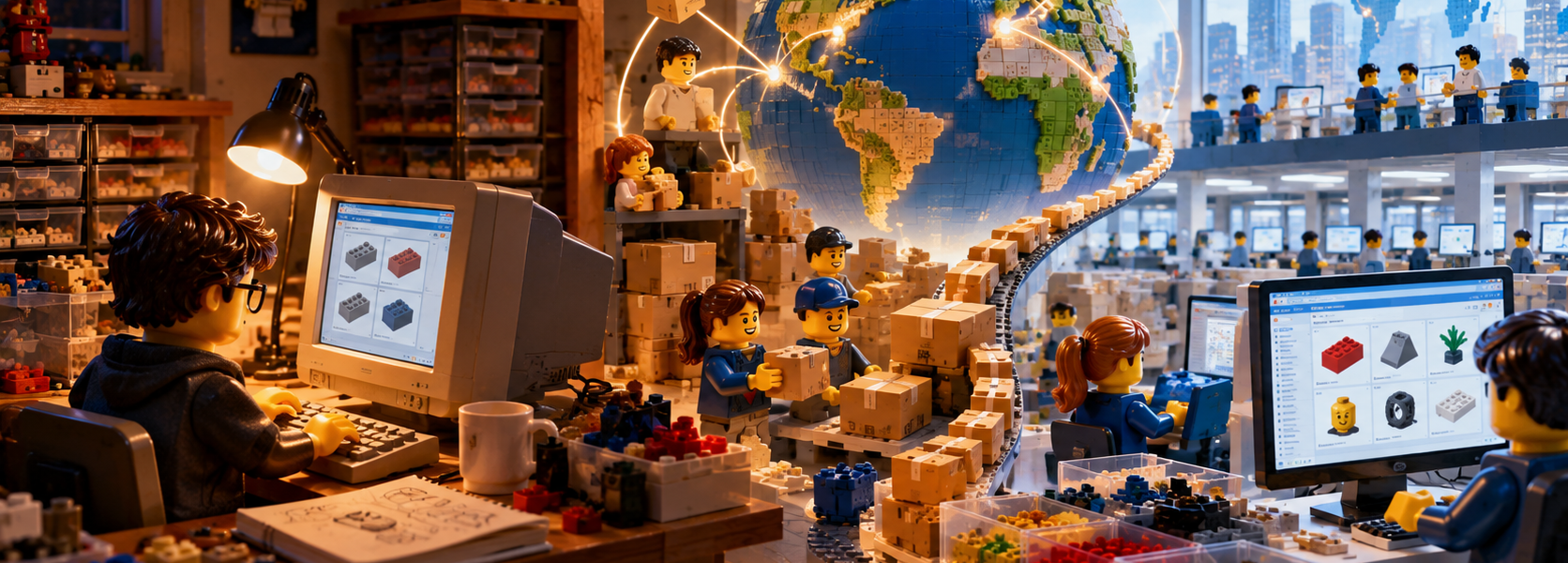
During the years that followed, BrickLink broadened beyond marketplace transactions alone. Its ecosystem also came to include digital design tools, community activity and projects connecting fan-designed models with physical products.
By 2019 BrickLink was far more than a resale site
When the LEGO Group announced its acquisition, BrickLink had more than one million members and more than 10,000 stores across 70 countries, according to the company’s 2019 announcement.
That scale matters. The LEGO Group was not buying only a website where used bricks changed hands. BrickLink combined a global marketplace, a deep product catalog, digital building software and a large adult fan community.
The LEGO Group acquisition
On November 26, 2019, the LEGO Group announced that it had acquired BrickLink Ltd from NXMH.
The company said the deal was intended to strengthen its connection with the growing community of adult LEGO fans. It also emphasized BrickLink’s marketplace, community and digital building tools, and said it intended to retain and nurture the platform’s independent spirit.
The LEGO Group’s 2019 annual report records that the acquisition of BrickLink Corporation’s assets and liabilities, together with BrickLink Limited and Sohobricks, was completed on December 16, 2019.
Why the deal mattered
The historical symbolism was hard to miss. A platform launched in 2000 by one fan and programmer had, less than two decades later, become part of the company that manufactures LEGO products.
The strategic rationale can be described without guessing at motives beyond the public record. The LEGO Group said BrickLink offered a unique opportunity to connect with adult fans through new channels and deepen collaboration with them.
At the same time, BrickLink brought with it a powerful ecosystem: a secondary marketplace, a detailed catalog, thousands of independent sellers, digital design tools and a highly engaged builder community.
Corporate ownership did not erase the marketplace model
The acquisition naturally generated discussion among users. Some saw the potential for greater stability and investment. Others worried about what corporate ownership might mean for a platform that had long been seen as independent.
Those reactions should be separated from what actually changed. BrickLink continued to operate around independent stores, buyer and seller accounts, a shared catalog and a global community.
The platform’s ownership changed, but its core marketplace structure remained recognizable.
A story of continuity, not a single takeover
It is tempting to compress the whole story into one line: a fan site was eventually bought by the LEGO Group. That misses the most interesting part.
After Jezek’s death, his family kept the service alive. NXMH then took ownership and moved the platform into a more formal phase. Only after that did the LEGO Group acquire BrickLink.
Each stage changed the organization behind the site, but the underlying role remained remarkably consistent: connecting sellers, buyers, collectors and builders around the catalog and secondary market for LEGO products.
That continuity is what makes BrickLink unusual. The project outlived its founder, changed ownership more than once and eventually became part of the LEGO Group without losing the basic marketplace model that made it valuable in the first place.
Part three of this series looks at the most visible consequence of that long history: why BrickLink still feels so old-school compared with modern marketplaces, and why rebuilding a 25-year-old working system is much harder than giving it a visual redesign.