
How the LEGO Group Approaches Child Safety Online: Build & Talk, UNICEF and RITEC

The LEGO Group’s responsibility to children does not stop with the physical safety of a brick. The company also operates apps, games and digital environments used by younger audiences, which brings a different set of risks into view: privacy, moderation, social interaction, parental consent and the design of digital experiences themselves.
In earlier installments of this series, we looked at LEGO Education and at how the LEGO Foundation actually works. This article moves into a third part of the ecosystem: child rights and digital wellbeing. It is part of our broader series on what LEGO does beyond selling sets.
First, separate the organizations
This topic becomes confusing very quickly if every initiative is described simply as something “LEGO” does.
The LEGO Group is responsible for its own digital products, safety policies, moderation systems, parental-consent mechanisms and family-facing resources such as Build & Talk.
UNICEF is a major external partner in work on child rights and online safety. It has collaborated with the LEGO Group on tools and policies including Child Online Safety Assessment, while also playing a central role in RITEC.
The LEGO Foundation is a separate entity. In the case of RITEC, it has provided funding for research and development. That funding should not be attributed to the LEGO Group itself.
RITEC is not an internal LEGO program. It is a UNICEF-led initiative developed with partners that currently include the LEGO Foundation, the LEGO Group, the Joan Ganz Cooney Center and Games for Change, building on earlier academic collaborations.
The story starts with child rights, not a family activity
The LEGO Group’s work with UNICEF predates Build & Talk. The broader foundation is children’s rights in business: how a company serving children should think about marketing, privacy, safeguarding and digital safety as part of its ordinary operations.
UNICEF lists several concrete outcomes from its partnership with the LEGO Group, including a Digital Child Safety Policy, a Child Safeguarding Policy, work on responsible marketing to children and the Child Online Safety Assessment, or COSA.
COSA matters because it is not limited to one LEGO app or platform. It was created as a tool companies can use to assess how their digital operations account for children’s rights and online safety.
Build & Talk: using play to start difficult conversations
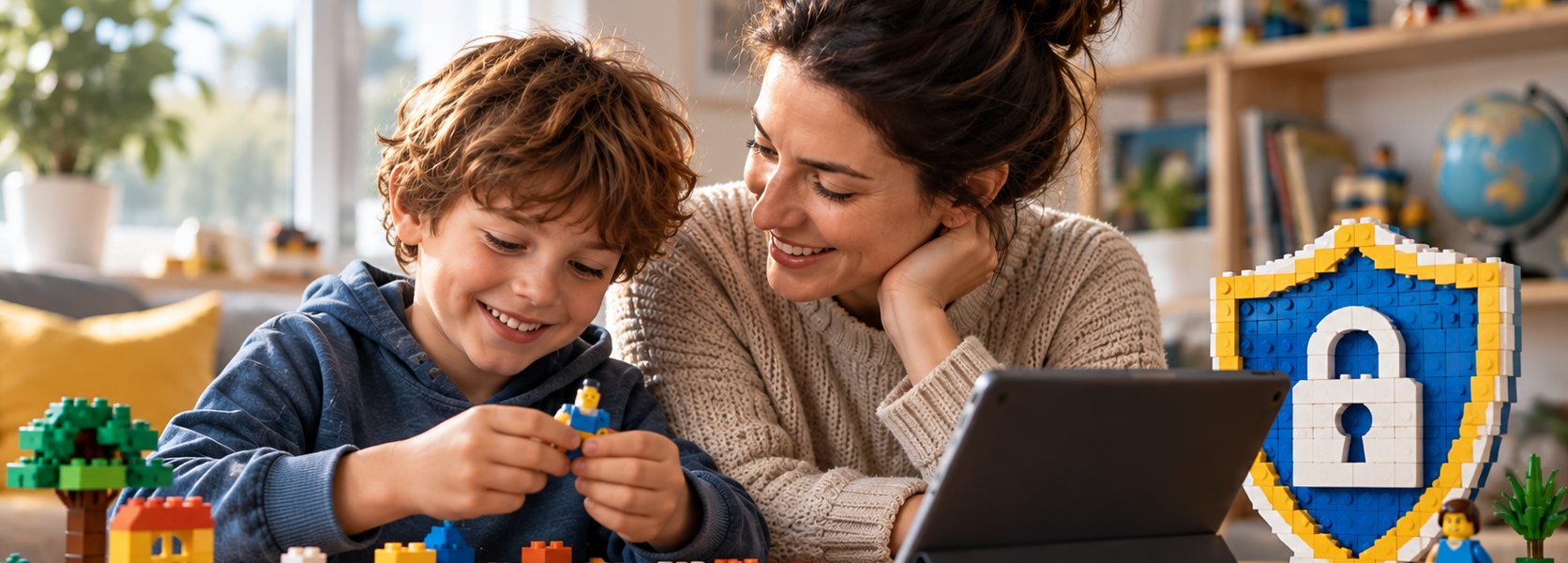
For parents, one of the most visible pieces of the LEGO Group’s digital-safety work is Build & Talk. The idea is straightforward: instead of opening a conversation about online risks with a lecture, a parent and child build together while prompts introduce topics and scenarios drawn from digital life.
The first activities appeared in 2020, and later additions covered issues such as cyberbullying, privacy and safe sharing. The format turns building into a conversation tool rather than treating the brick itself as the solution.
Build & Talk remains available through LEGO’s family and digital-safety resources, so it should be treated as an active initiative, not as a one-off pandemic-era campaign.
The next step is designing safer products
Family education is only one side of the problem. The other is whether a digital product is built in a way that reduces risk before the child ever has to make a decision.
The LEGO Group says it follows a safe-by-design approach in children’s digital experiences. Its public materials describe measures such as anonymous child profiles, moderated content, pre-approved usernames and Verified Parental Consent.
That distinction matters. A company can tell children to behave safely online, but if its own product design creates avoidable risks, the burden is being shifted back onto the user. Safe-by-design attempts to move some responsibility into the architecture of the service itself.
There is an important limitation, however: the most detailed claims about moderation effectiveness and internal safety processes come from the LEGO Group. They tell us what the company says it has built, but they are not the same as an independent audit of how effective every safeguard is in practice.
RITEC changes the question from safety to wellbeing
The most substantial part of this story is RITEC — Responsible Innovation in Technology for Children.
RITEC asks a broader question than how to prevent harm. It looks at how digital play can be designed to support children’s wellbeing in the first place.
UNICEF describes RITEC as a global initiative focused on designing digital play with children’s wellbeing in mind. Its current partners include the LEGO Foundation, the LEGO Group, the Joan Ganz Cooney Center and Games for Change. Earlier phases also involved research teams from Western Sydney University, New York University, the City University of New York, the University of Sheffield and the Australian Research Council Centre of Excellence for the Digital Child.
787 children, 18 countries and the RITEC-8 framework
RITEC’s framework was not developed only by adults defining what children ought to need. The RITEC-8 model was informed by work with 787 children across 18 countries, with particular attention to children aged 8 to 12.
The resulting framework identifies eight dimensions that digital play can support:
- safety and security,
- diversity, equity and inclusion,
- autonomy,
- competence,
- emotions,
- relationships,
- creativity,
- identities.
This moves the debate beyond the absence of obvious harm. A children’s digital product can also be judged by whether it supports agency, creativity, relationships and emotional development — and whether its design undermines any of those things.
What the research actually says
UNICEF’s RITEC research suggests that well-designed digital play can support creativity, autonomy, a sense of achievement, emotional regulation and social connection. The important word is can.
Positive outcomes do not happen automatically because a game is made for children. They depend on specific design choices and on the context in which the child uses the product.
That is why the project moved from a conceptual framework to the RITEC Design Toolbox, released by UNICEF in 2024. The toolbox is meant to help designers and game teams turn research findings into concrete product decisions.
RITEC is moving from research into implementation
RITEC did not end with a report. UNICEF has announced a new three-year phase focused on applying wellbeing-by-design principles in the games and digital-products industry.
The work now includes practical tools, training, industry engagement and a Community of Practice for people trying to apply the framework in day-to-day product development.
That shift is important. The project is moving from “what design principles appear to support children’s wellbeing?” toward “can those principles become part of real industry practice?”
Who pays for RITEC?
This is one of the areas where organizational precision matters most.
UNICEF states that RITEC was initiated with the LEGO Group, while its research and development were funded by the LEGO Foundation. The LEGO Foundation has its own governance, budget and grant-making activity, and should not be treated as another name for the commercial company.
That distinction also explains why our previous article on the LEGO Foundation matters to this story: understanding who pays for a program can change how we understand what kind of initiative it is.
Why is the LEGO Group involved?
The business logic is not difficult to see. The LEGO Group increasingly operates in digital spaces used by children. As play shifts across physical and digital environments, the company has a direct interest in making those experiences feel safe and trustworthy to children and parents.
There is therefore both a child-rights argument and a commercial one. Trust in digital safety matters to families, but it also matters to a brand whose future increasingly includes software, games and online communities.
That does not make the work meaningless. It does mean that the company’s public-interest goals and its business incentives should be considered together rather than pretending they are unrelated.
What is well established — and what is not
We know that Build & Talk has existed since 2020, has expanded into additional topics and remains available as part of the LEGO Group’s family resources.
We know that UNICEF and the LEGO Group have worked together on child-rights and online-safety tools, including COSA.
We know that RITEC is based on direct research with children and that its framework and design tools have been made public.
We also know that the current phase of RITEC is focused on practical adoption by the digital-products and games industry.
What is much less clear is how much Build & Talk changes real-world behaviour. We did not find strong independent evidence showing that the program measurably reduces cyberbullying or other online harms.
Likewise, the LEGO Group’s stated use of safe-by-design and wellbeing-by-design principles does not prove that every digital product implements those principles equally well.
Why this matters beyond one company
A generation ago, toy safety was often discussed mainly in terms of materials, construction and physical standards. For a company that now creates digital experiences for children, the definition has expanded.
Privacy, moderation, peer interaction, parental consent and the psychological effects of product design are now part of the same responsibility.
That is why the most interesting part of this story is not a single LEGO campaign. It is the shift from telling children to “be careful online” toward asking whether digital play can be designed so that safety and wellbeing are built in from the start.
Build & Talk is an educational tool. RITEC is a research and design framework. The LEGO Group’s own digital-safety systems are product decisions. They are different kinds of interventions, led and funded by different organizations.
Taken together, they show why understanding the modern LEGO ecosystem requires more than looking at what appears in a box.