

Are All LEGO Technic Axles Made From the Same Plastic. Why Longer Axles Twist More

Anyone who has built a large LEGO Technic model has probably seen it. A short 3L or 5L axle feels almost rigid. A 12L or 16L axle can visibly wind up under load, and in a powered drivetrain you may even notice a delay between motor rotation and the mechanism responding.
The first assumption is understandable: if longer axles twist more, perhaps the LEGO Group makes them from a different plastic.
Public LEGO material does not support that conclusion. The company identifies POM as a material used for hard, rigid, wear-resistant elements including axles, and says those parts are transitioning toward ePOM from 2026. What it does not publish is a part-by-part table showing a different polymer grade for each axle length.
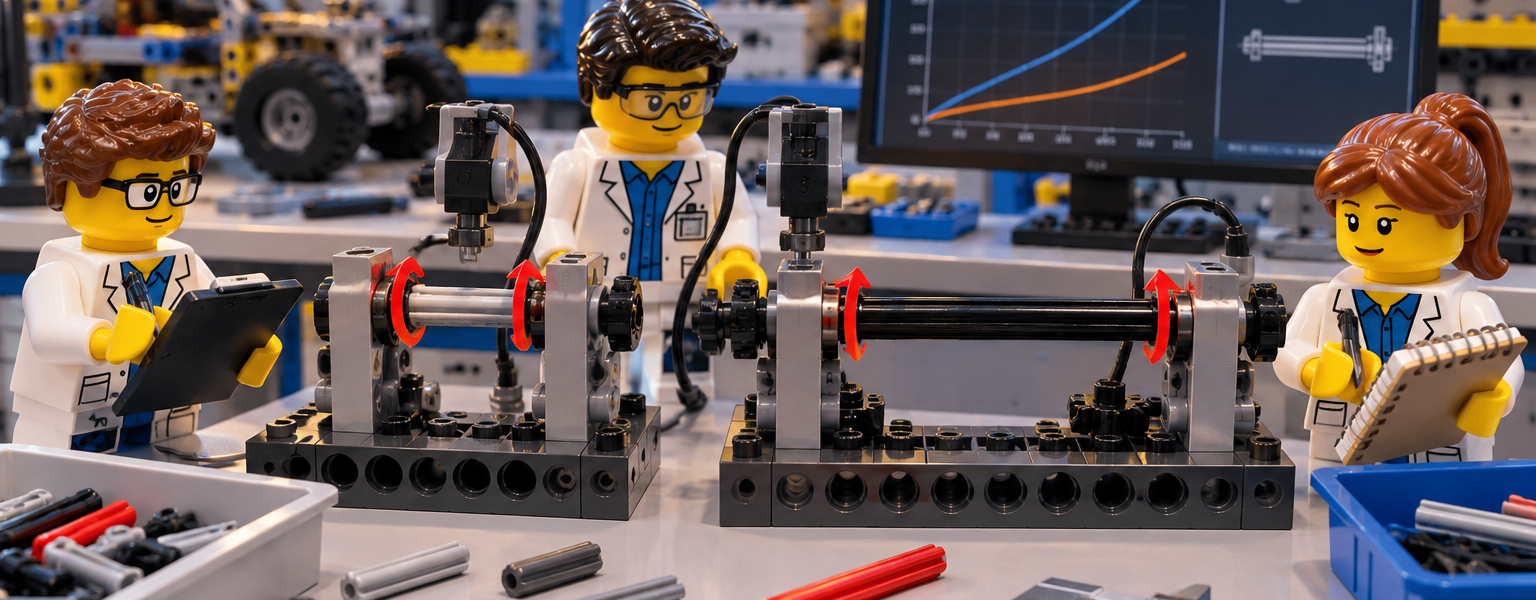
The different behavior has a much simpler explanation: a longer shaft twists more even when it is made from the same material and has the same cross-section.
What LEGO says about axle material
In its public material guidance, LEGO lists POM, or polyoxymethylene, among the plastics used for rigid technical parts such as axles.
POM is well suited to this job because it combines stiffness, wear resistance and relatively low friction. Technic axles rotate inside holes and bushes, carry torque and often spend long periods moving under load.
The company has also said that axles and related parts are beginning a transition from conventional POM to ePOM from 2026. For builders, the important point is that LEGO presents axles as one material-use category rather than publishing separate recipes for 3L, 8L, 12L and other lengths.
LEGO does not publish a material recipe for every axle length
There is no public table saying that a 3L axle uses one POM grade, an 8L axle another and a 12L axle a third.
That means it would be misleading to claim that different lengths are made from different plastics simply because they feel different under load.
This distinction matters. The stiffness you feel in a part is not the same thing as the stiffness of the material itself.
An element made from the same polymer can behave differently when its length or geometry changes.
Why a longer axle twists more
For a shaft under torsion, the angle of twist is commonly written as:
θ = TL / GJ
where:
- θ is the angle of twist,
- T is the applied torque,
- L is the shaft length,
- G is the material’s shear modulus,
- J describes the torsional resistance of the cross-section.
For this question, the key term is L.
If the material, cross-section and applied torque remain the same, the angle of twist increases in proportion to length.
In the linear-elastic range, an axle four times longer can therefore twist by roughly four times the angle under the same torque.
A 3L and a 12L axle can use the same material and still feel completely different
Imagine two axles with the same cross-section: one 3L and one 12L.
If both are made from the same material and experience the same torque, the longer axle will rotate through a much greater angle before the far end responds.
That does not mean the polymer itself is softer. It means there is more length over which elastic deformation can accumulate.
This is why a long Technic axle can feel noticeably more flexible in your hand even if it belongs to the same material family as the short one.
Why this matters in Technic drivetrains
In a small mechanism, the effect may be barely noticeable. In a large Technic vehicle, it becomes more interesting.
If a motor drives a mechanism through a long axle path, part of the initial rotation can be temporarily stored as torsional deformation in the axle. The mechanism at the other end then reacts slightly later.
When the load drops, the axle tries to return to its original shape and releases that stored energy.
Mechanically, it behaves a little like a torsion spring.
Drivetrain wind-up
In practice, the sequence can look like this:
- the motor starts turning,
- the long axle twists slightly,
- the driven mechanism starts moving only after some torsional wind-up has accumulated,
- when the system stops or the load decreases, the axle partially unwinds.
The longer the drivetrain and the higher the torque, the easier this behavior can be to notice.
It is not necessarily a material defect. It is a normal result of elastic deformation in a shaft.
Several axles and connectors can add up
Large Technic drivetrains often use more than one long axle. Torque may pass through multiple axles, connectors, gears and joints.
Each component can introduce a small amount of elastic deformation or mechanical play.
At the far end of a long drivetrain, those small effects accumulate: axle twist, gear backlash and connector compliance all contribute to a less immediate response.
That is one reason a large Technic mechanism can feel more elastic than a compact system built around one short axle.
Does a longer axle mean a weaker axle
Not in a simple sense.
A longer axle may twist more, but that does not automatically mean it uses worse material or has lower quality.
Within the elastic range, the deformation is reversible. The axle twists under load and returns toward its original shape after the load is removed.
Problems begin only when loads become excessive or the part is used beyond the conditions it was designed to handle.
Axle color is not proof of a different polymer
Technic axles come in different colors, and LEGO has long used color coding to make parts easier to identify during building.
But a black, gray or red axle should not automatically be assumed to use a different base structural polymer solely because of its color.
Pigments and color formulations are part of the material system, of course, but color alone is not evidence of a different engineering-plastic family.
Why use POM for axles in the first place
Technic axles have a demanding job. They need to be stiff without becoming brittle. They have to rotate inside holes and bushes, resist wear and survive repeated assembly and disassembly.
POM is a good match because it combines useful mechanical properties with low friction and good dimensional stability.
It also illustrates why LEGO does not make every element from one plastic. A System brick, a tire, a transparent windshield and a Technic axle all perform very different jobs and therefore need different material properties.
What we do not publicly know
Public LEGO documentation does not tell us whether every axle length always uses exactly the same POM grade, additive package or process settings.
The company does not publish that level of manufacturing detail.
The most accurate answer is therefore: LEGO publicly identifies POM as a material used for axles, but it does not provide a complete material specification for each axle length individually.
So the fact that a long axle twists more should not be treated as evidence that it is made from a different plastic.
The key takeaway
Different lengths of LEGO Technic axle can behave very differently even when they are made from the same type of material.
The reason is basic mechanics: under the same torque, a longer shaft accumulates a greater angle of twist.
That is why a short axle feels almost rigid while a long one can behave like a small torsion spring.
It is a neat reminder that even a simple Technic element follows the same fundamental mechanics as a real drive shaft.