
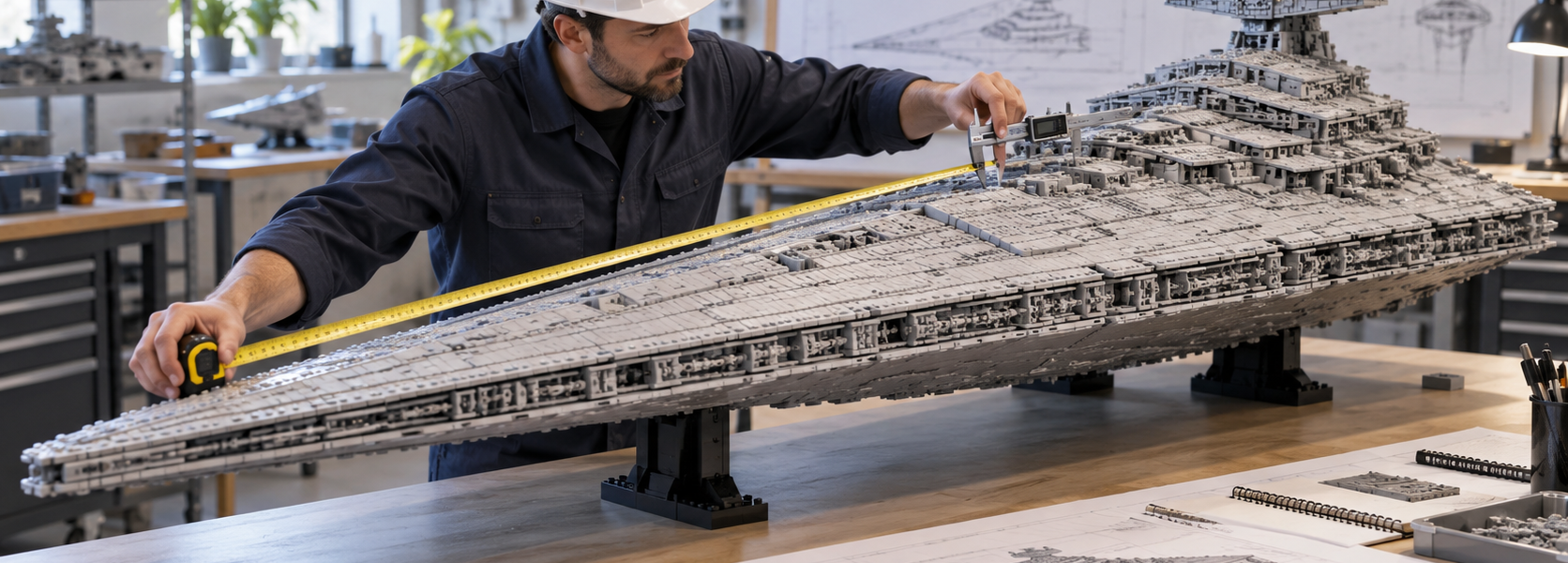
LEGO’s Executor Is 136 cm Long. What Happens When a Set Outgrows the Shelf

With large LEGO sets, piece count and price usually get the most attention. For LEGO Star Wars 75457 Executor Super Star Destroyer, another number may matter even more: 136 centimetres of length.
The model officially measures about 136 × 50 × 20 cm. Before thinking about the build itself, it is worth checking whether there is actually a surface at home large enough to hold it safely.
At this scale, the question is no longer simply “Do I have a shelf?” It is closer to: Do I have 1.36 metres of sufficiently deep surface area with enough access around it?
136 cm feels different when you measure it in a room
At 1.36 metres, Executor is longer than many sideboards, display cabinets and single shelving modules. The number looks abstract on a product page. It becomes much more real once you stretch a tape measure across a wall.
In practical terms, the model is better suited to a long sideboard, deep worktop, large media unit or dedicated display platform than a conventional collector shelf.
That changes the order of operations. With a normal set, buyers often figure out display space after finishing the build. With Executor, it makes more sense to find the display space first and buy second.
The 50 cm width may be the bigger problem
The most awkward Executor dimension may not be its 136 cm length. The more restrictive number could be the 50 cm width.
For context, a standard IKEA BILLY bookcase shelf is about 28 cm deep. Executor needs roughly 50 cm. On a shelf of that depth, the model would nominally project about 22 cm beyond the front edge.
A single BILLY section is also only around 80 cm wide, so the model is too long for one standard module anyway.
This is the real display problem: Executor is not merely very long. It is long and deep at the same time, which eliminates many typical shelving options.
Executor versus Titanic. Almost the same length, completely different footprint
LEGO Titanic 10294 is the clearest comparison. Titanic is about 135 cm long, making it almost identical in length to Executor.
But the two models behave very differently in a room. Titanic is only around 16 cm wide, while Executor is about 50 cm wide.
If we calculate a simple bounding rectangle for each model, the difference becomes obvious:
- Executor: 1.36 × 0.50 m = about 0.68 m²
- Titanic: 1.35 × 0.16 m = about 0.22 m²
This is not the true contact area of the models, only a useful planning rectangle based on their maximum dimensions.
Even so, it shows that Executor needs more than three times the rectangular display area of Titanic despite being almost the same length.
Millennium Falcon creates a different kind of display problem
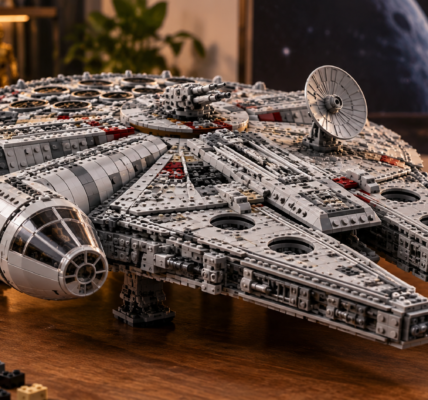
UCS Millennium Falcon 75192 measures about 84 cm long, 60 cm wide and 21 cm high.
The Falcon is much shorter than Executor but even wider. It behaves more like a large square object, while Executor demands a long, deep surface.
These are two different types of awkwardness. Millennium Falcon often needs a deep table or specialized stand. Executor needs a very long piece of furniture that is still at least around 50 cm deep.
Eiffel Tower uses vertical space instead
LEGO Eiffel Tower 10307 has a footprint of about 57 × 57 cm and stands roughly 149 cm tall.
Its main problem is vertical clearance. Ceiling height, shelves above it and stability matter more than total horizontal length.
Executor does the opposite. At only 20 cm high, it does not compete much for vertical space, but it stretches across more than 1.3 metres of horizontal surface.
How much display space do you really need
In theory, 136 × 50 cm is enough for the model to fit exactly. In practice, it is sensible to leave extra margin.
If the nose or stern sits only a few millimetres from the edge of a surface, every accidental bump becomes more consequential. The same is true along the sides. You also need room for hands, dusting and small adjustments after the model is placed.
There is no single universal minimum beyond the official dimensions because support points and final display setup matter. But the practical rule is simple: do not plan the surface to the exact dimensions of the model.
Dusting becomes part of display planning
The larger the model, the harder it becomes to treat it like a normal decorative object that can simply be lifted off a shelf, cleaned underneath and put back.
At 136 cm long, access to the rear of the model depends heavily on where the furniture sits. If Executor is placed close to a wall on a deep sideboard, cleaning the center and back sections may be much harder than with smaller sets.
That is another reason to leave working space around the model or choose a surface that can be approached from more than one side.
Plan movement before you start building
At this scale, moving the finished model is also part of the problem.
We are not suggesting specific lifting points without official instructions. But the 136 cm length alone raises an obvious practical issue: the model may be difficult to carry through narrow doorways, hallways or between furniture.
If the final display location is in a different room from the build area, it is worth checking the route before construction begins.
That sounds excessive only until you try moving an object more than a metre long through a furnished home.
Furniture first, set second
For most LEGO sets, price is the main purchasing constraint. With Executor, space becomes a second one.
At 136 cm long and 50 cm wide, the model requires a surface that is difficult to create accidentally. Standard shelves are often too shallow. Many sideboards are too short. A cabinet has to be genuinely large or built around the model.
The simplest pre-purchase test is also the most useful: take a tape measure and mark out 136 × 50 cm on the furniture you intend to use. Better still, use cardboard or masking tape to see how much real space that rectangle consumes.
With a set this large, the biggest problem may not be the price. It may be finding somewhere to leave it safely for years.
The key takeaway
LEGO Executor 75457 marks the point where a large collector set starts behaving more like a piece of interior furniture than a model that simply goes on a shelf.
The 136 cm length is dramatic, but the real challenge is combining that length with 50 cm of width. That is why the almost equally long Titanic is much easier to display.
Before buying Executor, the most useful question may not be about budget at all. It may be this: Do I genuinely have 1.36 metres of sufficiently deep display surface available for a single LEGO set?