

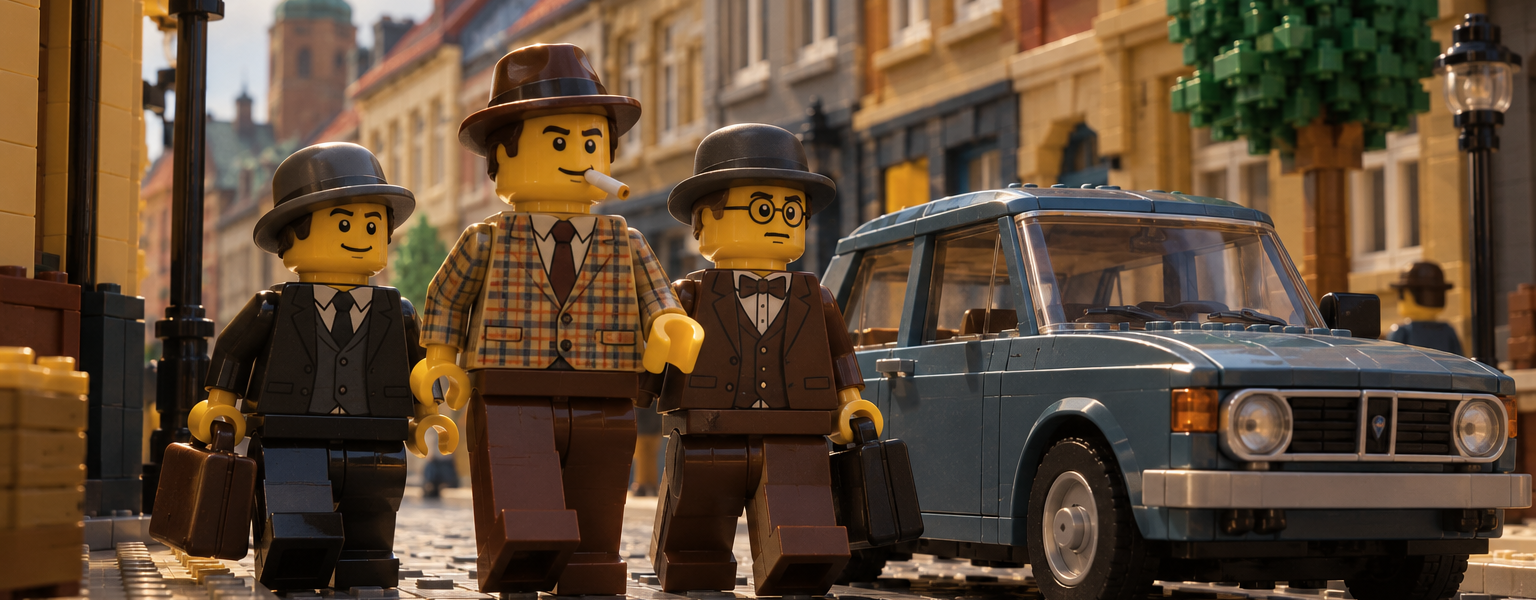

The Olsen Gang films are built around plans that are both absurdly complicated and strangely precise. In Olsen-banden overgiver sig aldrig (1979), the eleventh Danish film in the series, that formula produced one particularly memorable prop: a remote-controlled vehicle built from LEGO.
The gadget appears during the opening heist and is not simply background decoration. It plays an active role in the break-in, turning familiar construction pieces into a miniature piece of criminal engineering.
A 1979 heist with a LEGO-built vehicle
Olsen-banden overgiver sig aldrig was released in Denmark in 1979. Erik Balling directed the film, and Balling co-wrote it with Henning Bahs.
Danish source Cinemaonline describes the opening sequence as a technically elaborate robbery involving a remote-controlled LEGO car. The robbery itself quickly becomes a joke at the gang’s expense: the safe is empty, setting up the film’s wider plot.
What did the vehicle actually do?
The screen prop functions as a small remote-controlled helper during the break-in. Rather than using a conventional tool, the gang relies on something that, from a modern perspective, looks like a simple improvised robot or technical vehicle assembled from LEGO elements.
Fan descriptions and trivia sources add more detail, including claims that the vehicle was passed through a ventilation opening, assembled on the far side, and then used to help open access from inside. Those details are useful context, but they are not documented in the archival sources used here, so they should be treated as production trivia rather than fully verified technical facts.
Henning Bahs and the machinery of The Olsen Gang
The sequence becomes more interesting when viewed alongside the role of Henning Bahs. The Danish Film Institute credits Bahs on this film not only as a co-writer, but also for production design and special effects.
That combination matters. The Olsen Gang’s identity depended heavily on improbable mechanisms, purpose-built props and highly visual solutions to impossible problems. Bahs helped shape that world, where an everyday object could become part of a carefully engineered plan.
A recurring piece of production trivia claims that the hand seen assembling the LEGO contraption belonged to Bahs himself. That detail appears in fan and trivia material, but I could not verify it in the Danish Film Institute’s archival documentation, so it is best treated as an anecdote rather than established production history.
Why LEGO worked so well as a movie prop
LEGO was an unusually effective material for a scene like this. The audience can instantly read the object as something modular, handmade and mechanical. The prop does not need a long explanation: its construction already communicates that the gang has built a custom machine for a specific task.
It also matches the tone of the series. The Olsen Gang regularly turns ordinary objects into essential parts of highly elaborate schemes. A remote-controlled LEGO vehicle fits that visual logic perfectly.
LEGO on screen before the LEGO movie era
Today, LEGO has its own films, series, games and major entertainment partnerships. In 1979, seeing the bricks used on screen in this way carried a very different feeling.
The scene is especially interesting because the product itself is not the subject. The bricks are simply treated as a practical construction system — a way to build a functioning gadget for the story.
That makes the moment a small but fascinating example of LEGO’s place in popular culture before the brand became a major entertainment property in its own right.
A tiny prop with lasting appeal
Within the broader Olsen Gang series, the LEGO vehicle is only one of many ingenious contraptions. For LEGO enthusiasts, though, it stands out because it shows the system being used in an unexpectedly functional role: as a cinematic burglary tool.
More than four decades later, the scene still works because the central joke is easy to understand. The gang has taken a familiar building system and turned it into specialized machinery — exactly the kind of mechanical absurdity the Olsen Gang films did so well.