
What LEGO Actually Patented in 1958. Why Compatible Bricks Exist and Why Quality Varies

Look at a classic 2×4 brick and the idea seems almost too simple to patent: a rectangle, eight studs on top and a hollow underside.
The important invention, however, was not merely the outer shape. It was the way the studs interacted with internal tubes to create a controlled grip between bricks. That geometry gave the system the reliable holding force LEGO calls clutch power.
The patent mattered enormously, but patents are temporary. Once the core technical protection expired, competitors were able to use the underlying principle, provided they did not infringe other rights such as trademarks, protected designs or copyrighted material.
That is the legal and technical foundation of today’s huge market for compatible building bricks.
Before the modern LEGO brick
LEGO’s first plastic bricks did not appear in isolation. In the late 1940s, Ole Kirk Kristiansen and Godtfred Kirk Christiansen encountered plastic building bricks made by the British company Kiddicraft and developed by Hilary Fisher Page.
LEGO began selling its own Automatic Binding Bricks in 1949. These early elements were important, but they still had a fundamental limitation: the largely hollow underside did not create enough friction for highly stable models.
LEGO’s own historical material says the company later contacted Kiddicraft regarding similarities between the systems and, in 1981, acquired rights to the Kiddicraft bricks and trademark from Page’s heirs.
The modern LEGO brick was therefore not a single moment of invention. It emerged through stages, and the key breakthrough was the improvement to how the bricks connected.
The real problem was grip
By the mid-1950s, LEGO was already developing the idea of a coherent building system in which elements should remain compatible over time. But the bricks themselves needed to hold together more securely.
According to LEGO’s official history, feedback about unstable models pushed Godtfred Kirk Christiansen to look for a better solution.
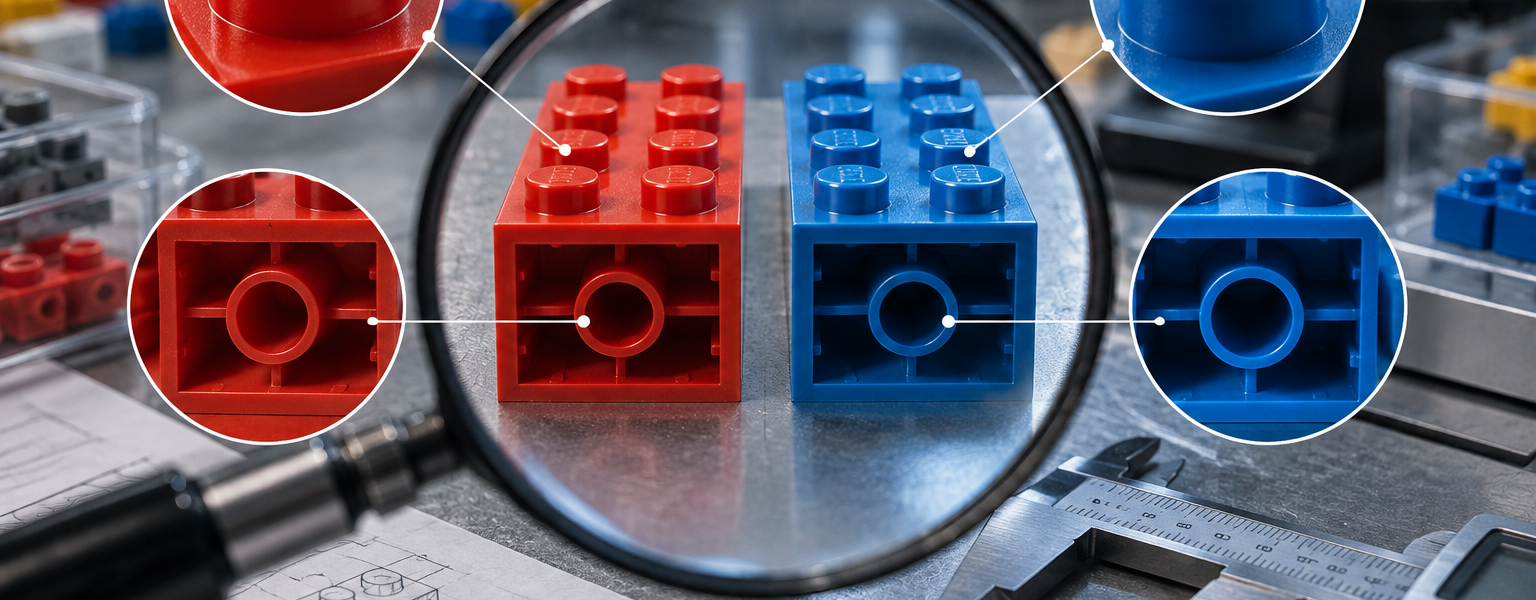
The answer was the internal tube. In a classic 2×4 brick, studs from the lower element press not only against the outer walls of the brick above, but also against the internal tubes.
That creates controlled friction from multiple contact points. The connection is strong enough to keep a model together, but weak enough that the bricks can still be separated by hand.
January 28, 1958
LEGO gives the moment unusual precision: on January 28, 1958 at 1:58 p.m., the company filed a Danish patent application for a “toy building brick.”
The U.S. counterpart, US Patent 3,005,282, was filed on July 28, 1958 while claiming priority from the Danish filing, and was granted on October 24, 1961.
The patent describes a technical goal: improving the way bricks interlock so they can be joined securely in many configurations.
That distinction matters. The patent was not a permanent monopoly on every rectangular toy brick. It protected a specific technical solution for coupling elements together.
Patents expire
Patent law is built around a trade-off. The inventor discloses how a technical solution works, and in return receives exclusive rights for a limited period.
Once the patent expires, competitors can generally use the underlying technical idea as long as they do not violate other active intellectual-property rights.
For the U.S. patent US 3,005,282, Google Patents lists an expected expiration date of October 24, 1978. Patent terms varied by country, so that date should not be treated as one universal global expiration date.
The larger point is clear: the fundamental stud-and-tube concept is not still protected today by that original patent.
A compatible brick is not automatically a counterfeit
This is one of the most important distinctions in the whole subject.
A manufacturer can make its own building bricks that are dimensionally compatible with the LEGO system without automatically producing counterfeit goods. Expired technical patents opened the door to lawful compatibility.
Other rights still matter. The LEGO Group can protect trademarks, certain product designs, graphics, instructions, distinctive elements and other intellectual property through separate legal mechanisms.
Compatibility therefore needs to be separated from copying a brand name, artwork, character or protected design.
LEGO tried other forms of protection too
After core patent protection expired, LEGO also pursued protection for the classic brick shape through trademark law.
One of the most important cases was C-48/09 P Lego Juris v OHIM. In 2010, the Court of Justice of the European Union upheld the conclusion that the classic red brick shape could not be monopolized as an EU trademark where its essential characteristics were necessary to achieve a technical result.
The court emphasized that major features of the shape, including the rows of studs, performed a technical function related to connecting the bricks.
The logic is important. Trademark rights can potentially be renewed indefinitely. Allowing trademark law to recreate permanent control over a technical solution after a patent expires would undermine the time-limited nature of patent protection.
Why so many compatible systems appeared
Once the core technical patents expired, manufacturers were free to create elements that worked with the established geometry.
That compatibility has enormous commercial value. A new brand does not need to persuade customers to abandon every brick they already own. Its parts can slot into an existing ecosystem.
That is why the compatible-brick market now includes very different types of companies: ultra-low-cost manufacturers, premium alternatives, specialist military and vehicle brands, and producers focused on unusual elements that the LEGO Group does not make.
Two bricks can look identical and behave very differently
This is where the technical story becomes more interesting than the legal one.
A brick can appear almost identical to another yet feel completely different during a build because connection force depends on very small dimensional differences.
Among the variables that matter are:
- stud diameter and height,
- the position of internal tubes,
- wall thickness,
- mold precision,
- material shrinkage during cooling,
- plastic formulation and stability,
- consistency from one production batch to another.
The differences may be tiny, but in a friction-based system tiny dimensional changes determine whether a brick feels right.
Clutch power is harder to reproduce than it looks
LEGO uses the term clutch power for the force that holds bricks together.
If that force is too low, walls can flex, larger models lose rigidity and connections feel unreliable.
If it is too high, separating bricks becomes tiring and unnecessary stress can build up inside large constructions.
A good brick therefore has to stay inside a narrow window between too loose and too tight.
And achieving that once is not enough. A manufacturer has to repeat it across millions or billions of parts, multiple factories, many colors and years of production.
Why some compatible bricks are worse
The simplest answer is that matching the nominal geometry is easier than maintaining the same manufacturing discipline.
A low-cost producer may use less precise molds, tolerate wider variation in material behavior or operate with weaker process control. One batch may connect well, another may feel loose and a third may grip too tightly.
Quality differences can also appear in color consistency, transparency, printing, surface finish, scratches and deformation.
But it would be wrong to say that every compatible brand is inferior. Some manufacturers now achieve very high quality and strong consistency.
The word “compatible” tells you only that the part can work with the system. It says nothing about how tightly the manufacturing process is controlled.
LEGO’s real advantage is system-wide consistency
One of the core principles of LEGO System in Play is long-term compatibility: bricks made years ago should continue to work with bricks produced today and in the future.
That is much harder than making one good production run.
Maintaining the same basic geometry over decades requires control across molds, machines, factories, materials and process changes.
That is why LEGO’s quality advantage cannot be reduced to a single “secret plastic.” The deeper advantage is repeatability.
A brick does not only need to work today. It should also connect predictably with one produced decades earlier.
The patent expired, but the system remained
The history of the LEGO brick patent is a good example of how technical innovation is supposed to work.
The company received temporary protection for a solution that substantially improved brick connections. Once that protection expired, competitors could adopt the core technical principle.
That opened the door to compatible systems, but it did not make all bricks equivalent.
A patent can be read. Geometry can be measured. What is much harder to reproduce is decades of experience in mold design, process control and maintaining compatibility across enormous production volumes.
So the interesting question today is not whether another company can make a brick that fits LEGO. Of course it can.
The harder question is whether it can make that brick with the same consistency, millions of times in a row, year after year.