

LEGO Ideas Paris Has 4,500+ Pieces. Are Fan Projects Getting Too Big?

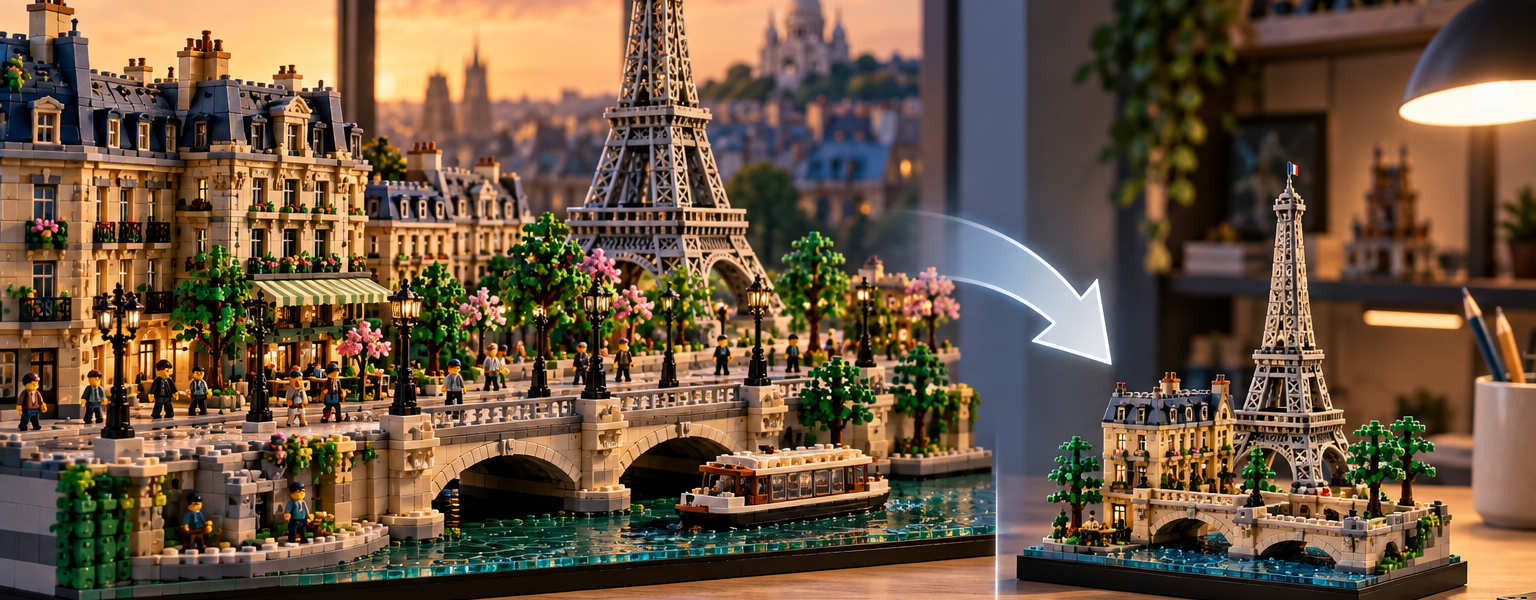
A large Paris-inspired LEGO Ideas project has reached 10,000 supporters and entered the third 2026 review. Created by Señor Casa, the model uses more than 4,500 pieces and spans several connected architectural sections with a distinctive angled corner facade.
That is an impressive achievement on its own, but the size of the submission raises a more interesting question about modern LEGO Ideas: do increasingly large projects have a real advantage, or are they simply better at attracting attention before the review process begins?
4,500 pieces make an impression before you even study the design
Large projects have an obvious visual advantage on a community platform. They photograph well, contain layers of detail and often feel like complete worlds rather than single objects.
The Paris project does exactly that. It is not just one facade or landmark. It presents a broader urban scene designed to evoke the atmosphere of a Parisian neighborhood.
That kind of scale can stop a user mid-scroll. Spectacle becomes part of the pitch.
That does not mean supporters are voting only for size. Architecture, presentation, theme and execution still matter. But on a platform where projects compete for attention, visual ambition can help.
10,000 supporters does not mean LEGO approved the scale
This is the most important distinction in the Ideas process.
Reaching 10,000 supporters earns a project a place in review. It does not mean LEGO has accepted the piece count, dimensions, price point or technical design as submitted.
If the concept is approved, LEGO’s design team can rebuild it extensively. A fan model is a starting point, not a production specification.
So the 4,500-plus pieces in this Paris submission should not be read as a forecast for a potential retail set. They describe the current fan design only.
E.T. shows how aggressively LEGO can scale a project down
LEGO Ideas 21370 E.T. the Extra-Terrestrial is a useful example.
The original fan project used 2,990 pieces and stood more than 30 cm tall. The final official set was reduced to 1,226 pieces and about 24 cm in height.
That is a reduction of roughly 59 percent.
The change was not simply about price. LEGO designers explained that the larger version created stability problems because E.T.’s long arms were too heavy for the available joints. Reducing the overall scale improved articulation and structural reliability.
It is a strong example of LEGO accepting the idea of a project without accepting its original scale.
Downton Abbey shows the opposite can happen too
LEGO Ideas 21373 Downton Abbey demonstrates the reverse scenario.
The fan submission used around 2,750 pieces. The final retail model contains 4,711 pieces.
Instead of compressing the design, LEGO expanded it by nearly 2,000 pieces while reworking proportions, interiors and construction to meet product standards.
That undermines the simple assumption that LEGO Ideas always cuts large fan projects down to fit a more affordable price point.
In LEGO Ideas, voters are not really voting for a piece count
E.T. and Downton Abbey make the underlying logic clearer.
Supporters see a specific model, but what LEGO may ultimately be evaluating is the product idea: E.T. as an articulated character, Downton Abbey as a cross-sectioned estate, or Paris as a dense urban architectural scene.
If the concept is strong enough, the final set can be smaller, larger or technically rebuilt from the ground up.
That means the fan project’s piece count is not a commercial promise.
Does a giant project have worse odds in review?
There is no reliable evidence that size alone determines a project’s chances.
Large models can create obvious challenges: higher price, bigger packaging, longer build time, more complex instructions and a narrower customer base. But modern LEGO Ideas is also clearly willing to support premium adult display sets, as Downton Abbey demonstrates.
More useful review questions may include:
- Can the concept survive a major change in scale?
- Is there a clear central idea behind the model?
- Is there a viable audience for the final product?
- Does the concept overlap with LEGO’s existing portfolio?
- Can the design be rebuilt without losing what made it distinctive?
Paris could therefore remain viable even if a potential final set ended up much smaller.
The real risk for large projects is sometimes product clarity
The bigger a display gets, the easier it is to create an impressive model and the harder it can become to answer a basic retail question: what exactly is the product?
Is the core idea a specific building? A street corner? A collection of facades? The atmosphere of a city?
That may matter more than the raw piece count. The strongest Ideas concepts are often easy to describe in one sentence. If a project needs a long explanation to justify every section, translating it into a retail product becomes more difficult.
For the Paris submission, that could be one of the most interesting review questions: does LEGO see one clear product inside the model, or an impressive cityscape that would need heavy condensation?
Large architectural builds have one important advantage
Architecture translates naturally into the adult display market. Buildings reward detail, work well at larger scales and do not require complex play functions to justify their presence.
That makes a large Paris model easier to imagine as a premium display set than some other 4,500-piece concepts.
It does not guarantee approval, but it also means that 4,500 pieces no longer sounds automatically unrealistic. Official LEGO Ideas products have already reached and exceeded that scale.
Does the 10K threshold reward spectacular renders?
This is a broader question about the platform itself.
LEGO Ideas is a competition for attention. Projects need clicks, followers and votes. A large, professionally rendered model can have a natural advantage over a smaller concept whose value becomes obvious only after closer inspection.
That does not mean the community is voting “wrong.” It simply means the system rewards projects that communicate visual appeal quickly.
The review stage serves a different purpose. LEGO then has to convert community enthusiasm into something that can actually be manufactured and sold.
Should creators design like product managers from day one?
There is no single correct answer.
A highly product-ready submission may make cost and format easier to evaluate. But if creators constrain themselves too early, they may remove the ambition that would have helped the project reach 10,000 supporters in the first place.
The history of LEGO Ideas shows that approved concepts are rebuilt anyway. A creator does not need to deliver a finished retail product. They need to deliver a concept strong enough to survive professional redesign.
That may be more important than landing on the “right” piece count.
Paris is a useful test of modern LEGO Ideas
The 4,500-plus-piece project will be interesting regardless of the review result.
If LEGO rejects it, that will not prove that it was simply “too big.” Review decisions depend on many factors, and LEGO does not publish a full rationale for every rejected submission.
If it is approved, the eventual comparison between fan model and retail set could be even more revealing. E.T. shows that LEGO can cut a project by more than half. Downton Abbey shows that it can significantly expand one.
That is why the most important number in a LEGO Ideas submission is not the piece count. It is whether the idea underneath those thousands of pieces is strong enough to remain recognizable after LEGO rebuilds it.