
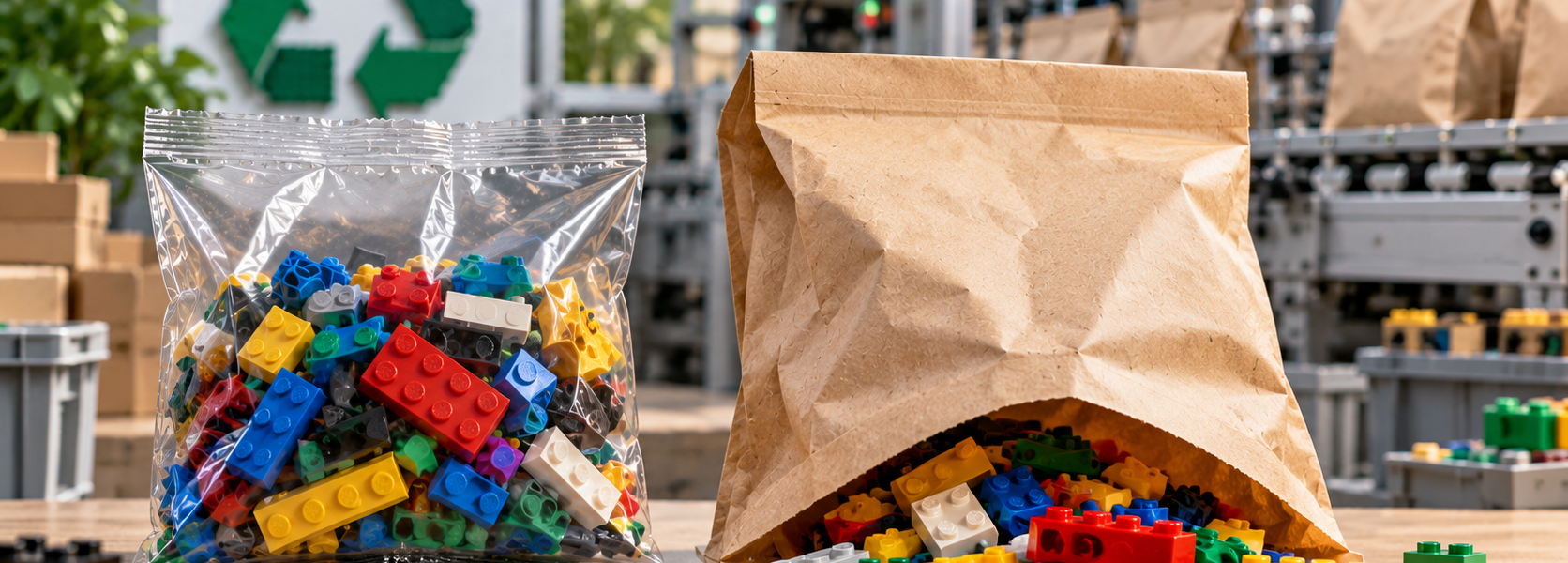
Why LEGO’s Switch to Paper Bags Is Taking So Long. 180 Tests and a Global Packaging-Line Overhaul

Replacing a plastic inner bag with a paper one sounds like one of the simplest changes in LEGO production. In reality, the LEGO Group tested around 180 different paper types and formats before settling on a solution that could work across a global manufacturing network.
The challenge was not just finding paper strong enough to hold bricks. The material had to survive high-speed packing, shipping, storage, different humidity levels and different climates, while also running reliably on automated packaging equipment in factories around the world.
Why 180 paper variants had to be tested
LEGO says it evaluated around 180 paper types and formats before selecting the current design. The requirements went far beyond basic strength.
A bag has to move through packaging machinery without tearing, remain sealed during transport and protect the contents until the customer opens the set. It also has to behave consistently in hot, humid environments as well as in cooler, drier conditions.
Humidity is a particularly important variable. Paper reacts to moisture much more than plastic, which means a material that performs well in one factory may not behave the same way in another climate.
Paper-based, but not 100% paper
The new pre-packs are made from at least 95% paper. The remaining portion includes a thin plastic layer on the inside.
That layer is there for a practical reason. It helps create a reliable seal and allows the bag to withstand contact with hard LEGO elements during packing, transport and storage.
The company says the bags have been verified as technically recyclable in the European Union, the United States and Canada. But actual recycling still depends on local collection and processing systems, which is why LEGO also advises consumers to check local guidance.
So “paper bag” does not mean an all-paper product, nor does technical recyclability guarantee that every bag will actually be recycled in every market.
The real challenge is the factory, not the bag
Finding the right material was only one part of the project. The bigger operational task was converting packaging lines across LEGO’s manufacturing network.
Paper and plastic behave differently during feeding, folding and sealing. Moving from one to the other requires equipment modifications, new machine settings, process testing and factory-by-factory validation.
LEGO has also acknowledged that packaging-equipment upgrades have to be balanced with ongoing capacity expansion. A large manufacturing network cannot simply stop while packaging lines are rebuilt, especially when demand remains high.
56% of packing lines had switched by the end of 2025
By the end of 2025, 56% of LEGO’s global packing lines had been converted to paper-based pre-packs.
A year earlier, the figure was around one third. That shows the rollout accelerated, but it also means a substantial portion of the network still required conversion.
LEGO says implementation is largely complete at factories in China, Vietnam, Hungary and the Czech Republic. The company expects the full global transition to be completed in 2027.
Why the full rollout runs to 2027
The timeline is not simply about waiting for the right paper. It reflects equipment-conversion schedules, production capacity and the need to keep factories running while upgrades take place.
LEGO is expanding output at the same time it is changing packaging technology. Every packaging-line conversion therefore has to be phased so that it does not create a new bottleneck inside a larger production system.
This is why a change that looks minor from the customer side can take years to complete globally.
Why 95% paper-based packaging and 56% converted lines are not contradictory
Two LEGO figures can easily be confused. In 2025, more than 95% of packaging by weight was made from paper, cardboard and other paper-based materials.
That does not mean 95% of the inner bags had already been replaced. Boxes already account for a large share of total packaging weight, so the paper share by mass is much higher than the share of packing lines converted to paper pre-packs.
The 95% and 56% figures measure different things: one is material composition by weight, while the other is progress in converting packaging equipment.
The switch also changes the unboxing experience
LEGO did not test only durability and machine performance. The company also evaluated around 15 packaging prototypes with hundreds of children and parents.
One difference is obvious: clear plastic reveals the contents immediately, while paper hides them. LEGO says some children in testing treated that as an extra moment of surprise during unboxing.
Larger paper bags were also designed so they could stand upright and temporarily hold loose elements during a build.
Paper does not automatically mean lower environmental impact
LEGO presents the paper-based bags as part of its effort to reduce single-use plastic and increase the use of packaging based on renewable materials.
That should not be simplified into “paper good, plastic bad.” The environmental footprint of packaging depends on material production, weight, durability, transport and whether the package is actually collected and recycled after use.
The defensible conclusion is narrower: LEGO is reducing the amount of single-use plastic in its packaging and replacing it with a solution that is primarily paper-based. That does not mean every bag has the same environmental outcome in every country.
This is a process redesign, not a simple material swap
The most interesting lesson is industrial rather than cosmetic.
LEGO did not only need to identify a paper that could form a bag. It had to find a material that could survive production and distribution, behave across different climates, work with automated machinery and be rolled out without disrupting global supply.
That is why the transition has taken years. The paper bag is a small component inside a LEGO set, but converting to it reveals how complex even a seemingly simple packaging change can become at global manufacturing scale.