
Skærbæk Fan Weekend. How a Small Danish Town Became a Global LEGO Fan Gathering

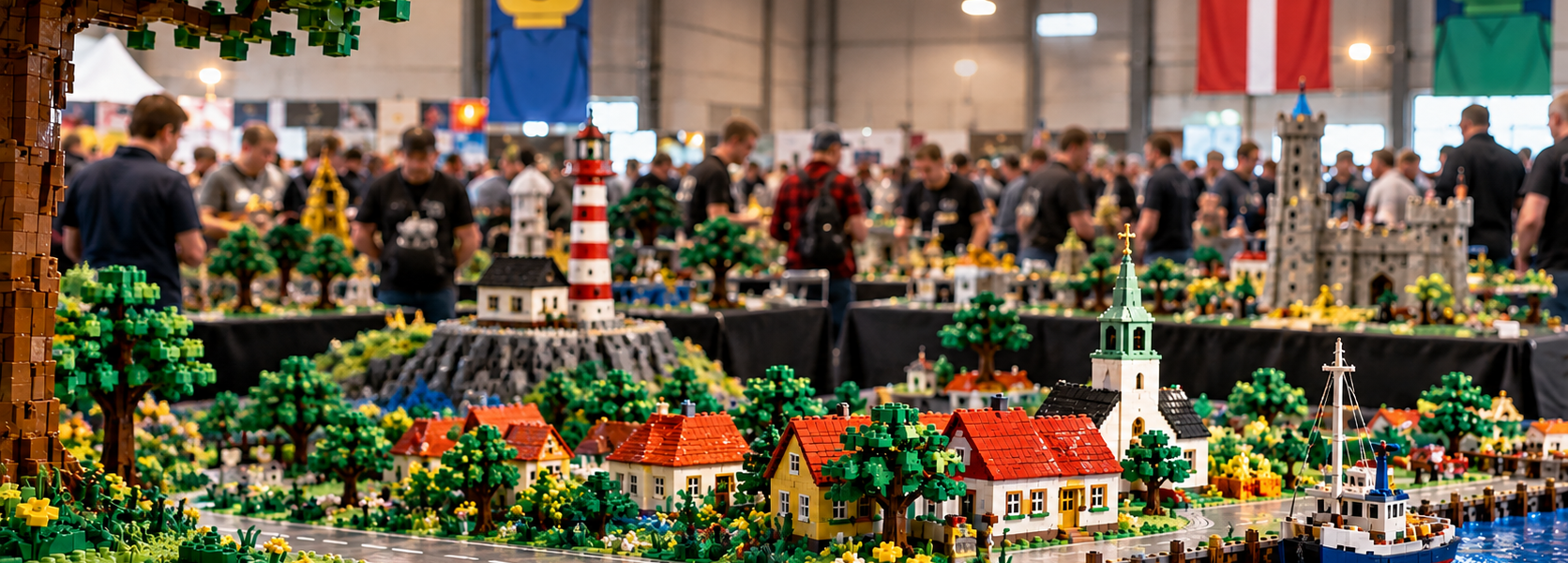
On Sunday morning, September 27, 2026, the final hours of a large international adult LEGO fan gathering are unfolding in the small town of Skærbæk in southern Jutland. More than a thousand AFOLs are looking at MOCs, talking about building techniques, trading parts, joining workshops and meeting people they may know mostly from online communities during the rest of the year.
The public portion of Skærbæk Fan Weekend 2026 runs today from 10:00 a.m. to 4:00 p.m. But the event is much more than a public model exhibition. At its core, it is a multi-day gathering of a community that has built its own culture around the LEGO hobby.
A small town with an outsized role
Skærbæk has just over 3,000 residents, so it is not the obvious place to expect a large international fan event. The organizers point to two practical reasons why the location works so well.
First, Skærbæk is roughly 80 kilometers south of Billund, which remains a natural reference point for LEGO fans. Second, Skærbækcentret offers two large exhibition halls and 100 holiday houses on site.
That means many participants do not simply visit an exhibition and leave. They effectively live together for the weekend, and that shared time is a major part of what makes the event distinctive.
The story began in 2005
The roots of the event go back to 2005, when the LEGO Company organized a small gathering for adult fans under the name LEGO Fan Weekend.
The event grew over time and attracted an increasingly large group of participants. After roughly a decade, LEGO decided not to continue organizing it.
That could have ended the story. Instead, it created the moment that defines Skærbæk Fan Weekend today.
In 2015, fans took over
Three AFOLs decided to continue the event themselves, and in 2015 Skærbæk Fan Weekend was born.
That transition is central to its identity. SFW is not a corporate event run by the LEGO Group. It is organized by fans for fans, and the fact that it continued after LEGO stepped away says a great deal about how mature and self-sustaining the AFOL community had become.
Skærbæk Fan Weekend is not a LEGO Group event
This distinction matters. The official SFW terms explicitly state that LEGO is a trademark of the LEGO Group and that the company does not sponsor, authorize or endorse the website or event.
At the same time, SFW remains deeply connected to the wider LEGO ecosystem. Registered participants can take part in a LEGO House AFOL Day in Billund, and additional activities may include visits or experiences linked to places such as LEGO Campus, LEGOLAND and other Billund locations.
The most accurate description is therefore an independent fan-run event that exists very close to the cultural and geographic center of the LEGO world.
More than 1,000 AFOLs in one place
Official organizer materials describe more than 1,000 adult LEGO fans attending Skærbæk. The registration cap for 2026 is 1,150 AFOL participants.
Many do not arrive only as individual builders. They also come as members of LUGs — LEGO User Groups that organize local and regional fan communities.
That is one reason Skærbæk feels more like a community gathering than a conventional trade show.
MOCs matter, but they are not the whole event
Public visitors naturally come to see the models. Participants bring MOCs — My Own Creations — covering a wide range of scales, themes and building styles.
For registered AFOLs, however, the program is much broader. It includes workshops, presentations, a communal dinner, an auction, informal meetups and additional activities before and after the main public weekend.
In other words, some of the most important parts of Skærbæk happen away from the display tables.
The LUG Lounge reveals what the weekend is really about
The LUG Lounge is a good example. Organizers describe it as a place for members of fan groups to meet friends, trade parts, play games, relax and talk with people from other LUGs.
Participants even bring snacks from their home countries to share with others.
It is a small detail, but it captures the social function of the weekend. Skærbæk is not simply a place to look at models. It is a place where local communities connect with one another and become part of a wider international network.
Billund is close, but not always easy to reach
Geographically, Skærbæk is only about 80 kilometers from Billund. Public transport, however, is not especially convenient. The organizers note that a trip from Billund to Skærbæk can involve a change in Esbjerg and take around three hours.
As a result, attendees often organize shared rides and help each other with transport.
That practical reality reinforces the self-contained character of the event. Once people arrive, much of the weekend happens in one place and on one shared rhythm.
LEGO House AFOL Day and Monday activities
For many attendees, the weekend starts before Saturday. In 2026, LEGO House AFOL Day took place on Thursday, September 24.
After the main event ends, additional Monday activities are organized in Billund. The details vary by year and spaces are limited, but they can include visits and other experiences for registered participants.
This turns SFW into a multi-day fan trip rather than a two-day exhibition.
Why Skærbæk survived after LEGO stepped away
The most interesting part of the story is not the number of MOCs or the size of the halls. It is what happened in 2015.
When LEGO stopped organizing LEGO Fan Weekend, the community did not let the event disappear. Fans took responsibility for the logistics, programming and continued development of the gathering.
That makes Skærbæk a strong example of how mature AFOL culture has become. LEGO fans are not just customers. They build their own groups, media, events, knowledge networks and international relationships.
What Skærbæk says about LEGO fandom
It is easy to reduce the LEGO hobby to sets, launches and prices. Skærbæk Fan Weekend shows another side of it.
Here, the most important thing is not a particular product. It is the people who build their own models, learn from one another, organize events and return to the same place year after year.
That is probably why a small Danish town has become such a recognizable point on the map for adult LEGO fans. Not because it is home to a factory or a corporate headquarters, but because the community chose to make it its own.