
A LEGOLAND Miniland Model Sold for DKK 60,000. Park Builds Are Entering the Collector Market

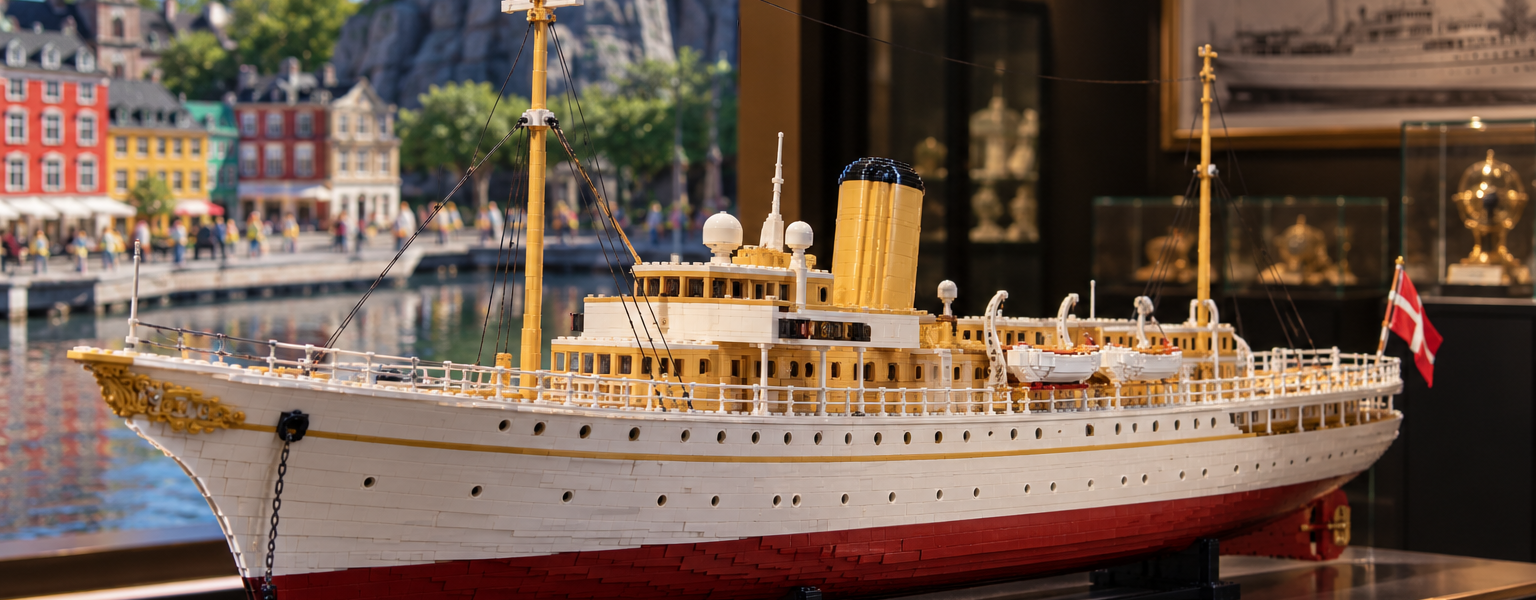
An original Dannebrog royal yacht model from Miniland at LEGOLAND Billund sold on 16 September 2026 for DKK 60,000, roughly twice the upper end of its pre-sale estimate.
The result is interesting, but the more important question is what exactly the buyer acquired. This was not a retail LEGO set and not a fan-built MOC. The model was created in 1998 specifically for Miniland, used around 25,000 elements, measured nearly two meters long and spent close to three decades as part of the park’s public display.
That history makes its value fundamentally different from the simple replacement cost of the bricks.
A Miniland model is a different kind of object
A typical collectible LEGO set has a set number, packaging, instructions and a known production run. Buyers can compare prices, assess completeness and follow a relatively transparent secondary market.
A Miniland model operates differently. It is created for a specific attraction, often in a unique configuration, and its identity is tied to a place as much as to the bricks used to build it.
Dannebrog was not merely a large ship model. It was part of LEGOLAND Billund’s visual landscape, seen by visitors for decades.
Provenance matters more than the parts list
In art, antiques and serious collecting, provenance — the documented history of an object — can be as important as the object itself.
That concept applies unusually well here. The model’s origin, display location, age and role are all known. Its history is not speculative.
A privately built copy could use the same pieces and even match the shape closely, but it would not be the model that actually stood in Miniland.
That distinction is what transforms the object from “a large LEGO build” into a piece of attraction history.
Wear does not always reduce value
Condition is critical in conventional LEGO collecting. Discoloration, scratches and wear usually reduce the value of a used set.
Display objects can work differently. Signs of age may become part of the object’s documented story rather than simple defects.
A model that spent decades outdoors or in a public attraction is not expected to look like a sealed set removed from storage. The wear can reflect authentic use.
This is similar to film props, museum display pieces or historic signage: evidence of use can support provenance instead of automatically destroying value.
The first auction carries extra weight
According to LEGOLAND Billund, this was the first time the park had auctioned an original Miniland model.
That matters because there is no mature, transparent market for these objects. Buyers cannot consult years of comparable sales to establish a normal price range.
The DKK 60,000 result is therefore more than a transaction price. It is an early reference point for a category that has barely existed in the open collector market.
Why the model was retired
The original Dannebrog was removed because Miniland received a new, much larger version as part of an updated Copenhagen display.
The replacement uses around 225,000 elements, measures 4.10 meters long and required roughly 800 hours of work.
That comparison is useful because it shows that the older model was not necessarily retired because it was no longer valuable. The attraction simply moved to a newer, more ambitious display.
The retired model lost its role in the park but gained a new one as a collectible artifact.
This is not a price-per-piece story
Trying to value the model by multiplying 25,000 used bricks by their market price would miss the point.
The object carries several layers of value:
- uniqueness — it was not a mass-produced retail set,
- provenance — it came directly from LEGOLAND Miniland,
- display history — it spent decades in a public attraction,
- scale — it is far larger than a typical consumer set,
- place association — it was part of a specific, recognizable park environment,
- irreplaceability — there is no retail channel for buying another identical official display model.
Park builds may form their own collectible category
The LEGO collector market is usually associated with retired sets, rare minifigures, prototypes, test parts and items tied to company history.
Original Miniland builds fit that world, but with a very different profile. They are larger, often unique and directly connected to attraction history.
That could make them appealing not only to LEGO collectors but also to people who collect theme-park memorabilia, design history or objects connected to Danish cultural institutions.
Will more Miniland models reach auction
There is currently no basis for assuming that LEGOLAND plans to auction retired Miniland models regularly.
This sale could remain an exception, or it could eventually become a precedent. Without an official announcement, it would be speculative to predict a broader program.
The important point is that LEGOLAND chose to treat the retired model as something worth preserving and selling, rather than simply dismantling it.
The sale also gave the model a social second life
All proceeds from the auction were donated to the Mary Foundation.
That adds another layer to the story. The retired model gained a second life as a private collectible while also generating funding for a social cause.
Its full journey is unusually complete: built for an attraction, displayed for decades, replaced by a newer version, sold to a collector and turned into a charitable contribution.
The real value is context, not brick count
The DKK 60,000 sale highlights an interesting boundary between toy, display model and historic object.
A Miniland build may use the same bricks found in retail sets, but its value comes from somewhere else: documented history, location, use and provenance.
If more retired attraction models eventually reach the market, those factors are likely to matter more than any simple parts valuation.
Because a collector buying a Miniland original is not just buying thousands of bricks. They are buying a piece of a specific place’s history.