
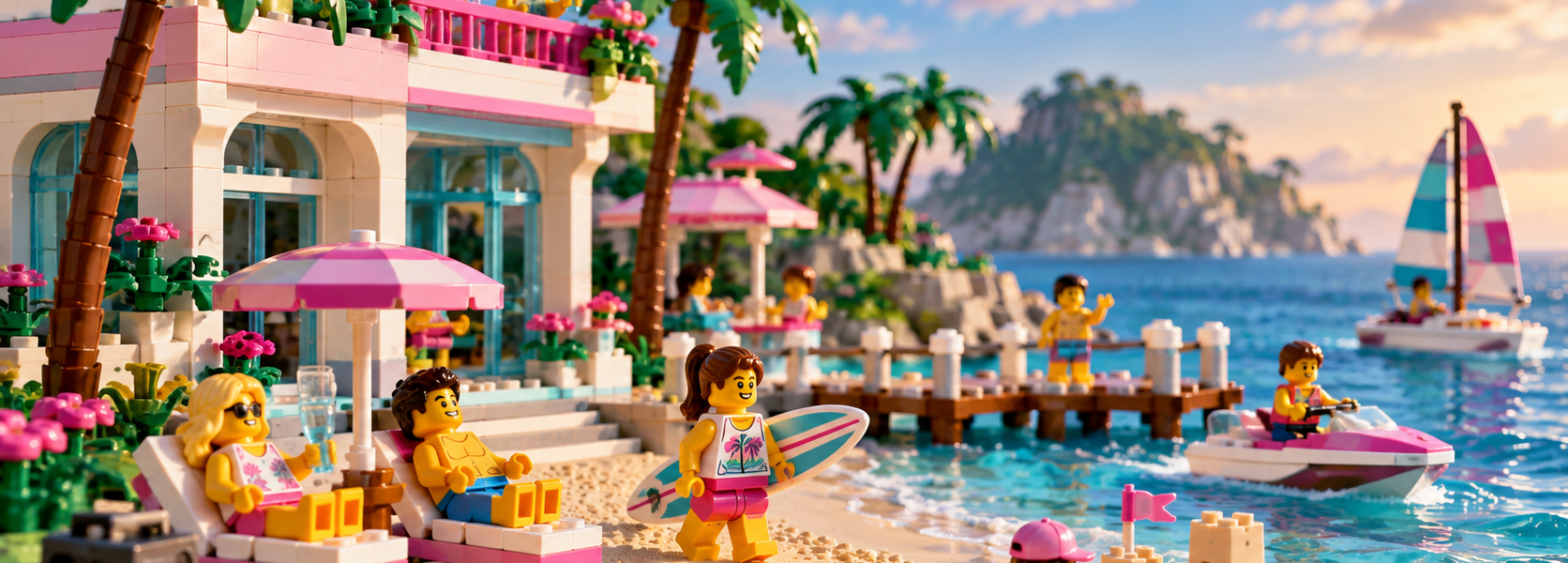
LEGO Paradisa Returns as a Fan-Favorite Aesthetic — 30 Years Later

Paradisa remains one of the most distinctive LEGO Town subthemes of the early 1990s. Its pastel colours, leisure-focused settings and coastal atmosphere made it stand apart from the more utilitarian side of Town, and that identity is still immediately recognisable today.
LEGO Ideas has now highlighted that enduring appeal by selecting five winners in a Paradisa-inspired challenge: Dancercise in Paradise-A!, The Sand Dollar Café – A Paradisa Tribute, Paradisa Beach, Paradisa Tennis Clubhouse and Paradisa Leisure Point.
What makes the selection interesting is that the projects do not try to reinvent Paradisa completely. Instead, they preserve the core ingredients that defined the original line: beaches, sport, cafés, social spaces and a bright, relaxed visual identity.
Why Paradisa still looks like Paradisa
Paradisa launched in 1992 as part of LEGO Town. Sets such as 6411 Sand Dollar Café and 6416 Poolside Paradise established a strong design vocabulary built around light colours, palm trees, water, recreation and open social spaces.
That consistency is probably why the theme has aged so well as a piece of LEGO history. Paradisa is not remembered only because of one colour or one set. It is remembered because the whole range shared a clear sense of place.
Five winners, one visual language
The five winning Ideas projects approach the theme from different directions while still feeling connected. The Sand Dollar Café project directly references one of the original sets, while Tennis Clubhouse leans into sport and the Beach and Leisure Point concepts expand the holiday atmosphere into larger scenes.
Dancercise in Paradise-A! is especially useful as a reminder that nostalgia does not have to mean rebuilding an old set exactly. A historical theme can still support new scenes as long as its design language remains recognisable.
Paradisa has already returned as a nostalgic reference
LEGO has also acknowledged Paradisa in more recent products. LEGO Ideas 21358 Minifigure Vending Machine includes characters inspired by classic themes and subthemes, including Paradisa references.
That does not amount to a full revival, but it shows that Paradisa still exists as part of LEGO’s own historical vocabulary, not just in collector memory.
Does this mean Paradisa is coming back?
No official return of Paradisa as a regular product line has been announced. LEGO Ideas challenges often use historical themes as creative prompts, and winning a challenge does not automatically mean a submission will become a retail set.
The more useful takeaway is that Paradisa still works as a design language. More than 30 years after its debut, fans can reinterpret it without losing what made the original theme distinctive. That makes the current Ideas challenge less about reviving one old set and more about showing how durable a strong LEGO visual identity can be.