

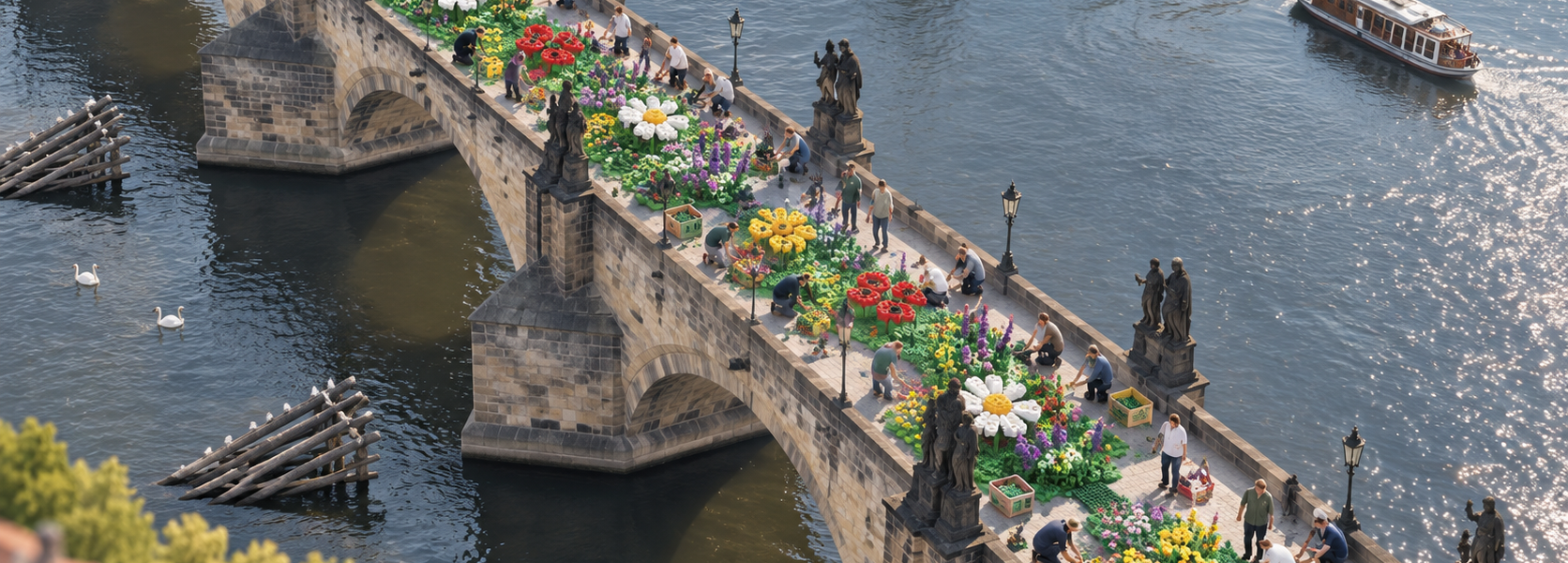
A Brick-Built Meadow Grows Flower by Flower in Prague’s Botanical Garden

Prague Botanical Garden is hosting a quietly unusual activity from September 17 to 20, 2026: visitors are helping build a Czech meadow from LEGO bricks.
Each participant can choose one of five native plant species, recreate it with bricks and add it to a growing communal installation. As more visitors take part, individual models gradually become a larger meadow.
It is a light weekend activity, but it also demonstrates a useful idea in informal education: people often learn more actively when they have to build what they are looking at rather than simply read about it.
Building encourages closer observation
A sign can tell you the name of a plant and a few facts about it. Building works differently.
To recreate a species with bricks, even in a simplified form, you first have to notice how it is structured. Is the stem tall or branching? How are the leaves arranged? Where does the flower sit? Which colors and proportions make the species recognizable?
The model does not need to be botanically perfect. The act of simplifying the plant forces the builder to identify its most distinctive features.
Five native species instead of random flowers
The activity is not an open-ended flower build. Participants choose from five specific native plants.
According to the organizers, some of the featured species are rare or declining in the wild. That gives the shared meadow a second layer of meaning: it is not just decorative, but connected to local biodiversity.
A colorful brick model can therefore become a starting point for a conversation about real habitats and real plants.
A shared meadow works differently from one model
One brick-built flower would be a pleasant miniature. Hundreds of them together create something else entirely.
The installation grows over time, and every participant leaves behind one small contribution. That turns the activity from individual making into collective participation.
The point is no longer only to build well. It is also to see your model become part of a larger landscape made by strangers.
This is education without a classroom tone
One of the strongest features of the project is how little it feels like a lesson.
Participants do not need to begin with a lecture about biodiversity or habitat loss. They begin by building. Information can emerge naturally during the activity.
That makes the format especially approachable for families and children. The bricks lower the barrier to entry and create a reason to ask questions after the hands-on part has already begun.
LEGO Botanicals and real botany are starting to overlap
LEGO has spent years expanding plant and flower building through the Botanicals range, which has familiarized a large audience with the idea of recreating organic forms in bricks.
In a botanical garden, however, the goal is different. The brick model is not primarily a decorative object for a shelf. It becomes a way to study a real species and translate observation into construction.
That creates an interesting meeting point between hobby building and nature education.
The analog format matters
The project does not need an app, a screen or augmented reality.
Participants handle physical pieces, choose colors and shapes, and work through the model with their hands.
That simplicity is part of the appeal. Manipulating objects and making choices about form creates a different kind of attention than swiping through images on a phone.
The garden becomes a place of co-creation
In a traditional exhibition, visitors mainly observe something prepared for them.
Here, part of the display is created by the public. Every new builder adds something physical to the installation.
That changes the role of the visitor from observer to participant.
Realism is not required for learning
A brick-built plant does not have to be a scientific model to be educational.
If a participant remembers a leaf shape, flower color or species name because they had to build it, the activity has already created a stronger connection than passive viewing alone.
Simplification can even help because it forces the builder to decide which features matter most.
A small project with a good Sunday rhythm
The Prague meadow is not a major product launch or a high-tech experiment. It is a simple participatory idea that fits the character of bricks unusually well.
The process is calm, social and cumulative. Each person adds one small plant, and only the sum of those small actions creates the full meadow.
For a Sunday afternoon, it is hard to find a more literal metaphor: piece by piece, flower by flower, a shared landscape grows.