
20 Years of LEGO Modular Buildings: How Café Corner Changed Adult Building

In 2027, LEGO Modular Buildings turns 20. The anniversary traces back to Café Corner 10182, released in 2007 as the first set in what would become one of LEGO’s most recognizable adult-focused collections.
Looking back, it is easy to treat Modular Buildings as an established category. In 2007, however, the idea was much less obvious. Café Corner was not driven by a movie license, a character or a nostalgic franchise. Its core appeal was architecture — and, more importantly, the promise that one building could connect to the next.
That idea changed the way adult fans could collect LEGO. Instead of buying isolated display pieces, they could build a city that expanded over time.
Café Corner was an early experiment in adult-focused building
Café Corner 10182 debuted in 2007 with 2,058 pieces. Its large corner facade, architectural styling and modular connection system clearly targeted older builders who wanted something more substantial than a conventional playset.
This was before the modern 18+ branding era and before LEGO’s adult portfolio became as broad as it is today. Café Corner helped demonstrate that adults were willing to buy large, non-licensed sets because of design quality, building experience and display value alone.
That made it important not only as the first modular, but as part of a wider shift in how LEGO understood adult hobbyists.
The biggest innovation was continuity
Most LEGO sets are self-contained. You build the model, display it and the experience is complete.
Modular Buildings introduced a different logic. Each new set worked as a standalone product, but it also became another section of a shared street.
Standardized connection points and compatible scale meant collectors could place buildings side by side and gradually create their own urban environment.
That changed the psychology of collecting. A new modular was not just another model. It was another piece of the city.
The collection evolved from facades into full interior worlds
Early modular buildings placed much of their emphasis on exterior architecture. Interiors were simpler, sometimes relatively sparse, with the facade doing most of the visual work.
Over time, the balance shifted. Later models added denser interiors, more storytelling, more micro-scenes and more functional spaces.
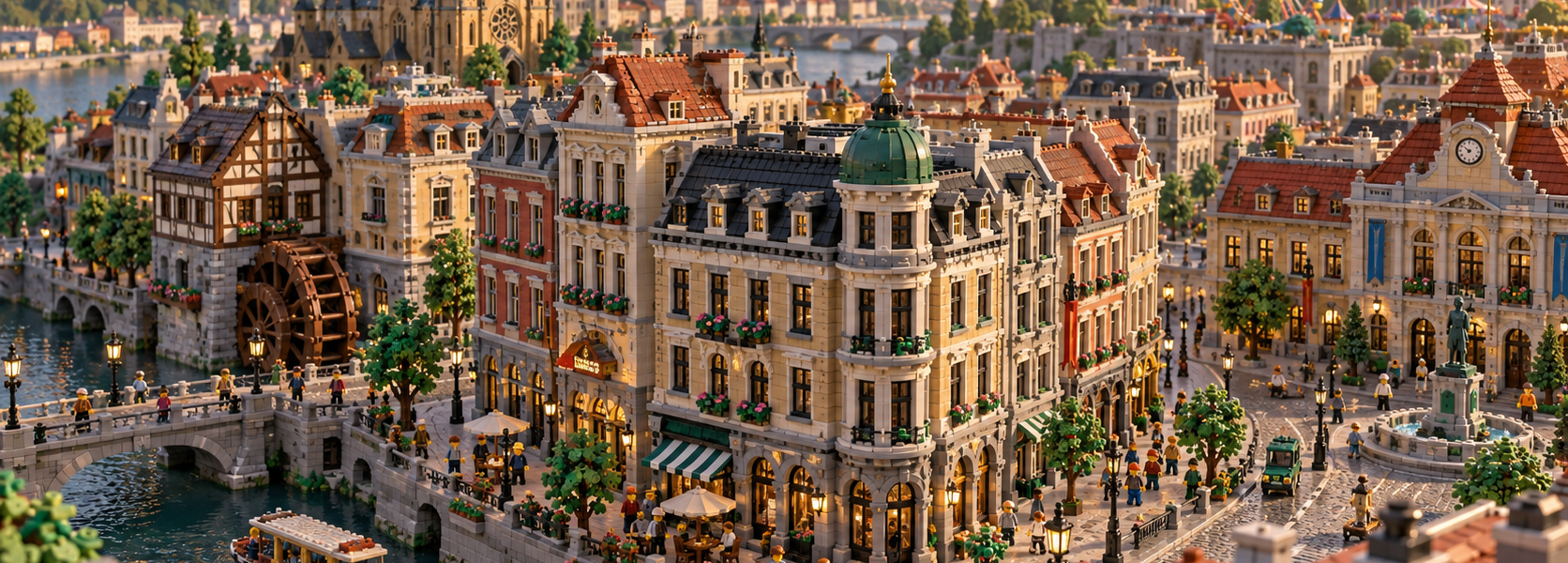
A modern modular building is not only a facade. It is a miniature neighborhood packed with apartments, shops, offices, restaurants and small slices of daily life.
That evolution made the sets more rewarding as building experiences, not just display pieces.
Modular Buildings became an annual ritual
Regularity became one of the collection’s strongest features.
Fans began to expect a new modular every year. Each release generated discussion about architecture, scale, color, placement and how the new building would fit beside earlier ones.
The line gradually became more than a set catalog. It became a yearly event with continuity and shared expectations.
LEGO’s own adult-focused editorial content presents Modular Buildings as a collection that grows over time into a larger city.
Assembly Square showed that the line had developed its own history
Assembly Square 10255, released for the 10th anniversary of Modular Buildings, was an important milestone.
The set was larger, more complex and filled with callbacks to earlier models. Longtime collectors could recognize design cues, color choices and details referencing the first decade of the series.
That was a sign of maturity. Modular Buildings had existed long enough to reference its own past.
Boutique Hotel deepened that self-awareness
Boutique Hotel 10297, released around the collection’s 15th anniversary, continued the same approach.
For a new buyer, it worked as a standalone hotel. For a long-term collector, it functioned as another chapter in a larger architectural history.
This is a key feature of mature collecting ecosystems: a product can be accessible on its own while becoming richer for people who understand the references and continuity behind it.
Modular Buildings helped normalize expensive non-licensed sets
One of the most important lessons of the line was that adults would pay premium prices for large LEGO models without needing a film, game or character license.
The value proposition was architecture, design, building experience and display potential.
That mattered as LEGO expanded its adult portfolio. Today, 18+ products cover cars, architecture, decor, engineering and lifestyle builds, but Modular Buildings was one of the earlier long-running demonstrations that LEGO’s own design identity could sustain a premium adult audience.
Collectors are not just buying buildings — they are buying space
This may be the most distinctive feature of Modular Buildings.
In many collections, each product remains separate. You can display several models together, but they do not necessarily form one world.
With modulars, every new building physically expands the collection. The street becomes longer, new corners appear, new businesses join the neighborhood and the layout evolves.
Collectors are therefore accumulating urban space, not just objects.
That creates unusually strong long-term engagement because each new purchase increases the value and complexity of what is already on the shelf.
Modular scale became a shared design language
The influence of the line extends far beyond official sets.
AFOLs around the world build their own modular buildings, combine multiple official sets into larger structures, redesign facades and create entire cities around the same proportions and connection system.
Modular Buildings effectively became a design language: familiar lot sizes, compatible edges, urban facades and detailed interiors immediately signal that a model belongs to the same ecosystem.
That is one of the clearest signs of cultural impact. Fans do not only collect the official products — they use the format as a framework for their own creations.
The 20th anniversary shows how far the format has moved beyond retail
The 20th anniversary is also being celebrated through a large FanColab community project.
According to published information, 22 LEGO communities around the world are set to recreate classic modular buildings at roughly four times the linear scale. Instead of a typical 32×32-stud footprint, builds are expected to use bases around 128×128 studs.
The project is estimated to use around 11.5 million LEGO elements in total.
That scale of community involvement shows how deeply Modular Buildings has become embedded in AFOL culture. The line is now something that can be celebrated as shared history, not merely as a sequence of products.
Café Corner created more than a line of buildings
After 20 years, the most important achievement of Modular Buildings is not the number of sets released or the total piece count.
Café Corner introduced a collecting model built around continuity. Each building strengthens the ones that came before it, and the collection gradually becomes a personal city.
The line also helped prove that adult LEGO products do not always need licensed characters, nostalgic franchises or entertainment brands. Strong architecture, shared scale and the promise of another city block next year can be enough.
Two decades later, that promise remains one of the main reasons Modular Buildings still works.