
When One Castle Was Enough to Build a Whole World. How Classic LEGO Left Room for Imagination

One yellow castle. A handful of knights. A few brick-built horses. By modern standards, that sounds almost modest. In 1978, it was enough to launch an entire LEGO world.
That is a useful way to think about classic LEGO themes. Their strength was not simply that they were older or simpler. It was that many of them gave builders a language for a world rather than a fully defined story.
Colors, vehicles, factions, characters and a few visual rules could be enough. The rest belonged to the person building.
1978 and the rise of theme-based worlds
1978 was a major year for LEGO play. The modern minifigure with moving arms and legs arrived, making role-play much more expressive.
At the same time, the company was developing a stronger “System within the System” approach, where individual sets could function as pieces of larger, connected worlds rather than isolated models.
Town, Castle and Space became key examples of that shift.
A set no longer had to feel complete on its own. It could be one location, one vehicle or one chapter in a world that the builder expanded with other sets or with their own creations.
Castle 375. One model as an entire setting
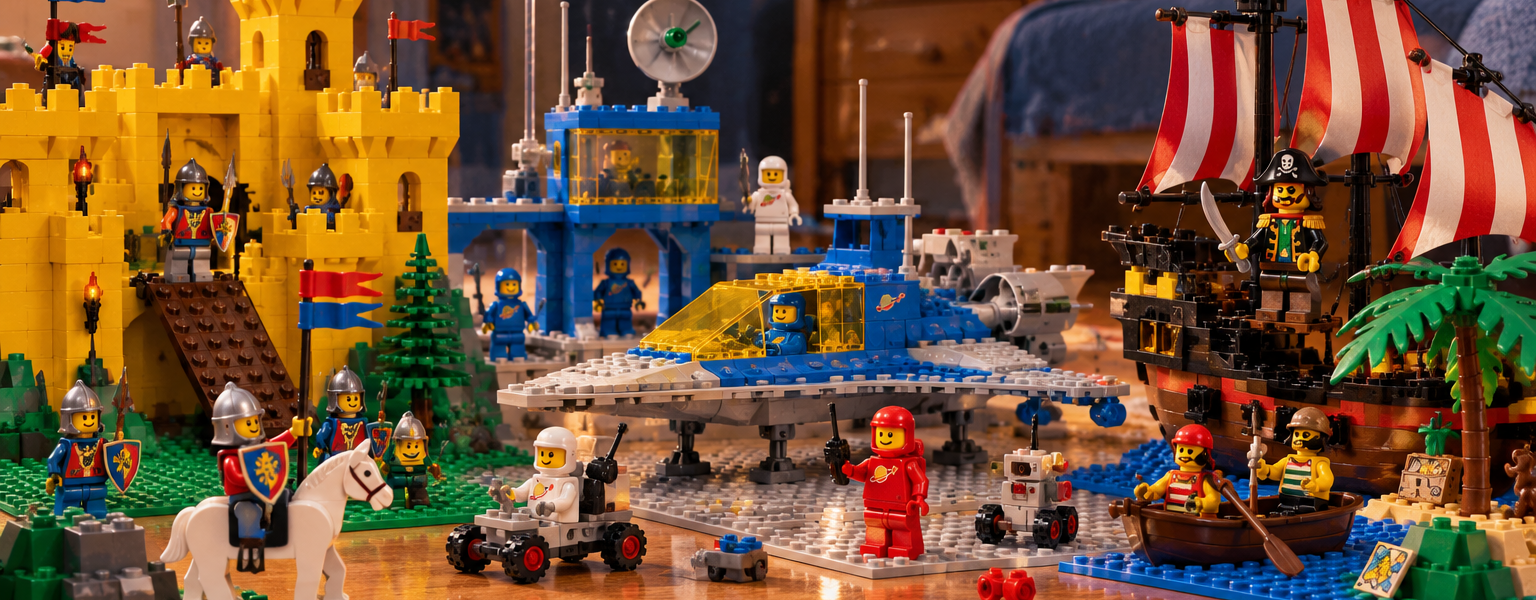
The original Yellow Castle 375 from 1978 is strikingly simple by today’s standards.
It was not trying to reproduce a realistic medieval fortress in exact detail. Instead, it used a few unmistakable signals: walls, towers, a gate, knights, shields and horses.
That was enough to establish the setting immediately.
Some elements that would later receive dedicated molds were still brick-built. The horses, for example, were assembled from regular LEGO pieces rather than represented by specialized animal elements.
That limitation also created freedom. The castle could be a fortress, a palace, a besieged stronghold or the beginning of an entire kingdom. The set did not insist on one official interpretation.
Classic Space built a universe from visual grammar
Early Space worked differently.
It was not tied to a film license, so the designers did not have to reproduce an existing ship, character or storyline. Instead, LEGO created its own visual language.
Gray and blue, transparent yellow elements, antennas, radar dishes, lunar vehicles and simple astronaut suits made separate sets feel like they belonged to one coherent universe.
That coherence was powerful because it did not require a fixed plot.
A builder could decide whether a vehicle was a research ship, a transport, a rescue craft or part of an imaginary fleet. The design language suggested a world without closing off what that world had to be.
Classic Space did not so much tell a story as provide the grammar for telling one.
Galaxy Explorer and the power of ambiguity
Galaxy Explorer 928 from 1979 is one of the clearest examples.
The ship had a strong silhouette, a cockpit, space for astronauts and a support vehicle. It looked unmistakably futuristic, but it was not locked to a particular film, military faction or official mission.
That ambiguity gave it flexibility.
For one child it could be a scientific exploration vessel. For another it could be a cargo ship. For someone else it could be the flagship of a fleet built from spare bricks.
LEGO established visual and functional rules, but the interpretation remained open.
Pirates added stronger characters and conflict
When LEGO Pirates arrived in 1989, the balance began to change.
The theme did not rely only on ships, forts and islands. It introduced clearer factions, recognizable characters and a more explicit conflict.
Captain Redbeard became one of the most distinctive figures in the LEGO universe. There were soldiers, governors, pirates, ships and forts, along with new minifigure features such as hooks, peg legs and more varied facial expressions.
There was also official story material, including The Golden Medallion, which gave the characters more defined backgrounds.
This was an important step. Castle and Space had largely provided scenery and visual language. Pirates began to provide more of the cast and story structure as well.
From scenery to narrative
Put the three themes together and an interesting progression appears.
Castle offered scenery and archetypes. A castle, knight, shield and horse were enough to suggest a medieval world.
Space added a highly consistent visual identity. Colors and vehicle types made the universe coherent while still leaving the story mostly to the builder.
Pirates went further by adding named characters, factions, conflict and official narrative material.
LEGO was gradually moving from providing the stage toward co-authoring more of the story.
Why simplicity could leave more room for imagination
A simpler model has one interesting advantage: it defines itself less precisely.
A highly detailed recreation of a specific object already has a fixed identity. A more symbolic model can be reassigned more easily.
The yellow castle can become another fortress. The spaceship can take on a different mission. A small pirate island can become part of a much larger harbor built from loose parts.
That does not mean fewer details automatically produce better play. It means that abstraction can leave more room for reinterpretation.
Many modern adult sets have a different job
A large part of today’s 18+ portfolio is built around a different goal.
Collector models often emphasize accurate recreation of a specific object, scene, vehicle or building. Once completed, they are designed to look impressive on display and be instantly recognizable as a particular subject.
That is a different kind of value, not an inferior one.
Classic Castle, Space and Pirates were often designed as the beginning of play. A modern display model may be designed more as the end result of the building experience.
Those are two different design philosophies.
Classic themes did not need to explain everything
The most interesting difference is not piece count or whether old sets were “better.”
It is the amount of space left undefined.
Classic themes often gave builders a set of symbols: a knight, a spaceship, an astronaut, a flag, a fort, a base, a vehicle.
From those symbols, builders could create stories with almost no limit.
LEGO did not always have to tell you who the hero was or what had happened before the box was opened. The world only had to be coherent enough to trigger imagination.
When one castle was enough
That is why Yellow Castle 375 remains such a good symbol of the era.
It was not realistic. It was not enormous. It did not attempt to reproduce a real fortress in exhaustive detail.
But it was legible enough for a builder to see an entire kingdom inside it.
Classic Space did the same thing with the future. Pirates later added stronger characters and conflicts to that formula.
The best classic LEGO themes did not put a complete world in the box.
They gave builders a few rules, a few characters and enough empty space to build the rest themselves.