
Winter Village Goes Back Home: Why 11387 Holiday House Feels Like a Return to the Collection’s Roots

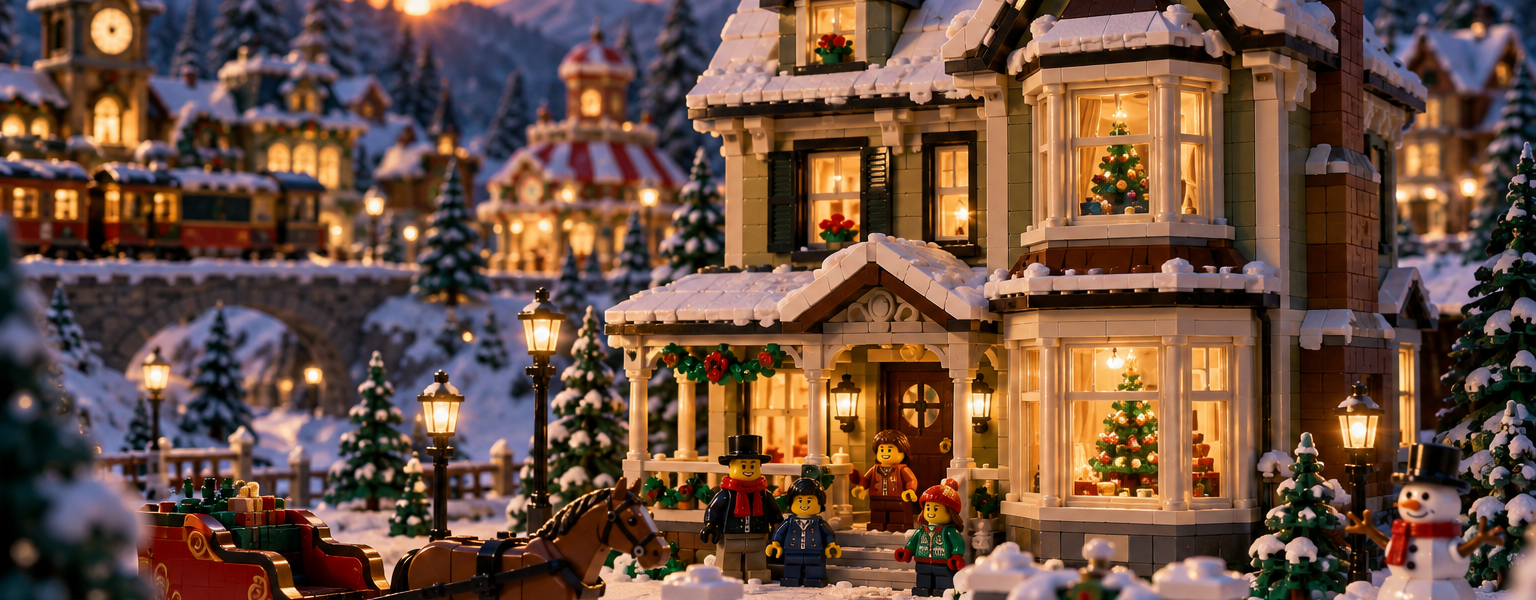
LEGO Winter Village returns in 2026 with 11387 Holiday House, a 1,354-piece set featuring four minifigures, a horse-drawn sleigh, a snowman and a large family home built around a lit Christmas tree. LEGO Insiders Early Access begins on 1 October 2026, with wider availability following on 4 October.
On the surface, it is another annual holiday release. In the context of the full Winter Village line, however, Holiday House feels more significant than that. It brings a family home back into the collection after a five-year gap and revives a type of building that helped define the line’s original village identity.
Winter Village was built as a place, not just a series of Christmas sets
The collection began in 2009 with Winter Village Toy Shop 10199. Over the following years, LEGO added a bakery, post office, market, train station, fire station and other everyday locations.
That progression gave the line a strong sense of geography. Each release added another piece of a shared small-town environment rather than simply offering a standalone seasonal display.
In that sense, Winter Village has always worked best as a long-running world-building project.
Family homes have been rare, but important
Private homes have appeared less often than shops, services and fantasy-adjacent locations, but they have always played an important role in grounding the collection.
Winter Village Cottage 10229 in 2012 focused on family life inside a home, while Santa’s Visit 10293 in 2021 once again centered the story around an ordinary household.
Since then, the collection has moved through other formats. Holiday Main Street 10308 returned to commercial buildings, Alpine Lodge 10325 explored a hospitality setting, Santa’s Post Office 10339 leaned into the Santa mythology, and Holiday Express Train 10361 shifted back to a vehicle-led release.
Holiday House 11387 is therefore the first full family home in five years.
Why an ordinary house matters to a collector display
One of the biggest strengths of a normal residential building is flexibility.
A toy shop, station or post office has a very specific function. A family home can sit naturally next to almost any previous Winter Village building without competing for attention.
For collectors who build a larger seasonal layout, that makes Holiday House especially useful. It acts as connective tissue between more distinctive locations and helps the display feel like a real village rather than a row of attractions.
11387 also returns to a more compact village scale
Industry coverage has noted that Holiday House feels closer in scale to earlier Winter Village buildings. The model measures roughly 28 cm wide and 21 cm tall, giving it a compact footprint despite its detailed interior.
That matters because Winter Village has historically depended on compatibility. A model should look good on its own, but the collection becomes more convincing when multiple buildings can stand together without one overwhelming the rest.
Holiday House appears designed with that relationship in mind.
The architecture is more grounded than fantastical
The building uses a Victorian or farmhouse-inspired style, with red, dark green and gold accents under a snow-heavy roof.
The color palette is unmistakably festive, but the structure still reads as a believable home. That separates it from some of the more fantasy-oriented releases linked directly to Santa and elves.
This does not suggest that Winter Village is abandoning fantasy. It simply shifts the focus back toward a building that looks like somewhere people actually live.
The interior reinforces the domestic theme
The central feature inside is a tall Christmas tree that rises through two floors, forcing part of the upper level to open around it.
The house also includes domestic details such as a fireplace, clock, phonograph and telephone. Instead of workshops, counters or institutional spaces, the interior is built around family life.
That is what makes the set feel different from a themed destination. Holiday House is not about a Christmas service or attraction. It is about Christmas happening inside a home.
The horse-drawn sleigh connects the house to the wider village
The set includes a horse-drawn sleigh, with a mechanism that moves the horse as the sleigh rolls forward.
It is a small feature, but it helps the model function as part of a larger world. The house does not feel like a closed diorama; the sleigh implies movement between buildings and makes it easier to integrate the set into an existing layout.
A return in style does not mean a return in price
Holiday House may feel stylistically closer to earlier Winter Village releases, but its pricing is firmly modern. The set is listed at €109.99 and $119.99.
Historical price comparisons are difficult because piece counts, inflation, design complexity and LEGO’s overall pricing have all changed substantially since the early years of the collection.
Still, the contrast is notable. 11387 revisits an older design philosophy while remaining a contemporary premium seasonal product.
Is this really a return to the roots?
For this specific set, the answer is largely yes. Holiday House brings back a family home, a compact layout-friendly scale and architecture designed to support the wider village rather than dominate it.
That does not mean LEGO has announced a permanent change in direction. Next year could easily bring another station, shop, vehicle or fantasy location.
The safest interpretation is that 11387 is a return to the classic Winter Village formula, not evidence of a new long-term strategy.
The most important character is still the village itself
Holiday House may not be the most spectacular release in the history of the collection. That is exactly why it works.
Winter Village is strongest when its sets contribute to a shared environment instead of competing as isolated showpieces. A family home with warm windows, a Christmas tree and a sleigh outside is the kind of model that strengthens everything around it.
After several years of more specialized releases, 11387 is a reminder that the defining feature of Winter Village was never one particular building. It was the village those buildings created together.