

LEGO has spent decades making the minifigure one of the most recognisable shapes in its entire system. More recently, the company has increasingly reversed the usual scale relationship: instead of placing minifigures inside larger builds, it has been turning the minifigure itself into the build.
The idea is not difficult to understand, but it has proved surprisingly flexible. A standard yellow figure, a licensed character and a themed display model can all use the same basic visual language without looking like the same product.
The minifigure is already an icon
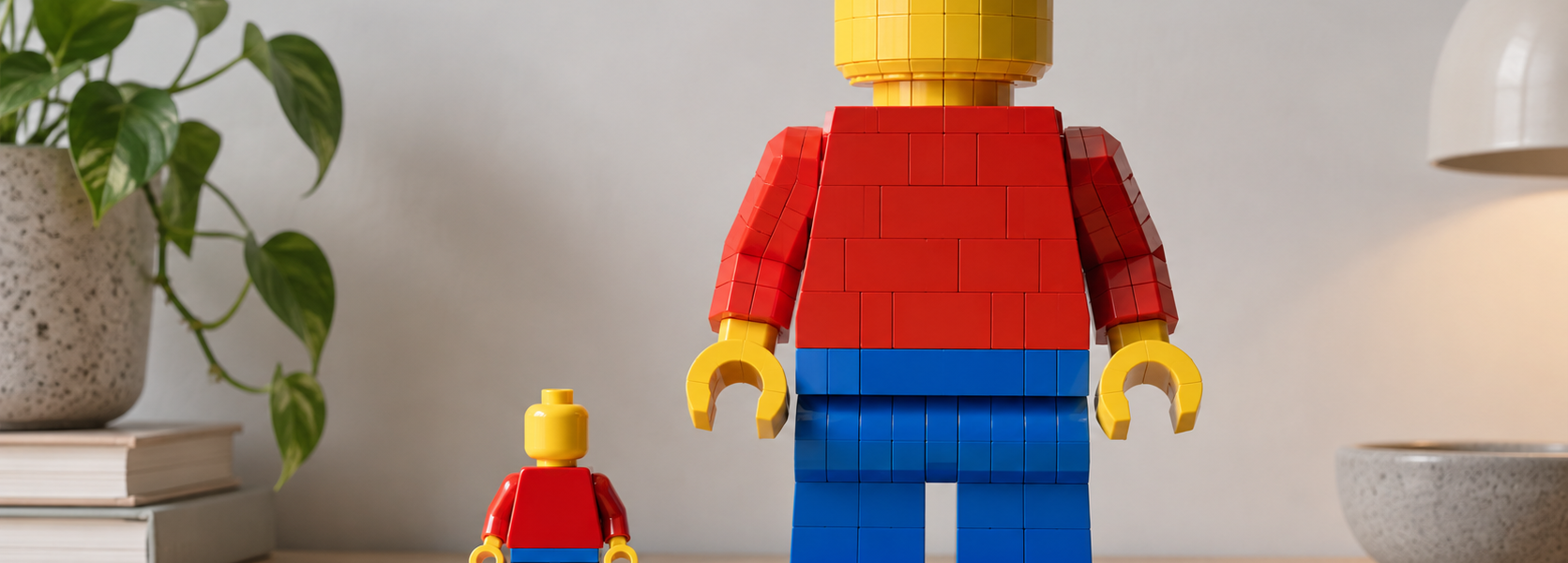
40649 Up-Scaled LEGO Minifigure from 2023 is probably the clearest version of the concept. LEGO describes it as a buildable icon with a movable head, arms, legs and hands. At 27 cm tall, it is large enough to work as a display piece, but still immediately reads as the same simple minifigure shape collectors have known for decades.
That familiarity does much of the work. Unlike a character bust or a highly detailed statue, an enlarged minifigure still looks unmistakably like LEGO rather than simply like a licensed character rendered in bricks.
Licenses make the format more useful
The same principle becomes more interesting when applied to a character such as Darth Vader. LEGO’s 75461 Up-Scaled Darth Vader Minifigure keeps the proportions of the standard minifigure while expanding the form into a 28 cm, 1,028-piece display model. LEGO itself describes it as roughly six times the size of the standard figure.
That makes the format useful for licensed themes. The model can preserve the instantly recognisable LEGO silhouette while adding character-specific details such as armour, fabric elements and accessories. It sits somewhere between a traditional minifigure collectible and a larger display sculpture.
Why the format keeps coming back
There are several reasons the idea works. First, the basic structure is familiar, so designers are not starting from zero each time. Second, it can be adapted to very different themes without losing its identity. Third, the finished model has a clear display function while still offering articulation and a recognisable building challenge.
There is also a strong nostalgia element. Enlarging a minifigure turns a tiny object many fans grew up with into something substantial enough to sit on a shelf or desk. The scale changes, but the proportions and visual shorthand remain familiar.
Not an official collection — but increasingly a format
LEGO does not currently group every oversized minifigure-style model into one formal product line. That distinction matters. Calling them a single official collection would go beyond how LEGO presents them.
What is clear, however, is that the company now treats the upscaled minifigure as a repeatable design format rather than a one-off experiment. The clearest examples show how easily the idea can move between a generic LEGO icon and a licensed character while keeping the same core appeal.
That may be the real reason oversized minifigures keep returning: they are one of the rare display formats that can be both highly recognisable as LEGO and flexible enough to support completely different themes.