
A Light Saturday Feature: What LEGO Fans Are Doing Around the World Today

Saturday is a good time to step away from release dates, rumors and price discussions for a moment.
LEGO is a product, but for many adult fans it is also a social hobby — and in some ways the hobby only really comes alive when people leave the instruction book behind and meet other builders.
On September 19, 2026, fan events are taking place across several countries: public shows, train layouts, local LUG meetings, workshops and community build challenges. Rather than turning this into an event calendar, it is more interesting to treat those activities as a snapshot of what fans actually do together.
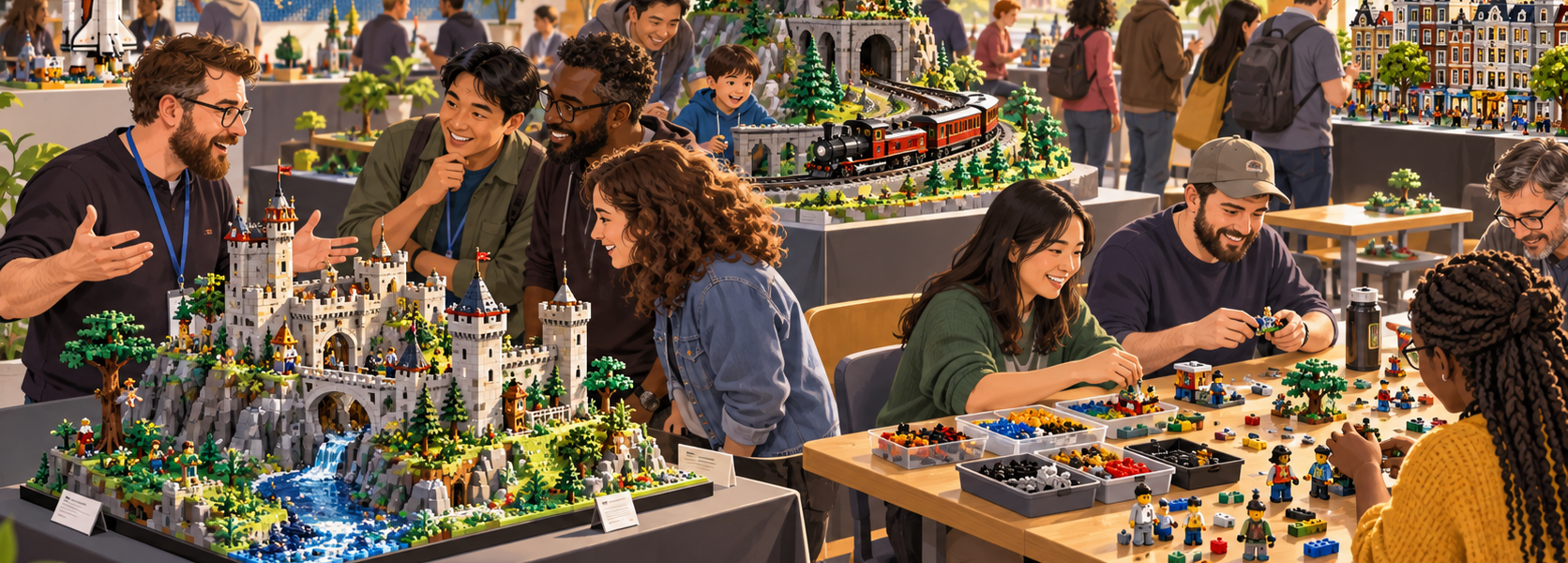
Someone is setting up a MOC for a public show
For many builders, one of the most satisfying moments is not finishing a model at home, but putting it on a table where other people can see it.
Fan exhibitions bring together cities, castles, mosaics, trains, technical builds and scenes that cannot be purchased as official sets.
The important difference is the audience. A visitor stops, notices a detail, asks how something works or explains that they have been trying a similar technique themselves.
A private model becomes part of a conversation.
Someone else is running a train layout
LEGO trains naturally encourage collaboration because a large layout needs space, track, power and planning.
One fan may bring the locomotive, another the rolling stock, another a station, and someone else an entire section of city for the train to pass through.
The finished layout can become much larger than anything one person would realistically build or transport alone.
A LUG meeting does not need to be a big convention
Not every community event takes place in an exhibition hall.
Some of the most ordinary meetings are simply groups of people sitting around a table, bringing unfinished builds, sorting parts, talking about ideas and showing each other recent MOCs.
It works much like a model-making club, camera group or board-game night. LEGO is the reason people meet, but the social value comes from spending time with people who understand the same hobby.
Sometimes the whole evening revolves around a challenge
Local groups often organize themed build challenges rather than open-ended building sessions.
Houston Brick Club, for example, is running a Shiptember challenge this month, encouraging members to build different kinds of ships.
A shared theme changes how people approach building. Instead of working indefinitely on a perfect personal project, builders respond to the same prompt and get to compare very different solutions.
For some fans, LEGO is mostly conversation
This may be the least photogenic but one of the most important parts of fan culture.
Someone brings a box of parts, shows a section of a MOC and spends an hour talking about hinges, old train track, color changes or why one element works better than another.
From the outside, that can look like an extremely specialized conversation about plastic pieces. Inside the hobby, it is no different from photographers talking lenses or car enthusiasts talking engines.
Some fan events are built around teaching
Many exhibitions also include workshops or hands-on activities.
Visitors may get a simple building prompt, children may be invited to create something on the spot, and experienced builders often demonstrate techniques that rarely appear in standard instructions.
At that point, the fan stops being only an exhibitor and becomes someone passing knowledge forward.
LEGO fandom contains a surprising number of specialties
One builder may focus almost entirely on medieval models. Another knows every generation of LEGO train systems. Someone else collects minifigures, builds mosaics, creates modular buildings or only works with Technic mechanisms.
That diversity is one reason local community events are interesting. The same pile of bricks can lead to completely different hobbies depending on the person using it.
A public show changes what a MOC means
A model at home is a private project. The same model on a public table begins to work differently.
People photograph it, ask questions and notice details the builder may not have considered especially important.
Sometimes a single technique becomes the seed for someone else’s unrelated build.
In that sense, fan events create a circulation of ideas. The point is not to copy finished models, but to see solutions and reinterpret them elsewhere.
And sometimes a perfect LEGO Saturday is just sorting parts
Not every fan weekend needs a giant display.
For some people, a quiet afternoon means a few containers, a drink and sorting a collection by color, element type or part number.
It is not spectacular, but it is a useful reminder that adult LEGO building can also be a calm, repetitive hobby. There does not always need to be a finished masterpiece at the end.
The internet has not replaced local communities
Fans can share a model globally within seconds, yet local groups continue to organize physical meetups and shows.
The reason is simple: a large collaborative layout, a moving train or a table full of MOCs does not feel the same on a screen.
There is also the basic value of talking face to face and building together, which online communities cannot fully reproduce.
A Saturday snapshot instead of a major headline
Today’s events do not form one dramatic story — and that is exactly why they make a good Saturday feature.
At the same time, one fan is setting up a display, someone else is running a train, another group is holding a build challenge, and somewhere else several people are simply sitting around a table talking about ideas.
LEGO as a hobby does not end with a set and an instruction book.
For many fans, that is where the interesting part starts.