
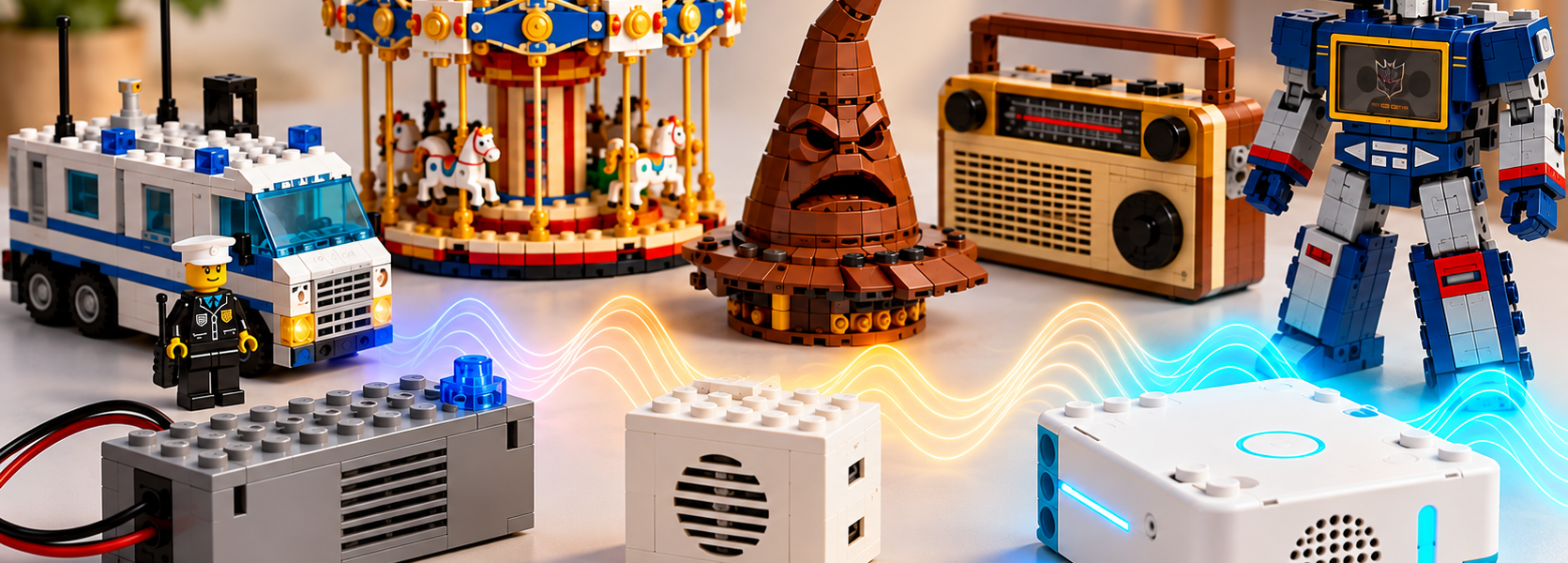

A LEGO sound brick can be a tiny part of a much larger model, yet it can be the one missing piece that makes a used set feel incomplete. A silent police truck, a carousel without its tune or a Talking Sorting Hat that never speaks may still look correct on a shelf. They no longer offer the experience their designers intended.
The term “sound brick” covers several generations of technology. Some early units relied on an external electrical system. Later self-contained modules played a particular recording. In 2026, LEGO SMART Play introduced a SMART Brick that can generate sounds in response to movement and other interactive elements. Understanding that progression is useful both for LEGO history and for buying replacement electronics.
This is a selected history, not an exhaustive inventory of every LEGO product that has made a noise. In particular, it does not attempt to award an unqualified “first ever” title to one set: regional release dates, DUPLO sound elements and other electronic systems deserve separate research.
First, understand the three different jobs a LEGO sound brick can do
External-power sound: A component is part of a larger electrical circuit, as with the classic 9V Light & Sound system. The sound module is only one of the components needed for a working feature.
Recorded, self-contained sound: A purpose-built unit contains the electronics and a small power source needed to play its own sound programme. The sound might be a carousel tune, an alien effect, dialogue or an imitation radio station. Similar-sized modules need not contain the same recordings.
Responsive sound: The SMART Brick combines a speaker, onboard sound synthesis and sensors. With SMART Tags and SMART Minifigures, it can respond to how a model is being played with. This is not the same thing as pressing a button to replay one fixed clip.
The 9V era: a siren was part of an electrical system
One firmly documented early example is 6450 Mobile Police Truck (1986). Its BrickLink inventory identifies the black 4774c01 siren, catalogued as Electric, Sound Siren 9V 2 x 2 x 1 1/3 with 2 Town Police / Fire Noises. The set uses elements of the 9V Light & Sound family, including a separate battery supply and electrical connections. The siren alone is not an independently powered modern sound brick.
BrickLink also distinguishes 4774c02, the 9V siren programmed with two space-themed effects. This is an early illustration of a collector’s problem: an electronic component can fit physically while producing the wrong sound for the original set. It is worth checking the suffix in a catalogue number, not just the shape of the housing.
The BrickLink catalogue dates these specific siren variants to 1986. That supports the year used here but does not establish that no LEGO sound product existed anywhere before it. For restoration, the verified set inventory is more valuable than an unsupported claim about historical firsts.
2009–2011: the same form factor, a different soundtrack
The 10196 Grand Carousel (2009) offers a different use for sound. Its rotation is driven by a separate motor system, while its recognisable tune comes from a dedicated module. BrickLink identifies that module as 55206c04: Electric, Sound Brick 2 x 4 x 2 with Light Bluish Gray Top and Carousel Sound. The catalogue notes that it uses three LR41 button batteries.
Two years later, LEGO Alien Conquest set 7065 Alien Mothership (2011) included its own UFO effect. Brickset’s LEGO-derived inventory names an FX SOUND BRICK 2X4X2, UFO, with LEGO element number 4625192 and design number 96285. BrickLink lists the associated space-sound version as 55206c05, also using three LR41 batteries.
For collectors, the lesson matters more than the exact tune. 55206c04 and 55206c05 are not equivalent sound programmes, even though the parts share the same nominal 2 × 4 × 2 dimensions. A replacement sourced by size alone could leave a carousel making UFO noises—or a spaceship playing fairground music. Always check the exact set inventory and sound variant before buying.
2024–2025: sound becomes the character, not merely the atmosphere
The 76429 Talking Sorting Hat (2024) demonstrates how a sound brick can carry a model’s personality. Tipping the top of the hat or wearing it activates one of 31 randomised sounds, according to LEGO. The official-parts inventory reproduced by Brickset lists the specialised unit as LEGO element 6432415, design 102723, labelled BRICK 4X4, W/ SOUND, NO. 1.
Another 2024 release, 10334 Retro Radio, uses an apparent tuning dial to trigger recorded music and radio-style audio. Its sound-brick element is 6488969, design 109006. The built model also offers a place to position a smartphone, but that is a separate convenience: LEGO explicitly says the radio has no speaker function for a phone. The model is not a functioning broadcast receiver or a Bluetooth speaker.
In 10358 Transformers: Soundwave (2025), pressing the play button activates recorded voice lines and effects associated with the character. Brickset identifies element 6538582, design 112444. What distinguishes this set is not a claim that it invented talking LEGO models, but that the audio is an integral part of depicting a character whose original fiction revolves around sound and a cassette-player form.
These three 4 × 4 sound units demonstrate another important distinction: their design and element numbers identify specific catalogue entries. An apparently similar new-generation sound brick is not automatically the correct replacement for a different licensed model.
A sound-brick identification chart for collectors
The table deliberately uses BrickLink part numbers for the older modules and LEGO element IDs from Brickset inventories for the newer ones. These are different numbering systems. They should not be entered into a marketplace as though they were identical types of ID.
| Set / year | Identifier to check | Type of sound | Power / operation |
|---|---|---|---|
| 6450 Mobile Police Truck / 1986 | 4774c01 — BrickLink | Police/fire sirens | External 9V Light & Sound system |
| 10196 Grand Carousel / 2009 | 55206c04 — BrickLink | Carousel music | Self-contained module; 3 × LR41 |
| 7065 Alien Mothership / 2011 | 55206c05 — BrickLink; 4625192 — LEGO element | UFO effect | Self-contained module; 3 × LR41 |
| 76429 Talking Sorting Hat / 2024 | 6432415 — LEGO element | 31 randomised sounds | Button cells; triggered by the hat mechanism |
| 10334 Retro Radio / 2024 | 6488969 — LEGO element | Recorded radio-style audio | Button cells; activated through the dial mechanism |
| 10358 Transformers: Soundwave / 2025 | 6538582 — LEGO element | Character voice and effects | Button cells; play-button activation |
| SMART Play / 2026 | SMART Brick — system component | Dynamic, context-responsive sounds | Rechargeable; wireless SMART Charger |
Identification sources: BrickLink catalogue entries, Brickset inventories sourced from LEGO replacement-parts data, and LEGO’s official product and SMART Play documentation. Battery types for the modern 4 × 4 units should be checked against the instructions for the specific set; do not assume every generation uses the same cells.
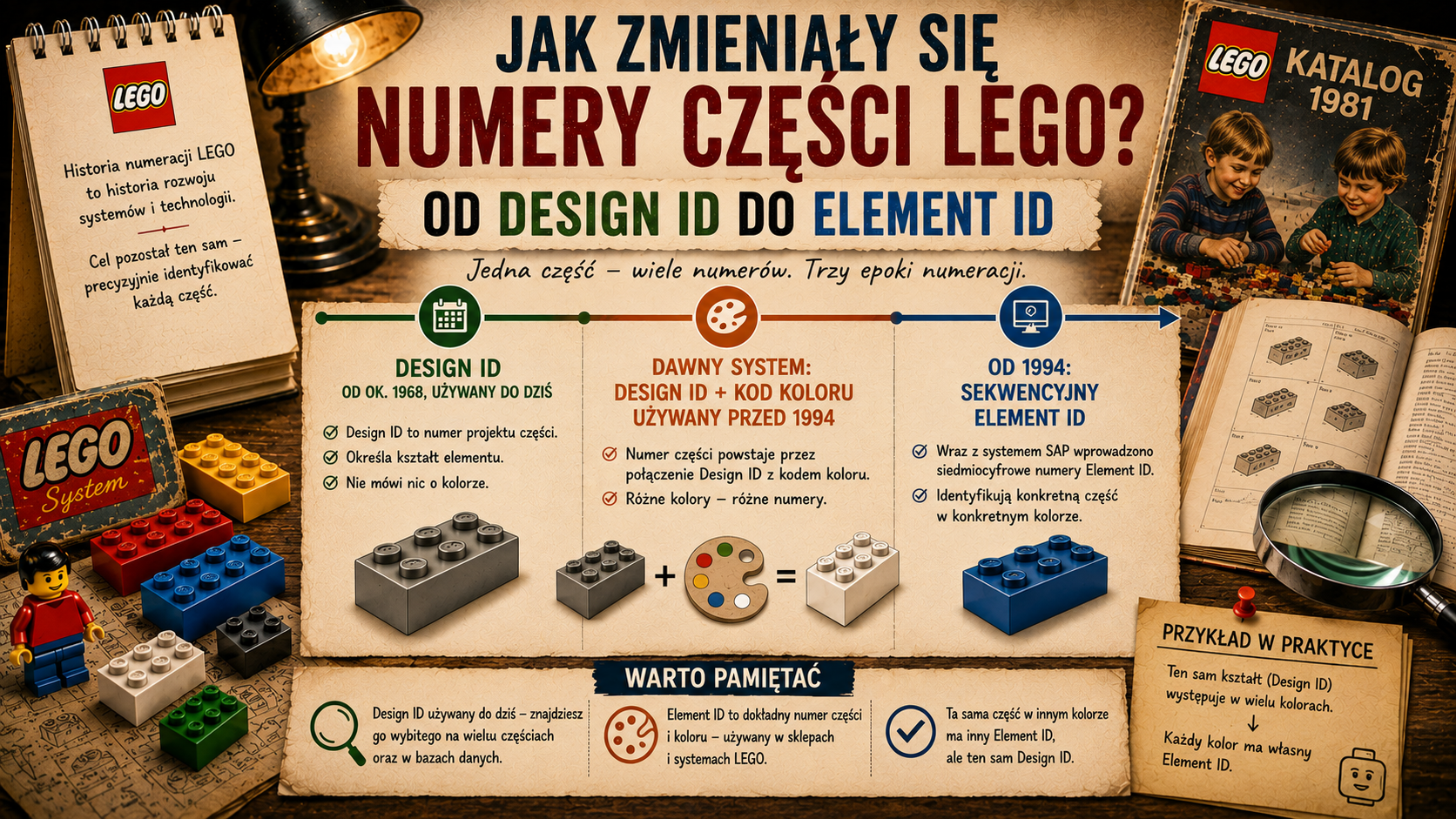
Part number, design ID and element ID: why searches get confusing
When working across BrickLink, Brickset, LEGO replacement-parts pages and individual resale listings, there are several ways of identifying a piece. A BrickLink part number is a catalogue identifier, sometimes including a suffix for the particular electronic variation. A LEGO design number may describe a design family, while a LEGO element ID identifies a specific catalogued element, generally accounting for its configuration and colour.
For instance, Brickset lists the Talking Sorting Hat’s unit with element ID 6432415 and design 102723. The Retro Radio uses 6488969 / 109006; Soundwave uses 6538582 / 112444. Those paired numbers are not alternative sounds that can be selected on a universal brick. They refer to different physical catalogue entries, each associated with its own model and audio.
Start with the set number and work outward to the inventory. Only then search the part identifier in the marketplace. This is more reliable than searching for an image of “the LEGO sound brick.”
Buying a used LEGO sound brick: a practical inspection checklist
- Identify the exact set. Search the set number in BrickLink and compare the relevant sound module with Brickset’s inventory. Record both the catalogue number and, where available, the LEGO element ID.
- Ask for a short working video. A photo cannot prove that the correct sound plays. Request footage showing the activation method and clearly audible output. For a 9V item, ask to see it working with its battery box and connections.
- Check the power arrangement. A separate 9V circuit is not interchangeable with LR41-powered sound bricks or modern button-cell units. Consult the instructions for the exact battery specification before replacing cells.
- Inspect the battery compartment and contacts. Corrosion, a missing cover, damaged contacts or an inoperative switch can be more significant than a few scuffs on the plastic. Avoid improvising repairs to sealed electronics.
- Check associated functions separately. A Grand Carousel motor and its music module can fail independently; Retro Radio’s physical dial action and sound should both work; a SMART Brick must charge and respond to compatible SMART elements.
- Compare the delivered price, not just the listing price. Used electronics may be sold from other countries, with shipping, import charges or regional availability affecting the total. An untested unit should not be valued as if it were proven working. There is no dependable universal resale price for these parts.
Battery safety: Button batteries pose a serious risk if swallowed. Follow the set’s battery instructions, keep loose cells away from children, and do not use an electronic brick with a damaged battery compartment. Seek urgent medical assistance if swallowing is suspected.
SMART Play changes the question: what should the brick do?
The LEGO Group announced SMART Play on 5 January 2026, with the initial launch scheduled for 1 March 2026. Its SMART Brick combines sensors, a miniature speaker, onboard sound synthesis and wireless charging. Compatible SMART Tags and SMART Minifigures help it recognise a role or context; motion and other sensor inputs can change the sounds and lights during physical play.
That makes the platform different from a vintage siren or a module with a small set of recorded phrases. LEGO’s getting-started documentation describes sounds being created in real time. It also confirms that an app is not required for ordinary play; LEGO SMART Assist provides adult-facing management, troubleshooting and updates.
There are limits worth stating plainly. A SMART Tag or SMART Minifigure does not contain the sound system; the SMART Brick is the component making the sounds. LEGO’s help pages say owners cannot currently upload their own audio or light programmes. Although LEGO’s feature overview describes a microphone-based sound sensor, the built-in microphone is currently deactivated. LEGO says enabling it would require an update and the owner’s permission; it is not an active listening feature in current play. LEGO also states that the brick cannot store or transmit audio recordings. And although SMART Play components fit into the wider LEGO building system, attaching an ordinary older brick does not magically add sensors or an electronic sound function to that brick.
For someone building a custom scene, this distinction is crucial. A pre-programmed sound brick may be exactly what a historical restoration needs. SMART Play provides a more flexible responsive system, but it is not a drop-in replacement for every retired sound module.
Preserving the sounds is part of preserving the set
Collectors often measure completeness by pieces, minifigures, instructions and stickers. Electronic models add an extra question: does the original feature still perform as intended? The siren in a 1980s emergency vehicle, the Grand Carousel melody and Soundwave’s recorded lines each contribute something specific. An otherwise complete model with the wrong audio module is still missing part of its intended experience.
LEGO sound bricks have therefore changed in two ways: technologically, from externally powered effects through compact recordings to sensor-driven synthesis; and creatively, from signalling an event to adding atmosphere, dialogue and responsive behaviour. Knowing both stories helps you buy the right piece—and appreciate why a few seconds of sound can matter so much to a LEGO set.
Sources and further reading
- BrickLink — 6450 Mobile Police Truck set entry (1986) and its inventory, including 4774c01.
- BrickLink — 1986 Light & Sound parts, including both 9V siren versions.
- BrickLink — carousel sound brick 55206c04 and space sound brick 55206c05.
- Brickset — 7065 Alien Mothership parts inventory.
- LEGO — 76429 Talking Sorting Hat and Brickset — 76429 sound element ID.
- LEGO — 10334 Retro Radio and Brickset — 10334 sound element ID.
- LEGO — 10358 Transformers: Soundwave and Brickset — 10358 sound element ID.
- LEGO Group — SMART Play announcement, dated 5 January 2026.
- LEGO — SMART Play getting started, sensors and charging, guidance on custom sounds, and guidance on the currently deactivated microphone.