

The most expensive missing piece in a vintage LEGO set does not have to be large, complex, or visually impressive. Sometimes it is a tiny accessory, an unusual color of an otherwise common element, or a part that disappeared from production decades ago.
That can feel counterintuitive. The amount of plastic is tiny, yet the aftermarket price can be high. The reason is not size. It is the combination of catalog rarity, age, surviving supply, collector demand, and one very practical problem: small pieces are easy to lose.
A part can be common and rare at the same time
In LEGO collecting, the shape of an element and the specific part + color combination are two different things. A basic piece may appear in hundreds of sets in black or light bluish gray, while the exact same mold in a short-lived color may have appeared only once.
BrickMissing’s large inventory analysis illustrates just how often that happens. Across 91,650 unique part-and-color combinations, 46,619 — 51% — appeared in only one set. Another 20% appeared in just two or three.
That does not mean half of all LEGO elements are expensive. BrickMissing explicitly treats this as catalog frequency, not market value. A one-set part from a mass-produced modern release can still be cheap and easy to find.
Time removes supply
Older parts face a different problem. Once production ends, there is no new supply coming from current sets. What remains comes from old collections, parted-out inventories, dealer stock, and whatever has survived decades of play and storage.
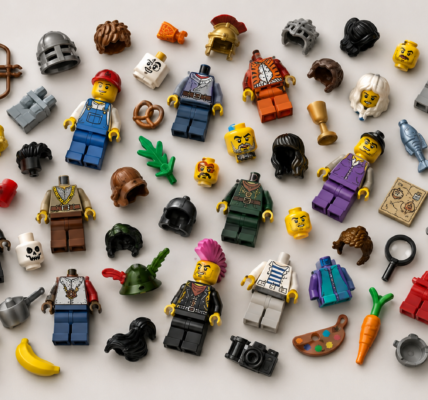
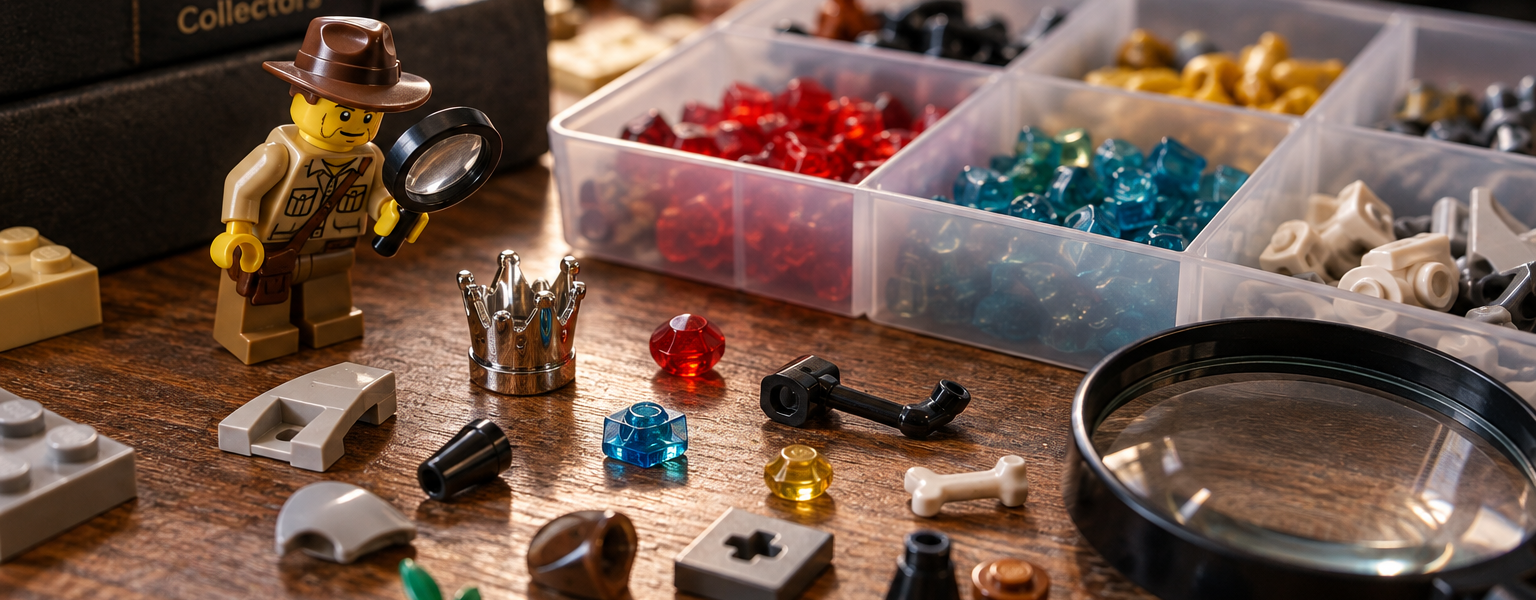
Large hulls, baseplates, and panels are difficult to overlook. Tiny coins, clips, tools, decorative pieces, feathers, visors, and minifigure accessories are much easier to separate from the original set. They disappear into other bins, under furniture, during moves, or quite literally into vacuum cleaners.
That gradual loss matters. A set may still be widely available second-hand while one specific accessory becomes increasingly difficult to source in the correct color and condition.
Old gold coins are a good example
Chrome gold minifigure coins from the 70501 sprue show how survival can matter as much as original production volume. BrickLink catalogs the part family across the period from 1989 to 2011, and the sprue appeared in more than one hundred sets.
That hardly sounds rare. But once separated, an individual coin is tiny — roughly 0.05 g and under a centimeter across. Over decades, pieces like that are extremely easy to lose.
BrickLink’s wanted-list data shows sustained collector interest in these coins despite their relatively broad historical use. It is a useful reminder that the number of sets released decades ago is not the same thing as the number of intact examples available today.
Sometimes the rare thing is only the color
Another common trap is assuming a familiar mold must be cheap. A brick, clip, plate, or accessory can be ordinary in most colors and surprisingly scarce in one.
For a builder who simply wants a functional replacement, that may not matter. A near-identical color can be good enough. For a collector restoring a set to its original inventory, the distinction is critical.
This is why two visually similar elements can trade at very different prices. The underlying mold may be common while the exact production run in one color was extremely limited.
Retirement changes the equation
A newly introduced element can look rare simply because LEGO has not reused it yet. That kind of rarity can disappear quickly if the part turns up in several later sets.
The more interesting cases are pieces that have been out of production for ten, twenty, or thirty years. There is no fresh retail supply to dilute the market. If collectors still need the element for restorations and the surviving pool is small, prices can climb sharply.
The effect becomes even stronger when several factors overlap: short production window, few sets, unusual color, small physical size, fragile decoration, or strong demand from a popular theme.
Rare does not automatically mean expensive
This is the most important caveat. Catalog rarity and market value are not the same thing.
Price depends on both supply and demand. A part used in one obscure set may remain inexpensive if almost nobody wants it. A part that appeared in many sets can still become expensive if it is associated with a highly collected theme and the available supply has thinned out.
BrickLink’s Price Guide is useful here because it separates current listings from recent completed sales. That matters far more than an isolated listing with an unrealistic asking price.
Why old bulk lots deserve a closer look
If you have unsorted LEGO from the 1980s, 1990s, or early 2000s, the most interesting pieces may not be the largest ones. Small accessories, unusual colors, retired prints, and theme-specific details are exactly the kinds of parts that can become hard to replace later.
That does not mean every old storage box is a hidden treasure chest. The strongest aftermarket cases usually combine several traits at once: limited production, few set appearances, unusual color, long retirement, small size, and real collector demand.
Those are the pieces worth sorting carefully instead of dismissing as random leftovers. Years later, a tiny part that looked insignificant can be the one somebody still needs to complete a favorite set.