
How COBI Built a Global Niche by Treating Brick Sets Like Scale Models

It is easy to judge every construction-brick brand against LEGO and assume that success means offering the same categories at a lower price. COBI has followed a different path. Instead of trying to cover every part of the market, it has built much of its identity around historical vehicles, defined model scales, printed details and collectors who want something closer to traditional scale modeling.
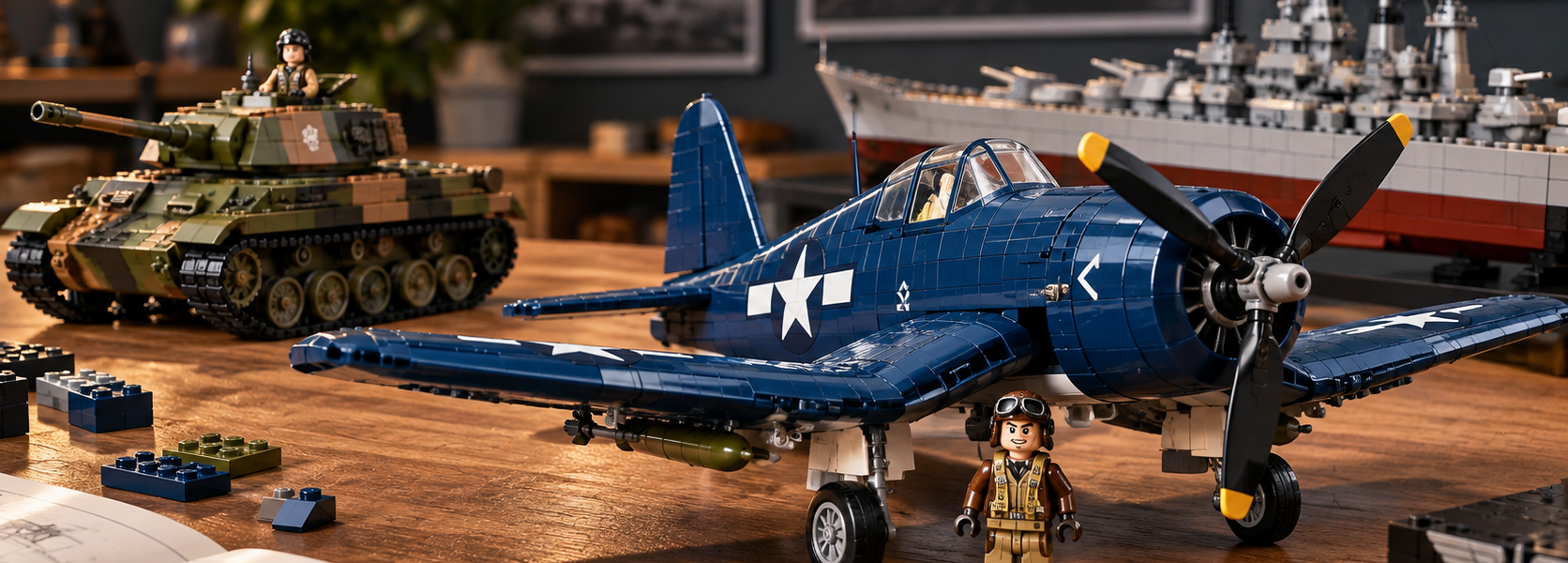
Its October 2026 Flying Bulls launch is a good example. COBI is introducing historic aircraft such as the Chance Vought F4U-4 Corsair in both 1:32 and 1:48 scales. The larger version contains 665 pieces, includes a pilot figure and folding wings, while the smaller build uses 236 pieces. The interesting story, however, is not one Corsair. It is the strategy behind it.
COBI does not need to be a second LEGO
LEGO operates across an enormous range of categories: play themes, licensed entertainment, vehicles, architecture, technical builds, preschool products and adult display sets. COBI is far more concentrated.
Its strongest identity comes from products built around specific real machines — aircraft, tanks, warships, cars and other vehicles that collectors can recognize by type, era and often exact variant.
That changes the design goal. The brick system remains the construction medium, but the finished object is expected to read like a scale model first.
Scale is part of the product language
COBI frequently communicates scale directly: 1:32, 1:48, 1:72 and other model-oriented formats. For collectors, that is useful information rather than a marketing detail.
A stated scale tells buyers how large the finished model will be and whether it will sit naturally beside other builds in the same collection. It also creates consistency across a range in a way familiar to traditional model-making.
The Flying Bulls Corsair illustrates this clearly. Offering the same aircraft in two scales serves two different collector needs rather than forcing every buyer into one standard size.
Military and historical subjects create differentiation
COBI has spent years developing subjects that LEGO rarely explores in depth: historical combat aircraft, tanks, naval vessels and modern military vehicles.
That specialization gives the company a clear market space. For builders interested in military history or specific machines, COBI can offer products that simply do not exist in LEGO’s mainstream portfolio.
The design consequences are visible as well. Accurate silhouettes often require specialized slopes, curved elements, wings, hull sections and other pieces tailored to reproduce real vehicle geometry more closely.
Printed details matter to model collectors
COBI often emphasizes printed elements rather than sticker-heavy decoration. For a display-focused collector, that can be an important selling point.
National markings, tactical numbers, panel details and vehicle-specific graphics are part of the identity of a real machine. Printing integrates those details directly into the model and avoids the alignment and aging issues that can come with stickers.
Licensing adds credibility
COBI has expanded through licenses connected with major automotive and aerospace names, including Boeing, NASA, Lockheed Martin, Maserati, Fiat and Opel.
Licensing matters differently in this segment than in a character-driven toy line. It allows COBI to market specific machines with official brand associations, reinforcing the idea that these are collectible representations rather than generic brick-built vehicles.
The Flying Bulls collaboration fits neatly into that approach because it combines historic aircraft, recognizable liveries and a collection built around real display machines.
A Polish company with an international business
COBI is a Polish brand, but its market is increasingly international. Industry reporting around the 2025 Resource Partners investment stated that more than 70% of COBI revenue came from foreign markets.
The same transaction also shows how far the company has grown. Resource Partners acquired a 40% stake while the existing owners retained majority control. That gives COBI additional capital and strategic support for expansion without turning the company into a subsidiary of a larger toy group.
Why the niche strategy works
COBI’s advantage may be precisely that it does not try to compete everywhere.
If a customer wants broad role-play worlds, minifigure ecosystems, entertainment licenses or open-ended family building, LEGO remains the obvious reference point. If the goal is a 1:32 aircraft, a historical tank, a large warship or a licensed car with a strong emphasis on silhouette and printed detail, COBI has a much clearer proposition.
That is classic niche positioning: instead of being moderately competitive in every category, the company aims to be especially relevant to collectors who value scale, realism and historical subject matter.
Flying Bulls is a useful snapshot of that strategy
The October Flying Bulls range matters less because COBI is releasing another Corsair and more because it summarizes the brand’s direction: a real machine, a defined scale, historical context and a product aimed at display-focused collectors.
In an increasingly crowded construction-brick market, specialization can be more powerful than imitation. COBI does not need to become “another LEGO” if it can remain the first brand many model-oriented builders think of when they want scale modeling in brick form.