
From Yellow Faces to Natural Skin Tones: How LEGO Minifigures Changed

Today, the yellow face of a LEGO minifigure feels inseparable from the brand’s visual language. For decades it represented the default human figure across Town, Space, Castle, Pirates and countless other themes. But the choice was not inevitable, and the minifigure itself evolved substantially before natural skin tones entered the system.
Before the modern minifigure
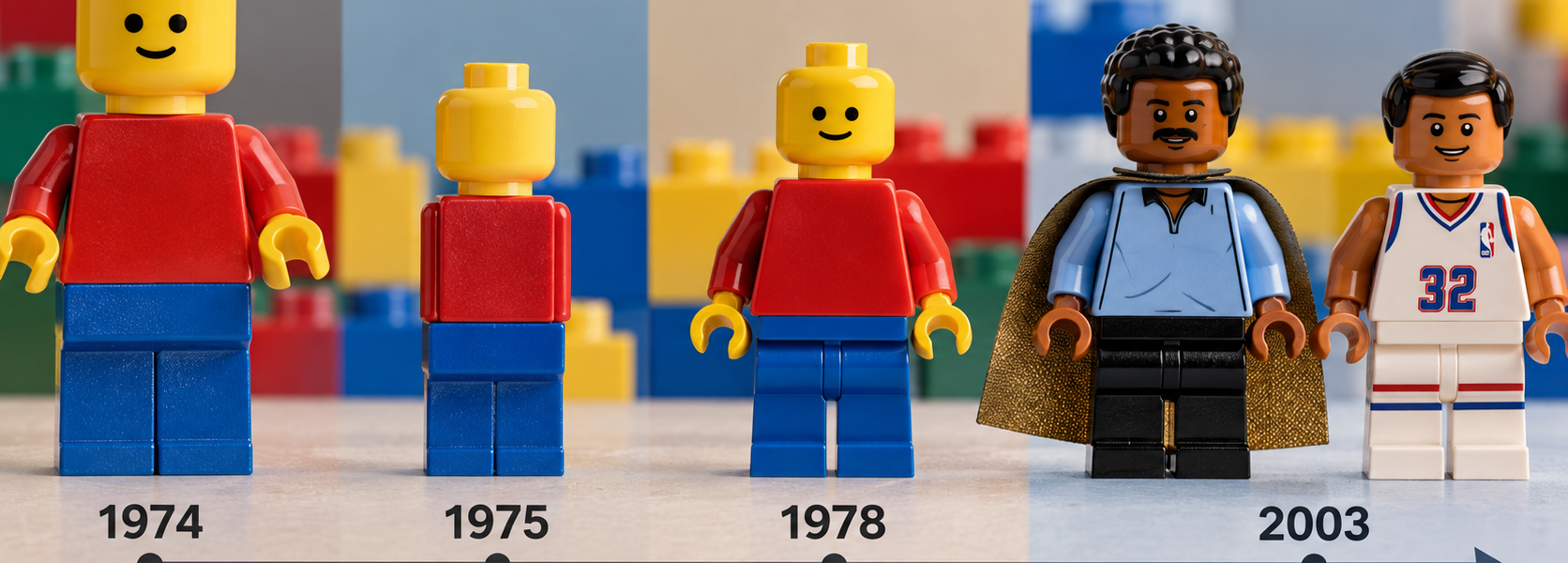
The story begins before 1978. LEGO experimented with character figures throughout the mid-1970s. In 1974, larger building figures appeared, assembled from system elements and fitted with yellow heads. In 1975, LEGO introduced a smaller, simplified figure that was closer in scale to the later minifigure but still lacked articulated arms and legs.
The familiar modern form arrived in 1978: a separate head and torso, movable arms and legs, and hands capable of holding accessories. That design turned the figure into a much more effective role-play tool and created the basic silhouette that still survives today.
Why yellow?
LEGO’s own historical material says the yellow head was supported by focus-group feedback during the 1970s, with participants preferring yellow heads over white ones.
Over time, yellow became much more than a color choice. It worked especially well for a toy system in which figures were usually not meant to represent specific real people. A yellow firefighter, astronaut, knight or construction worker could function as a generic character inside a stylized play world.
At first, the faces were almost identical
Early minifigures were visually restrained. The classic face used two black dots for eyes and a simple smile. For years, that expression reinforced the idea of a universal character rather than a specific personality.
That began to change toward the end of the 1980s. LEGO points to the Pirates theme, launched in 1989, as an important milestone. Pirates introduced more varied facial designs, including moustaches, beards, eyepatches and stronger expressions.
The minifigure was becoming more character-driven even while its skin color remained yellow.
Licensed characters changed the design problem
The next major shift came with licensed themes. Once a minifigure was expected to portray a specific actor, athlete or fictional character, the old universal approach became harder to maintain.
A generic yellow figure could still work well inside LEGO’s own worlds, but licensed characters raised a different question: how closely should the figure resemble the person it represents?
That tension pushed the minifigure toward greater specificity in faces, hair, costumes and eventually skin tones.
2003: natural skin tones enter the minifigure system
LEGO identifies 2003 as the point when natural skin tones were introduced for minifigures. Its historical materials cite Lando Calrissian and NBA players among the early examples.
This was a significant design change. The goal in those cases was no longer to represent an abstract person inside a stylized LEGO universe, but to make a recognizable version of a specific character or real-world individual.
Why yellow minifigures never disappeared
Natural skin tones did not replace yellow across the entire system. Many of LEGO’s own non-licensed themes continued to use the classic yellow head.
That created a useful visual distinction. Original LEGO worlds could retain the long-established yellow convention, while licensed themes could use natural skin tones when likeness and identity mattered more.
The rule has not always been perfectly uniform across every line or period, but the broader pattern is clear: yellow remained central to LEGO’s own visual language, while natural tones expanded the range available for specific characters.
A focus-group decision became a design language
The most interesting part of this history is how an apparently simple color decision became part of the identity of the entire toy system.
The yellow head began as one solution among several. Over decades, repetition turned it into a symbol. By the time natural skin tones arrived in 2003, yellow no longer looked like a temporary design choice — it looked unmistakably like LEGO.
That is why the change was not a replacement of one system by another. It was an expansion. The minifigure kept its iconic 1978 body language while becoming more expressive, more specific and more capable of representing both imaginary toy-world characters and recognizable licensed identities.