
LEGO Bricks Aren’t All ABS: Why Transparent Parts Need Different Plastics

“LEGO bricks are made from ABS” is only partly true. ABS remains the dominant polymer in the system, but the full parts library relies on multiple materials selected for very different jobs. A standard brick, a clear window, a tire and a hinge do not need the same combination of stiffness, flexibility, impact resistance or optical clarity.
That is why materials engineering matters so much in construction toys. The geometry may be standardized, but the polymer has to match the function.
ABS is still the foundation
ABS — acrylonitrile butadiene styrene — is the material most closely associated with LEGO bricks. The company has used it in standard rigid elements since 1963, and it still accounts for the overwhelming majority of resin used for bricks.
According to the LEGO Group’s 2024 Sustainability Statement, ABS represented around 85% of the resin used in brick production. That makes it clear that newer materials are expanding the system rather than replacing ABS wholesale.
Why one plastic cannot do every job
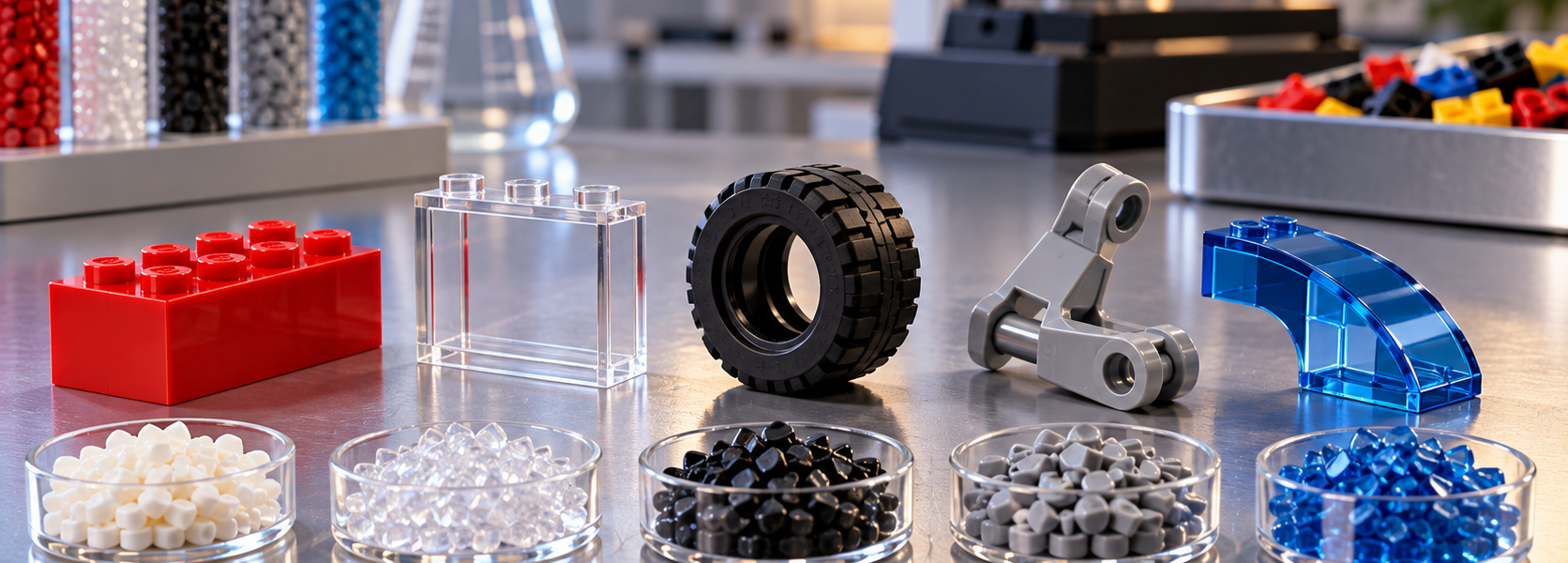
Different elements have different mechanical and visual requirements. LEGO’s product-safety and materials documentation lists a range of polymers used across the system, including ABS, HIPS, PA, PC, bio-PE, SEBS and arMABS.
- ABS — widely used for standard rigid system elements,
- HIPS — used in selected structural applications such as some base elements,
- PA — used where mechanical strength and load performance are important,
- PC — used in selected hinges, connectors and similar functional parts,
- bio-PE — used in some soft or flexible elements,
- SEBS — used in tires and other flexible applications,
- arMABS — now an important material for transparent elements.
This should not be read as a complete one-to-one map of every element in production, but it shows why “LEGO plastic” is not a single material category.
Transparent parts are a special case
Clear elements have optical requirements that an opaque brick does not. A transparent part has to maintain clarity and surface quality while still meeting the dimensional and durability standards expected from the LEGO system.
LEGO currently identifies arMABS as a material used for transparent elements. That includes many windows, windscreens and other clear parts across the current portfolio.
It would be misleading to describe arMABS simply as a “better ABS.” LEGO does not frame it that way. The useful point is that transparent elements have different material requirements, and arMABS is part of the company’s current solution for those applications.
More than 900 clear elements now include recycled material
The biggest recent change is in composition. LEGO says that more than 900 transparent elements now contain 20% recycled material, excluding colorants.
The recycled feedstock comes from waste generated during the production of engineered marble. LEGO uses that material as part of the input for arMABS rather than treating it purely as waste.
According to the company, transparent elements using this approach appear in more than 85% of LEGO sets. That makes this a broad system-level change rather than a small pilot limited to a handful of specialty parts.
arMABS entered the system in 2024
The LEGO Group’s 2024 Sustainability Statement identifies 2024 as the year arMABS was introduced for transparent elements.
That timing highlights how slowly material changes move through the system. Any new formulation has to satisfy requirements for safety, durability, manufacturing consistency and compatibility with existing parts.
For transparent components, visual performance adds another layer. Small shifts in clarity, color tint or gloss are immediately visible in a way they may not be on an opaque brick.
Why LEGO cannot just switch everything to one “greener plastic”
This is one of the easiest parts of the sustainability discussion to oversimplify. A polymer that works well in one application may fail badly in another.
LEGO has said it tested more than 600 different materials while searching for more sustainable solutions. Some candidates failed to meet quality, durability, safety or manufacturing requirements.
That is the central engineering challenge: a new material has to look right, hold dimensions precisely, survive repeated assembly cycles, remain safe for users and integrate with a system designed to stay compatible across decades.
Same geometry, different material
Two elements can fit into the same construction system while being made from different polymers. That is especially obvious in functional parts.
A tire needs to flex. A hinge has to survive repeated movement. A clear windscreen has to stay transparent. A standard brick needs stiffness and predictable clutch power.
All of those elements belong to the same system, but their material requirements are fundamentally different.
Why collectors should care
Material differences also matter over time. Aging, cracking, discoloration and changes in gloss can be tied to particular formulations and production periods rather than to “LEGO plastic” as one universal material.
That is why material, color and production era are useful distinctions when discussing long-term part behavior. Historical problems such as brittle brown or color shifts are better understood as specific material-and-formulation issues than as failures of the entire system.
One system, many polymers
The most useful takeaway is simple: LEGO does not build everything from one plastic. It builds one compatible construction system using multiple materials optimized for different functions.
ABS remains the core material, but clear parts, flexible tires, hinges and soft elements can demand very different properties.
That is why material substitution is so difficult. Changing the feedstock is easy on paper. Doing it without changing how the element looks, behaves, ages or connects to decades of existing bricks is the real engineering problem.