
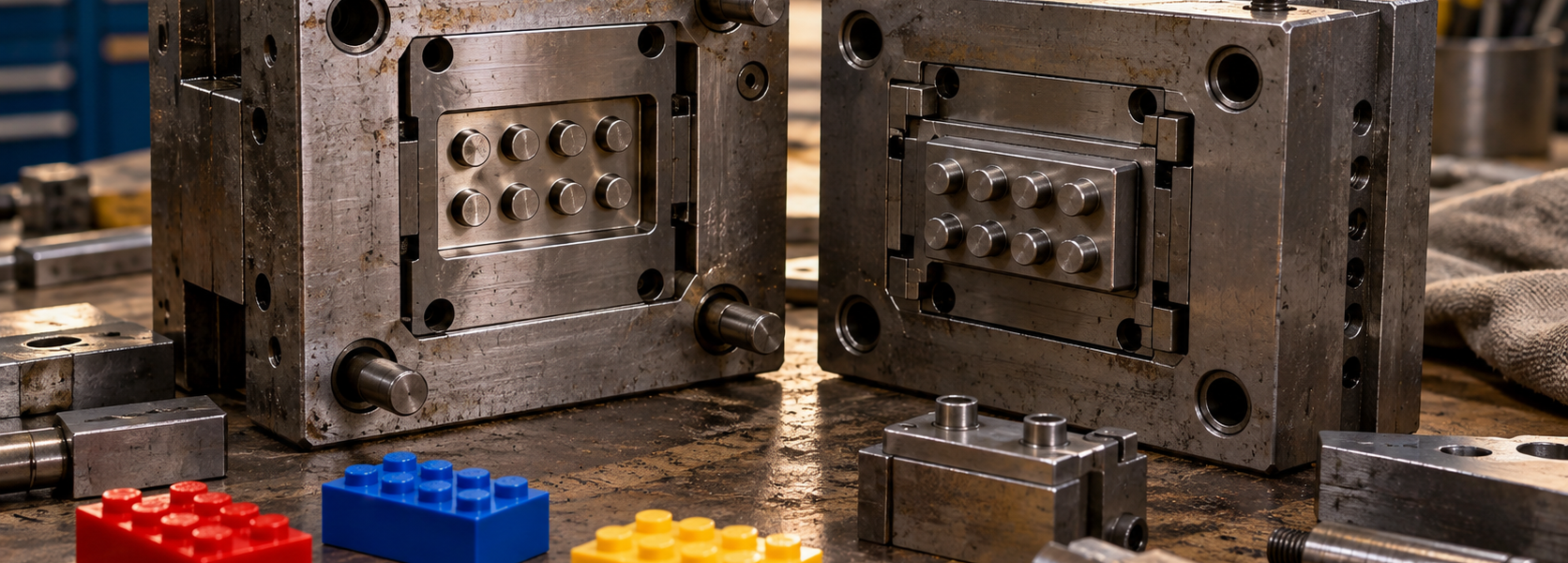

A LEGO injection mold is one of the most critical tools in the entire manufacturing system. It determines the geometry of a part, the repeatability of that geometry across production runs, and ultimately whether a new element will still connect correctly with parts made years earlier.
That is why a mold has a lifecycle of its own. It can be cleaned, serviced, repaired, qualified again and returned to production multiple times before it is finally retired.
LEGO began making its own molds in Billund in 1953
LEGO’s official history says the company began producing its own molds in Billund in 1953. As production grew, specialized departments developed around mold design, qualification, maintenance and repair.
A mold is not simply a negative cavity shaped like a brick. It is a precision industrial tool that has to hold extremely tight tolerances and remain stable through repeated production cycles.
Maintenance comes before retirement
Before a mold is considered obsolete, it may go through many maintenance cycles. LEGO describes dedicated Mold Maintenance and Mold Qualification functions responsible for cleaning, repairing and verifying tooling before it returns to production.
Historical company material states that an average mold could run for roughly four weeks between cleanings, while a full service took around two weeks. Mold Maintenance was responsible for around 18,000 repairs per year.
After repair, a mold has to be qualified again. If it still meets requirements, it can return to production. Retirement comes only when continued use no longer makes sense or the part is no longer required.
Old molds were once buried in building foundations
One of the strangest chapters in LEGO manufacturing history is how obsolete molds were disposed of in earlier decades.
Until around 1980, some outdated molds were embedded in the foundations of LEGO-owned buildings. The purpose was not archival storage. It was a way of permanently taking the tooling out of use.
In 2016, demolition work at an old company headquarters uncovered around 120 former molds. The oldest dated from the early 1950s, while the newest were from the early 1970s.
For decades, those tools had literally become part of the structure of the building.
Later, molds were sent to a foundry
After LEGO stopped using foundations as a disposal method, obsolete tooling was sent to a Danish foundry for destruction.
LEGO’s historical account describes the process as tightly controlled. The driver delivering the molds had to personally confirm that the tools had been destroyed.
The key objective was to make sure retired tooling could not return to circulation or be used again for production.
The retirement process changed again after 2002
In the early 2000s, LEGO modernized the process. After 2002, mold retirement became centrally coordinated from Billund, while the tools themselves were deliberately damaged so their working cavities could no longer be used.
The company describes methods such as burning through or otherwise permanently damaging the molding cavities. The point is straightforward: once the mold is retired, it should no longer be capable of producing a part to the original specification.
Today, physical destruction can take place at individual manufacturing sites, while selection and coordination remain linked to Billund.
Not every component is thrown away
Modern practice also includes dismantling selected molds before final destruction so reusable components can be recovered.
That makes sense from an engineering perspective. A mold is made from many components, and not every part of the tool is unique to the specific brick geometry. Some technical elements can potentially be reused while the critical cavity sections are permanently destroyed.
Why are retired molds so tightly controlled?
LEGO’s official history focuses on the procedure itself rather than reducing the rationale to one slogan. What it does make clear is that the company wants to know exactly when a mold stops existing as functional production tooling.
From a manufacturing-quality perspective, that is significant. The mold defines the geometry of the part, and the geometry determines compatibility, fit and clutch behavior. If old or unqualified tooling were reused outside the controlled process, the resulting parts might not meet the same standards.
That quality-control interpretation is a reasonable inference from the documented disposal process, rather than a direct quoted explanation from LEGO.
Can a retired part ever come back?
Yes, but that does not necessarily mean pulling a decades-old mold out of storage.
If an older element returns to production, it may require new tooling, a recreated mold design, or a fresh qualification process under current manufacturing standards.
That is one reason bringing back a discontinued part can be more involved than simply having the original geometry on file.
A mold has its own lifecycle
The most useful takeaway is that production tooling has a lifecycle separate from the part itself. A mold can work for years, pass through multiple repairs, be cleaned and requalified repeatedly, and eventually be dismantled and destroyed.
Historically, some ended up in foundations. Later, they went to foundries. Today, the process is more systematic and can include recovering reusable components before the critical parts of the tool are permanently retired.
It is an invisible part of LEGO production, but it helps explain the level of control required to maintain a construction system in which billions of elements need to preserve compatible geometry across decades.