
LEGO 6776 Ogel Control Centre: the Alpha Team set changed after September 11

LEGO 6776 Ogel Control Centre is remembered by many fans as one of the defining sets from the original Alpha Team wave. But its most unusual feature is not the volcano base, the missile, or Ogel himself. It is the way the set’s printed story material changed after September 11, 2001.
Contemporary press reports show that LEGO temporarily pulled unsold copies from the US market because illustrations in the instructions and packaging had suddenly become inappropriate in the context of the attacks. Years later, collectors documented multiple instruction variants that preserve different stages of that response.
What was LEGO 6776 Ogel Control Centre?
Released in 2001, 6776 Ogel Control Centre contained 411 pieces according to LEGO’s official instruction archive. The model represented Ogel’s headquarters inside a volcanic island, complete with a missile launch area and the fictional Mind-Control Orbs that drove the story of the first Alpha Team storyline.
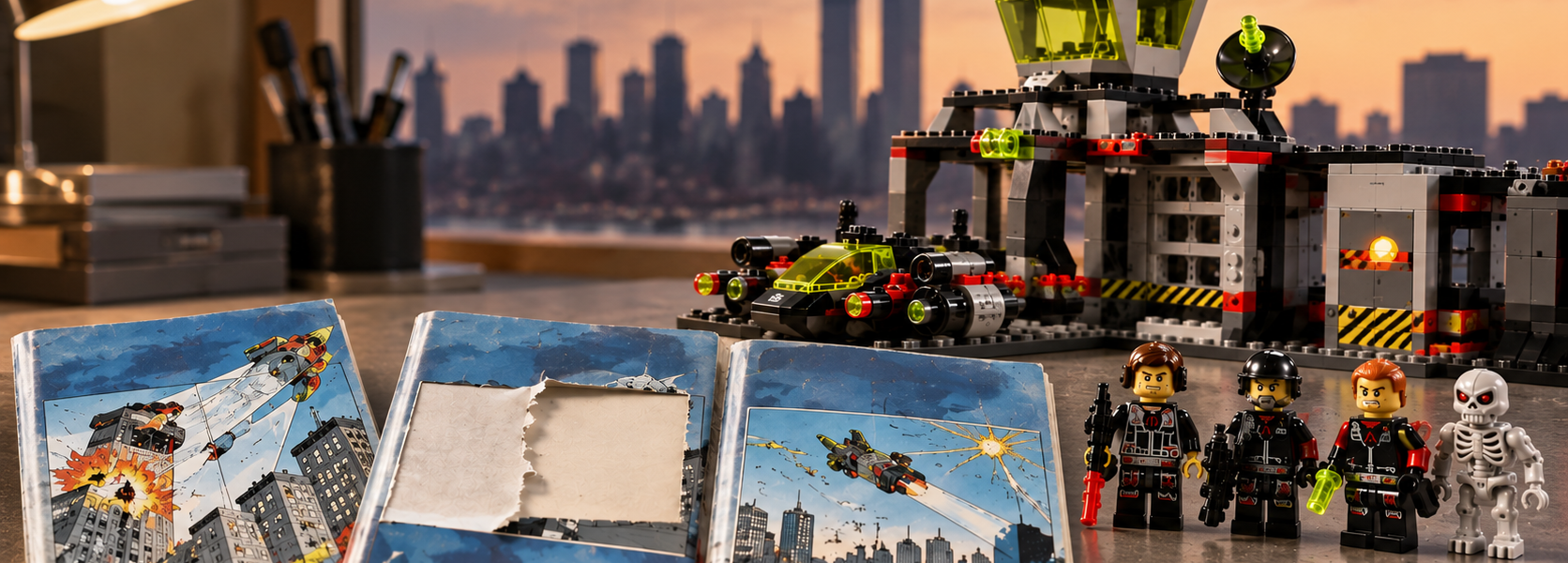
The set included Ogel and two skeletal henchmen, while the instruction booklet also carried a wordless comic. In that story, Ogel prepares a missile loaded with Mind-Control Orbs and launches it toward a city.
The original comic showed an attack on a city
In the first version of the story, the missile reaches an urban area and the orbs are released over civilians. The affected people are transformed into Skeleton Drones under Ogel’s control.
That sequence had originally been created as straightforward villain fiction for a children’s action theme. After the September 11 attacks, however, imagery involving an airborne attack on a city took on a very different meaning.
LEGO temporarily withdrew unsold US stock
In September 2001, LEGO asked US retailers to remove unsold copies of 6776 Ogel Control Centre from sale. Contemporary reporting in The Guardian quoted LEGO spokesperson Eva Lykkegaard saying the material was unacceptable and should not have passed the company’s internal review process.
The set itself was not permanently cancelled. Instead, LEGO revised the material associated with it and later copies reached the market with altered story content.
Collectors have documented three instruction variants
The most interesting part of the story today is that at least three distinct instruction versions have been documented.
The first is the original booklet with the full comic ending, where Ogel’s plan succeeds. The second is a transitional version in which the pages containing the problematic sequence were physically removed. A documented example from The Blocks Collection also shows the back of the box covered by a sticker concealing the related artwork.
The third version contains a newly edited ending. Instead of Ogel completing the attack, Alpha Team agent Dash arrives in the 6773 helicopter and intercepts the missile before it can reach the city.
Why the variants matter to collectors
Production differences in older LEGO sets are usually associated with part substitutions, packaging changes, or minor printing revisions. In this case, the difference reflects a direct response to a major historical event.
That makes the instruction booklet an unusually important part of a complete 6776 Ogel Control Centre. Anyone evaluating a used copy should look beyond the bricks and minifigures and check which version of the instructions is present.
It is important not to overstate the market impact, however. The existence of several variants is documented, but there is not enough reliable sales data to assign a clear rarity ranking or predictable price premium to each version.
Alpha Team was unusually story-driven for its era
The first Alpha Team range relied heavily on narrative. Ogel was not simply a generic villain: he had a base, an army of Skeleton Drones, a specific plan involving Mind-Control Orbs, and a wider storyline connected to the Alpha Team computer game and related material.
That narrative emphasis is exactly why the change to 6776 is so revealing. LEGO was not just changing a decorative illustration. It was rewriting the ending of a product’s story because the real-world context had changed almost overnight.
Twenty-five years later, the paperwork may be the most interesting part
As a model, 6776 remains a distinctive Alpha Team set. As a collectible, though, its instructions now carry a separate layer of historical interest.
The three documented variants show a progression: the original publication, a rapid physical removal of sensitive pages, and a fully revised narrative in which the attack is prevented. Few LEGO sets offer such a visible record of how a company reacted to a sudden shift in public context.
For collectors and theme historians, that makes Ogel Control Centre more than a nostalgic early-2000s villain base. It is also a small piece of LEGO publishing history.