
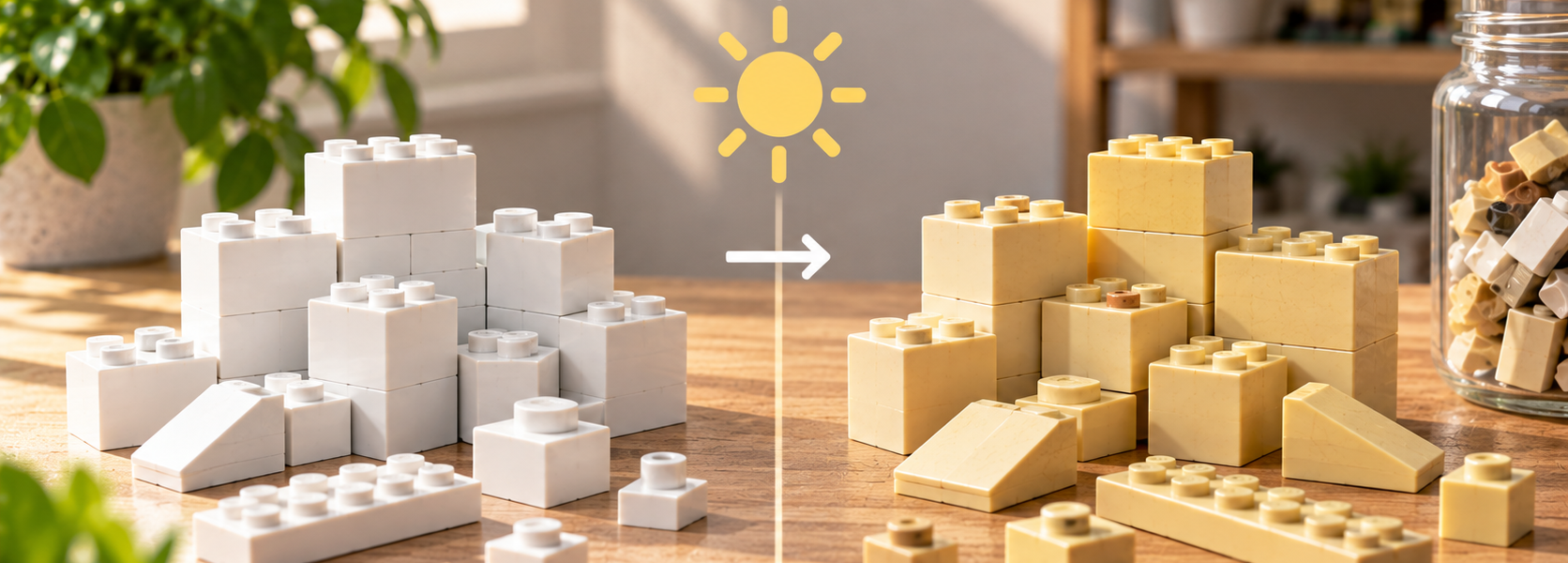

Yellowing is one of the most frustrating long-term issues for LEGO collectors, especially on white and other light-colored elements. The most effective strategy is not trying to reverse the damage later, but reducing the conditions that can accelerate it in the first place.
What LEGO officially recommends
LEGO advises storing bricks in a dry place, away from direct sunlight and heat sources. Its care guidance also warns against temperatures above 40°C, which can lead to discoloration or brittleness over time.
The same principle applies during cleaning: bricks should not be dried in direct sunlight or exposed to high heat.
Why direct sunlight is a problem
Plastics age under light and heat. In practical collecting terms, a model displayed on a sunny windowsill for years is more likely to change appearance than the same model kept deeper inside a room under more stable conditions.
Visible discoloration is often most noticeable on white and light-gray elements, but material aging is not limited to one color.
The simplest protection: avoid direct sun
A display cabinet next to a window can still receive several hours of strong light each day. For long-term display, a wall away from direct sun or an area with indirect light is a safer choice.
Blinds, curtains, and UV-filtering films may reduce exposure, but they should be viewed as added protection rather than a guarantee.
Heat matters as much as light
LEGO’s own guidance gives 40°C as a temperature to avoid. In most homes, normal room temperature is not the issue. Local hot spots are: enclosed cases in strong sun, attics, cars, shelves directly above radiators, and other areas that heat up far beyond the room average.
Humidity, dust and paper materials
LEGO recommends dry storage. Moisture is especially undesirable for sticker sheets, instruction manuals, boxes, metal components, and electronic elements.
Dust does not cause yellowing by itself, but it makes display maintenance more difficult. Enclosed cabinets can reduce dust buildup and therefore reduce how often fragile models need to be handled and cleaned.
Do UV-filtering display cases solve the problem?
They can help, but performance depends on the material and the actual filter specification. No display case should be treated as complete protection from aging.
A more reliable approach combines several measures: no direct sunlight, moderate temperatures, stable indoor conditions, and a reasonably protective case where appropriate.
What about reversing yellowing?
Collector communities often discuss hydrogen-peroxide-based brightening methods. These can change the appearance of discolored parts, but they do not restore the plastic to its original material state, and results can be uneven or temporary.
For that reason, this guide focuses on prevention rather than aggressive restoration treatments.
A practical collector checklist
- Keep models out of direct sunlight.
- Avoid radiators, attics, cars, and other heat-prone locations.
- Store loose parts and collectibles in a dry environment.
- Use enclosed display cases when dust control matters.
- Keep boxes and manuals away from moisture and strong light.
- Clean bricks with mild methods consistent with LEGO guidance.
- Do not dry parts with high heat or direct sun.
The key takeaway
You cannot completely stop plastic from aging, but you can reduce the conditions that accelerate it. For most collections, the biggest improvement comes from choosing a better display location: away from direct sun, away from heat, and in a dry, stable environment.