
How to Tell Whether a LEGO Piece Is Genuine: Markings, Part Numbers and Common Traps

Used LEGO lots can contain pieces from different decades, factories, molds and even different manufacturers. That makes authenticity checks more complicated than the familiar shortcut: “logo present means genuine, no logo means fake.”
BrickLink notes that part markings can vary by production period, factory and mold variation. In other words, the absence of a particular mark, copyright symbol or LEGO wordmark does not automatically prove that a piece is not genuine. A better approach is to look for several consistent signals and compare them with cataloged variants.
1. The LEGO logo is useful, but it is not the only test
Many familiar bricks carry the LEGO wordmark on studs or elsewhere on the molded part. That is an important clue, but it should not be treated as an absolute rule.
BrickLink documents production and mold variations in which markings can differ. Genuine elements may use different arrangements of molded numbers, different wordmark styles or fewer markings than a newer example of the same basic shape.
So if you cannot immediately find a logo, keep checking. Treat that as a reason to investigate further, not as a final verdict.
2. Look for a molded design number
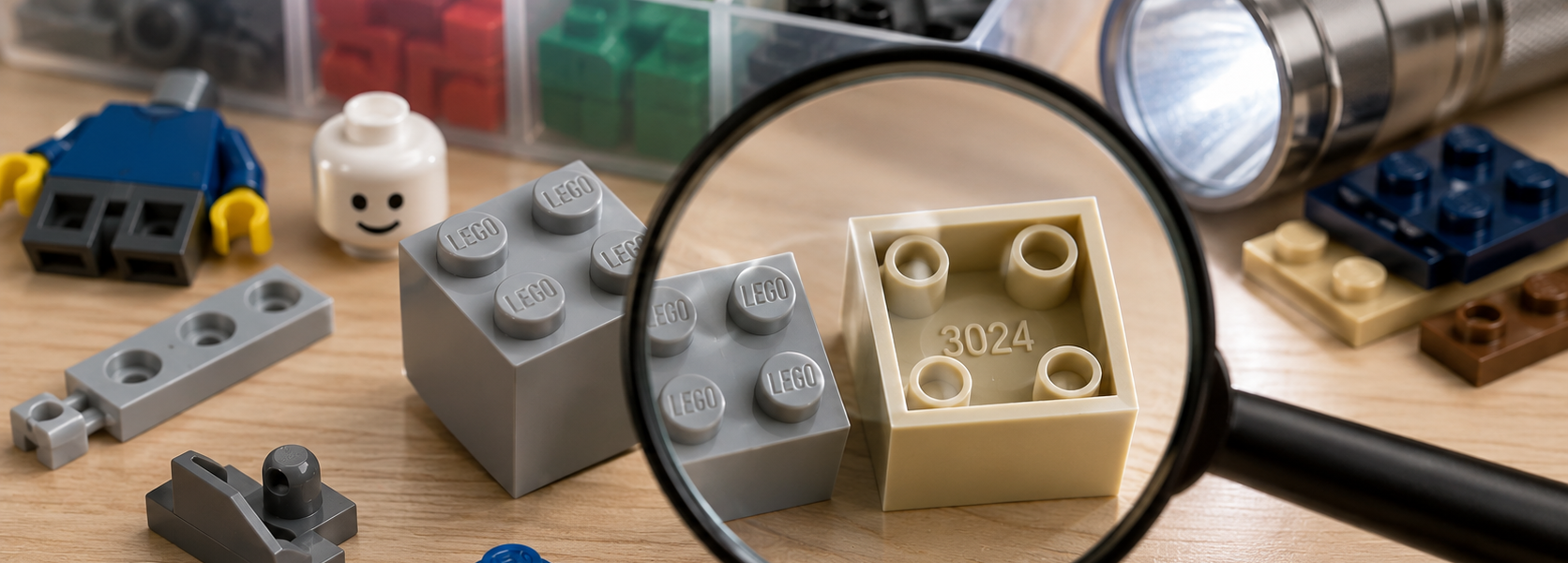
LEGO’s official support information explains that many elements include a small molded design number, often four or five digits, usually on the inside of the part. It can be tiny, so strong side lighting or a magnifier can help.
That number is useful because it points to the underlying part design. Combined with color and shape, it gives you a much better starting point than a visual comparison with a random marketplace photo.
3. Design ID, Element ID and BrickLink item numbers are not the same thing
One of the easiest ways to get confused is to assume every catalog uses one universal numbering system. LEGO distinguishes between identifiers for a design and identifiers for a specific element. BrickLink maintains its own catalog numbering, which may differ from the number molded into the plastic.
In practice, the molded number is best treated as a search clue. It may lead you to the right family of parts without matching every catalog entry character-for-character.
4. Two genuine parts can look different underneath
BrickLink documents mold variations that can differ in internal geometry and markings, including the presence or absence of molded numbers or wordmarks. A functionally identical part can therefore exist in more than one genuine production version.
This is especially important when sorting older bulk lots. Comparing an old element only with one modern image can lead to a false conclusion if the cataloged mold history is ignored.
5. Use a repeatable identification workflow
Instead of searching for a single authenticity trick, use a short sequence:
- Inspect the whole piece under good light and note every visible marking.
- Look for a molded design or mold number.
- Search for the part in LEGO Pick a Brick or the BrickLink catalog.
- Compare color, geometry, ribs, holes, pins and other structural details.
- Check whether more than one mold variant is documented.
- Only then decide whether the part is genuinely inconsistent with known LEGO versions.
The rarer or more valuable the element, the more worthwhile it is to verify it against more than one source.
6. Color, shine and clutch power are supporting clues, not proof
Used parts can vary because of age, wear, sunlight and storage. White pieces can discolor, transparent parts can scratch and heavily used connections can loosen over time.
That means color tone, surface finish or clutch power can raise questions, but none should be presented as a stand-alone authenticity test. These characteristics depend too much on the history of the individual piece.
7. Minifigures and decorated parts require extra care
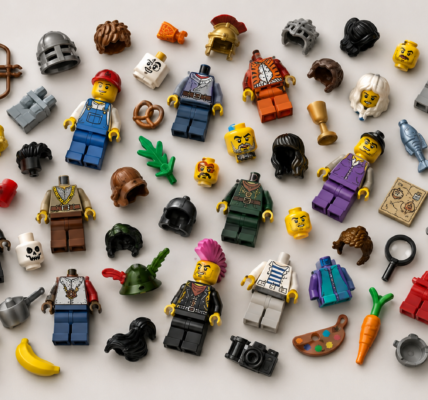
Minifigures are more complex because the torso, legs, head, headgear and accessories can all be identified separately. Printing adds another layer of variation.
BrickLink also uses its own conventions for decorated parts and catalogs many print variants. Do not assume that every printed element will have a simple one-to-one LEGO identifier that maps directly to a single catalog entry.
For higher-value minifigures, compare both the decoration and the underlying part geometry rather than focusing on the print alone.
8. Compatible does not automatically mean counterfeit
Other manufacturers sell bricks that are dimensionally compatible with the LEGO system. A non-LEGO compatible brick is not automatically a counterfeit simply because it fits.
The problem is misrepresentation: a product becomes a much more serious issue when it is presented as an original LEGO element despite not being one, or when it uses branding in a way that falsely suggests LEGO origin. BrickLink’s marketplace policy is clear that items listed as LEGO parts must be genuine and authentic; replicas and counterfeits are not permitted.
9. What should make you look more closely?
One discrepancy is not always enough, but a cluster of mismatches is worth investigating. Be cautious when:
- a molded number points to a completely different shape,
- the markings do not match any documented mold variant,
- the geometry differs clearly from cataloged versions,
- a supposedly factory-printed decoration does not correspond to a known cataloged variant,
- a seller describes a compatible part as original LEGO without evidence of its origin.
Older parts deserve extra caution because production variants are not always obvious from a single modern reference image.
10. How to sort a mixed bulk lot efficiently
If you have several hundred parts, inspecting every common brick under magnification is not practical. A better approach is triage:
- separate minifigures and accessories,
- separate printed and stickered parts,
- set aside unusual, older or potentially valuable shapes,
- set aside parts with unexpected material, color or markings,
- verify that smaller group in detail.
Common basic bricks can be spot-checked. In a mixed lot, efficient filtering is usually more useful than trying to prove the origin of every single piece individually.
A practical rule to remember
The best question is not “Can I see a LEGO logo?” but “Do the markings, molded number, geometry and known mold variants all make sense together?”
When several independent details match a documented LEGO part, you have a much stronger identification. When something does not fit, check the mold history and catalog record before labeling the piece a counterfeit.