
Why Do LEGO Sets Include Extra Pieces — and Why Are They Usually Tiny?

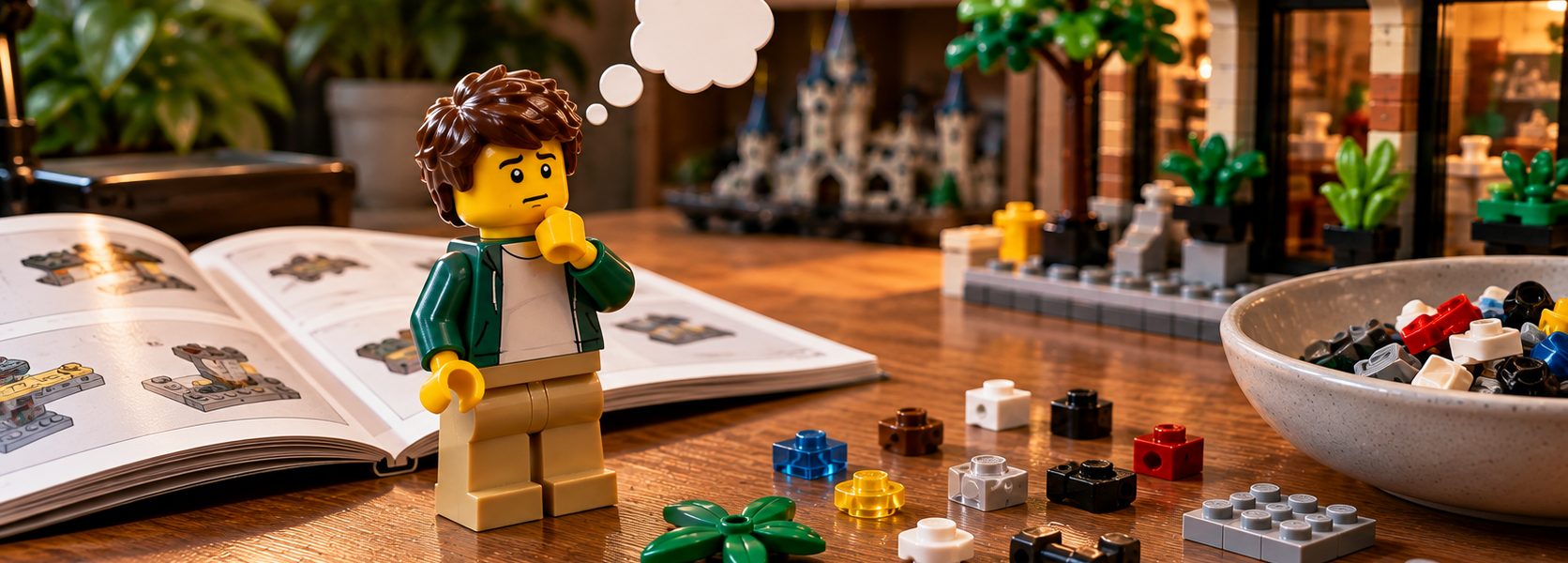
Finish a LEGO set and there is often one tiny piece left on the table. A 1×1 plate, a small tile, a Technic pin, or a minifigure accessory can immediately make you wonder whether you missed a step.
Very often, you did not. LEGO sets can include small spare elements that are not required to complete the model. BrickLink separates these from the regular inventory and lists them as Extra Items.
What counts as an Extra Item?
BrickLink treats Extra Items as parts found in new sealed copies of a set but not required for the actual build. The catalog does not simply assume that every leftover piece is a spare. According to BrickLink’s documentation, an extra part is added to the inventory only after it has been confirmed in at least two new copies of the same set.
That distinction matters because an unused piece on your desk can mean two very different things: a genuine spare, or a step you accidentally skipped.
Why are the extras usually tiny?
Small elements are the most difficult parts to control through packaging by weight. A missing large panel creates an obvious difference. A tiny plate, pin or accessory may fall within a much narrower weight margin.
This is not a new production problem. LEGO’s own historical material describes major packaging-accuracy issues in the late 1970s. Research at the time suggested that close to half of sets could contain too many or too few parts, and small elements were particularly difficult for weight-based checks to catch reliably.
One response was the development of pre-pack bags: smaller groups of parts prepared and counted before they were placed into the final box. Separating small and large pieces and improving counting systems made set packing much more reliable.
Do all copies of the same set include the same extras?
Not necessarily. BrickLink notes that Extra Items can vary depending on where and when a set was produced. Two sealed copies of the same set number may contain slightly different spare parts or different quantities of them.
That means Extra Items are not always a fixed part of a set specification in the same way as the pieces required by the instructions.
When should a leftover piece make you check the instructions?
One small element after a build is usually not alarming. A larger structural part, several identical unused pieces, or something that clearly looks essential to the model deserves a second look.
Typical extras tend to be small: 1×1 elements, clips, pins, tiny accessories and similar lightweight pieces. If you are left with a large Technic beam, wheel, panel or major structural component, it is worth going back through the final building steps.
Do spare parts matter when buying a used complete set?
This is useful for collectors and second-hand buyers. BrickLink’s definition of a complete used set focuses on the parts required to build the model. Spare Extra Items are not required for a used set to be considered complete.
So if a seller is missing one typical spare 1×1 piece, that does not automatically make the set incomplete. A missing element that is actually used in the instructions is a different matter.
Packaging is still changing
The underlying packing system has continued to evolve. LEGO is currently transitioning from plastic pre-pack bags to paper-based ones, with the global change expected to be completed by 2027.
For builders, however, the practical experience remains familiar: sets are divided into staged bags, and the smallest elements are still the pieces most likely to appear as extras.
What should you do if something is left over?
A useful rule of thumb is simple:
- one tiny leftover piece is often a genuine spare,
- a larger unused element deserves a quick instruction check,
- several identical leftovers are worth investigating,
- if in doubt, compare the set inventory on BrickLink or Brickset.
In other words, that tiny piece sitting on the table after the final step is often not evidence of a mistake. It may simply be there because the set was packed with a little margin for the smallest, easiest-to-miss parts.