
Seven Vintage LEGO Boxes Found: What Their 1950s Packaging Reveals

Finding one LEGO box from the 1950s would be unusual enough. Finding seven, along with loose bricks and old promotional leaflets, raises a more interesting question than ‘How much is it worth?’: what can the boxes themselves tell us about the first decade of plastic LEGO?
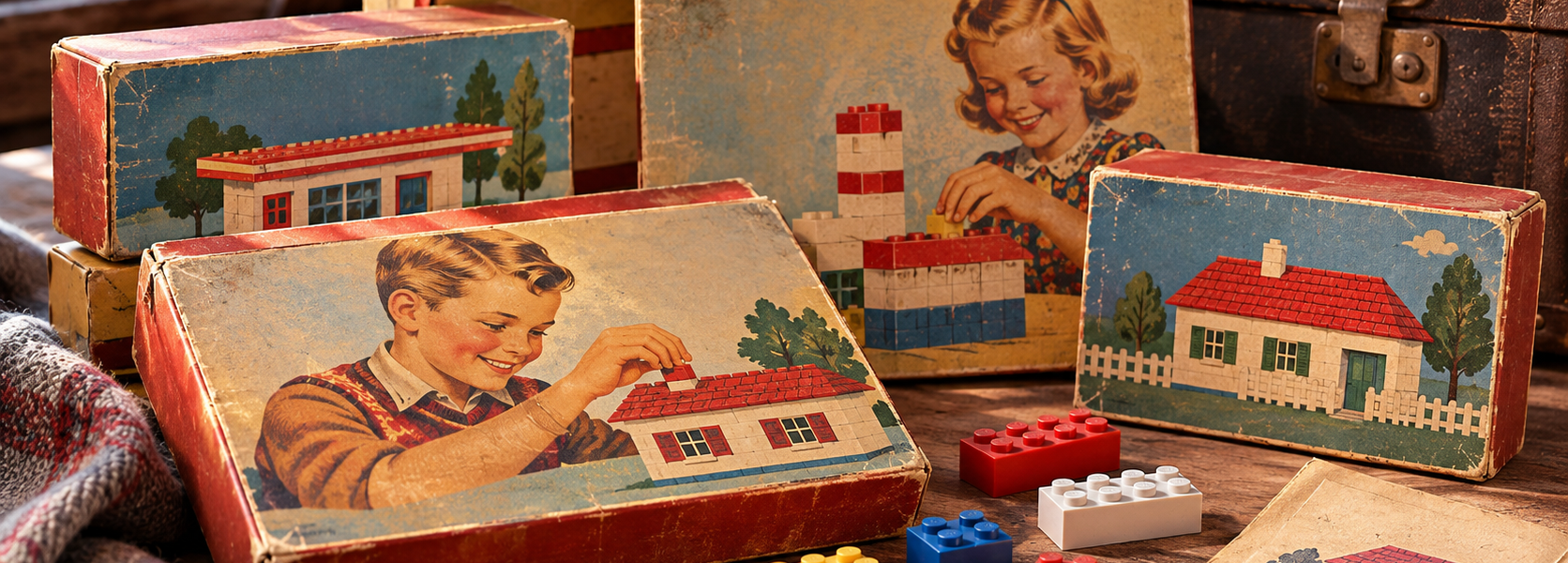
On 25 October 2026, a user of the r/lego community shared photographs and a list of vintage sets recovered from belongings associated with a former family holiday home. Three boxes carried the number 700/4, but not all had the same branding. Other reported markings included 700/6, possibly 210 and 1210, and one still-unidentified LEGO Mursten box. Together, these details provide a useful window into the period when the LEGO Group was establishing its System in Play and expanding through European markets.
There are limits to what we can establish from a social-media post. We have not examined the contents in person, authenticated any box or confirmed a sale. The following analysis combines the discoverer’s own account with the LEGO Group Archives, BrickLink’s historical catalogue and specialist research into packaging variations.
What was actually found—not seven different designs
The discoverer identified seven boxed items, plus additional bricks and numerous flyers. Their own list is more specific than headlines describing a generic collection of rare 1950s LEGO:
| Marking reported on the box | Boxes | Identification status |
|---|---|---|
| 700/4 — LEGO System | 2 | Number reported; packaging edition not established |
| 700/4 — LEGO Mursten, System i leg | 1 | Same number family, different printed branding |
| 700/6 — LEGO System | 1 | Number reported; precise edition unverified |
| 210 (K?) — LEGO System | 1 | Finder uncertain about the complete number |
| 1210 (K or 5?) — LEGO Mursten, System i leg | 1 | Finder uncertain about the extra character |
| LEGO Mursten, System i leg — number unknown | 1 | Insufficient information for a set identification |
The total is seven physical boxes, but three are from the 700/4 family; it is not evidence of seven distinct sets or seven uniquely rare releases. The poster described most sets as complete and some as almost complete, without supplying independently checked piece-by-piece inventories. For vintage collecting, that distinction matters.
The location also needs care. In a comment, the poster explained that their parents had previously owned a holiday home, which was sold after the parents separated. Their father recalled having old LEGO stored among belongings from that period, and the family subsequently went through those stored items. That is different from saying the boxes had just been discovered inside a holiday rental or an abandoned house.
The most revealing detail: three 700/4 boxes, two branding styles
The LEGO Group Archives entry for 700/4 identifies a LEGO Mursten edition launched in 1952, with that particular entry ending in 1958. Its notes also describe the longer history of the 700-series family and a succession of product names: Automatic Binding Bricks, LEGO Mursten and, later, LEGO bricks. The same archive includes other entries under 700/4, illustrating why a set number alone may not settle the question of a box’s age.
That makes the reported contrast intriguing. Two discovered 700/4 boxes say LEGO System; another uses LEGO Mursten, System i leg. The different markings are evidence of a packaging distinction, not by themselves proof that one specimen was produced a fixed number of years before another. Exact dating would require clearer views of every panel, printed details, and a comparison with documented regional editions.
Even the archive’s launch year cannot identify the manufacturing date of a particular box. It tells us when a catalogued product or edition entered the range—not when this specific cardboard package left the factory.
Why language and country matter to early LEGO packaging
Mursten is Danish for building bricks in this product context, while System i leg refers to a system in play. The distinction between local-language branding and the more universal LEGO System name reflects an important period of European expansion.
In a Brickset historical study, LEGO packaging researcher Gary Istok describes how local-language boxes became increasingly difficult to manage as sales expanded beyond Denmark, Norway and Sweden. Germany joined in 1956, followed by additional European markets in 1957 and later years. Several markets adopted standard LEGO System packaging during 1957–1959, while Denmark retained local System i leg designs until a broader change in 1960.
As a result, the same broad set family might appear with differing lid text, language and artwork. Some packaging changes reflect market distribution rather than a wholly different model. The label can therefore help narrow possibilities, but assigning the rediscovered 700/4 boxes to specific countries would still require additional evidence, such as side-panel text, retailer markings or accompanying printed material.
This is also why a collector should resist treating every 1950s box in the same numerical family as interchangeable. Two packages may be equally authentic yet document different periods or markets.
700/6: another early number with a longer history than one date
The reported 700/6 LEGO System box belongs to another well-documented family. The LEGO Group Archives records the LEGO Mursten edition as launched in 1953 and notes the gift set designation from 1954. Like 700/4, the catalogue entry has its own date range, while the archival notes discuss the wider family’s continued presence under changing names.
It would therefore be a mistake to label the photographed LEGO System example ‘made in 1953’ solely because the earliest related catalogue entry starts in that year. The more useful question is which lid design, box dimensions and included elements correspond to the photographed package. Without that comparison, the exact edition remains open.
1210 and 210: when similar sets appear under different numbers
The discoverer’s tentative readings 1210 (K or 5?) and 210 (K?) introduce a second identification challenge: historically related sets could be listed under different numbers.
The LEGO Group Archives records product 1210 as a House, 6 × 8 studs introduced in 1955. Its notes state that the item was described as a Shop (Forretning) as of February 1958. BrickLink, meanwhile, lists 1210-2 Small Store Set with a 1955 release year, adding that it was sold only in Denmark, Norway and Sweden.
A separate BrickLink entry for 210-2 dates that Small Store Set to 1958 and cross-references 1210-2 as a similar set with a different number. ‘Similar’ is the important word: this catalogue relationship does not authenticate the markings on the newly found boxes, prove that their contents are identical or establish their production years.
For a proper assessment, a collector would compare the box printing, printed signage bricks, instructions and each inventory against the exact regional release. Where a letter or suffix is hard to read, the correct response is to record the uncertainty rather than invent a definitive identification.
Why the old flyers could matter as much as the bricks
The Reddit post mentions a large quantity of old flyers. That may be one of the most informative parts of the discovery. Advertising inserts, illustrated building suggestions and local-language printed materials can help connect a box to a market, an era or a specific product line. They may also document the way the LEGO Group introduced its evolving system to customers.
The LEGO Group’s account of System in Play explains how the concept took shape in the mid-1950s and was formally presented in 1955. Products were intended to work together rather than function as isolated, single-purpose toys. Packaging and promotional materials helped communicate that idea.
Nothing in the available Reddit evidence proves that each flyer originally came from the box beside it. But keeping those papers with the rest of the find, photographing them separately and recording any dates or retailer details could preserve clues that might otherwise be lost.
Before and after the 1958 brick patent
These early LEGO products also sit near a major technical milestone. The LEGO Group introduced its first plastic Automatic Binding Bricks in 1949. On 28 January 1958, the company filed a Danish patent for the stud-and-tube coupling principle associated with modern LEGO bricks. The LEGO history archive explains how the change addressed problems with the stability of earlier hollow bricks.
For someone examining a 1950s collection, the underside and moulding details of the bricks may therefore offer additional context. However, finding a later brick inside an older box does not automatically mean the box is fake: families could mix pieces and add to their sets over time. It does mean the box’s contents cannot be described as fully original without a careful inventory and period comparison.
The $1,500 figure is an offer, not an appraisal
The discoverer said in the Reddit comments that a private buyer had offered the equivalent of roughly US$1,500, converted from Danish kroner for an English-language discussion. At the time of the comment, the interested buyer had not yet seen the inside of the boxes. The poster also mentioned possibly using an auction, depending on further enquiries.
That information should not be rewritten as a confirmed $1,500 sale, a professional appraisal or an established market value. We found no documented completed sale or verified transaction in the cited discussion. Nor is there confirmation that the LEGO Group or a museum acquired the collection; comments recommending such an approach are suggestions, not an outcome.
Any responsible valuation would need to establish the exact edition of each box, original contents, condition, paperwork, possible replacement parts and actual comparable sales. A private offer can indicate interest, but it does not put a dependable price on all seven boxes.
A preservation-first checklist for a similar find
- Photograph every box individually. Capture the front, sides, base, corners, seals and small lettering before moving or cleaning anything.
- Keep the contents separate. Preserve the relationship between each box, its bricks and any loose paperwork. Do not merge seven assortments into one storage container.
- Record numbers exactly, including doubts. A partially legible 210 or 1210 suffix is an identification question, not a reason to fill in missing characters from memory.
- Compare archives and regional catalogues. Use LEGO Group Archives for product history, BrickLink for set relationships and specialist packaging research for language and country variations.
- Check physical details before calling a set complete. Look for substituted bricks, later moulds, missing signage, altered packaging and papers that may have been added after purchase.
- Avoid amateur restoration of fragile cardboard. Adhesives, aggressive cleaning and handwritten labels can remove evidence or damage original finishes.
- Seek a specialist assessment before accepting a single offer. A knowledgeable vintage LEGO collector or toy auction specialist can help distinguish documented rarity from speculation.
What makes this discovery historically interesting?
The attraction is not simply that the boxes are old. Their mix of LEGO Mursten and LEGO System branding captures a period when a Danish toy business was finding a consistent product language for a growing European market. The possible link between 1210 and 210 shows how regional numbering complicates identification, while the original paper material may preserve clues that ordinary loose bricks cannot.
Until detailed photographs and inventories are available, several questions must remain open. But the collection already illustrates a lasting lesson for vintage LEGO research: the number on a box identifies a starting point, not the whole history of the object.
Sources and further reading
- Reddit / r/lego — the discoverer’s original post and comments, 25 October 2026.
- LEGO Group Archives — 700/4 LEGO Mursten.
- LEGO Group Archives — 700/6 LEGO Mursten.
- LEGO Group Archives — product 1210, House / Shop.
- BrickLink — 1210-2 Small Store Set and 210-2 Small Store Set.
- Brickset — Gary Istok, LEGO Box Variations by Country: Part 1 (2014).
- LEGO Group History — LEGO System in Play.
- LEGO Group History — The Stud and Tube Principle.
- LEGO Group Archives — Overview of Plastic Products 1949–1958.