
Exodia Won LEGO Ideas. What Does That Say About Testing New Licenses?

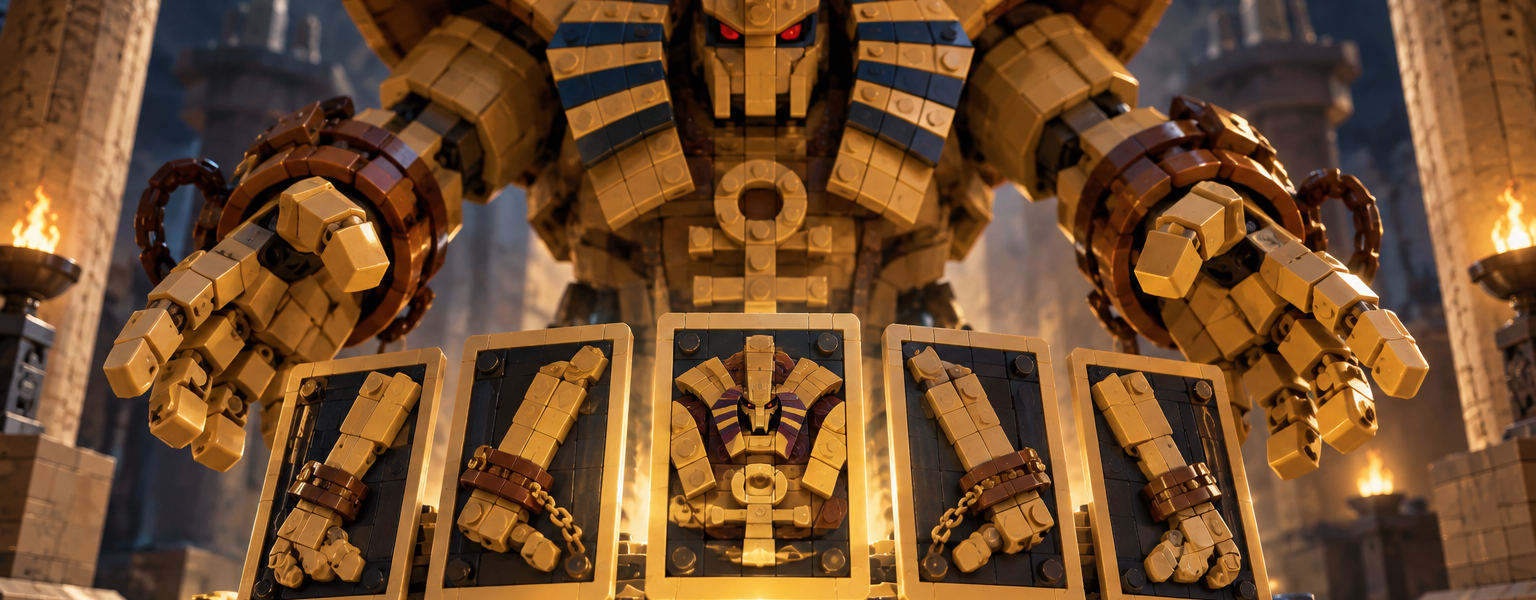
The Heart of the Cards – Exodia has been selected as the winner of the LEGO Ideas Yu-Gi-Oh! challenge, putting Exodia on track to become the first official LEGO set based on the franchise.
The result is noteworthy on its own, but the more useful question is what the challenge process reveals about how a new licensed theme can be tested before a full product strategy exists.
The finalist lineup represented several different ways to translate Yu-Gi-Oh! into LEGO form: iconic monsters, characters, battle equipment and display-focused models. That made the challenge more than a popularity contest. It became a controlled comparison between several possible product directions.
Exodia was not the most obvious mass-market choice
Yu-Gi-Oh! has several icons that are arguably more immediately recognizable to a broad audience. Blue-Eyes White Dragon is one of the franchise’s defining monsters, while Dark Magician is closely tied to Yugi and the original anime era.
Exodia won instead, and that choice is interesting because its appeal is not based on appearance alone. Exodia is tied to one of the most memorable mechanics and story beats in Yu-Gi-Oh!: the five-card combination that produces an automatic win.
That concept also translates naturally into a building medium. Exodia is literally associated with assembling a complete whole from separate pieces, which gives the model an unusually strong conceptual fit with LEGO.
A challenge is very different from the standard 10K review process
The regular LEGO Ideas pipeline is open-ended. A project reaches 10,000 supporters, enters review, and is then assessed for feasibility, market fit, licensing and portfolio overlap.
A themed challenge works differently. The franchise is already defined, the licensing partner is already part of the process, and all entries compete inside the same commercial and creative sandbox.
That produces a different kind of signal. LEGO does not need to ask whether there is interest in Yu-Gi-Oh! in general. It can instead ask: which part of Yu-Gi-Oh! creates the strongest product response?
The finalists represented different product strategies
The finalist pool included concepts linked to Blue-Eyes White Dragon, Dark Magician, the Duel Disk and Exodia.
Those choices map neatly onto different product directions:
- Blue-Eyes White Dragon — a creature-led display model built around one of the franchise’s most recognizable icons,
- Dark Magician — a character-led collectible with strong narrative identity,
- Duel Disk — a prop-style build tied directly to the act of dueling,
- Exodia — a mythic display piece built around one of the franchise’s most famous mechanics.
In practical terms, the challenge gave LEGO and Konami more than a ranked list of fan projects. It also gave them a comparison between several distinct product archetypes.
Why Exodia may be a strong first product
A first release for a new license has to do several things at once. It needs enough recognition to satisfy established fans, but it also needs to work as a standalone LEGO product without requiring a wider product line around it.
Exodia has several advantages in that context. It is visually distinctive, works naturally as a display model, and can carry the entire product concept on its own.
That makes it a relatively self-contained entry point into the franchise. LEGO does not need to establish multiple characters, locations or play systems before the model can make sense.
This is editorial interpretation, not an official strategy statement. LEGO has not said that Exodia was selected specifically because it is the safest possible way to open a Yu-Gi-Oh! range.
Fan voting reduces one kind of licensing risk
Launching any new licensed theme carries uncertainty. A famous franchise does not automatically guarantee that every character or object translates into a strong LEGO product.
A challenge helps reduce part of that uncertainty. Fans generate the concepts, the community reacts to them, and LEGO can observe where attention concentrates before committing to the final release.
That does not replace conventional market research. LEGO still has to evaluate price point, construction complexity, part availability, licensing requirements and fit within the wider portfolio. But fan participation adds a useful qualitative signal: it shows which symbols of the franchise generate the strongest enthusiasm among the most engaged audience.
The first set also tests Yu-Gi-Oh! as a LEGO category
The first Yu-Gi-Oh! set will matter for more than its own sales. It will also provide a first real indication of how the franchise performs in LEGO form.
Strong demand could make further experiments easier to justify. Weak performance would not automatically end the relationship, but it could affect how cautiously LEGO approaches future products.
There is currently no official confirmation that Blue-Eyes White Dragon, Dark Magician, Duel Disk or any other finalist will receive a set. The only safe conclusion is that Exodia has been selected as the first product.
Why this model could appeal to other licensed brands
The Yu-Gi-Oh! challenge shows why LEGO Ideas can be useful as more than a source of standalone fan designs.
For a franchise with a large and highly engaged community, a challenge can:
- generate several product concepts at once,
- show which icons matter most to fans,
- compare different product formats inside one license,
- and build awareness well before the final product reaches stores.
That does not mean every future license will launch this way. But for fandom-driven brands, the model is unusually efficient because it combines product ideation, community engagement and demand signaling in one process.
Exodia is more than the winner of a contest
The broader takeaway from the Yu-Gi-Oh! challenge is not simply that one fan project beat the others.
It is that LEGO Ideas can function as a testing ground for the shape of a new licensed product. Instead of asking only whether fans want Yu-Gi-Oh!, the challenge asks which part of Yu-Gi-Oh! they want first—and in what form.
If that is the right way to read the process, Exodia is both a product and an experiment. Its eventual performance could tell LEGO and Konami far more than the final vote count alone.