
LEGO Minifigure Head Variants: How to Identify 3626a, 3626b, 3626c and 28621

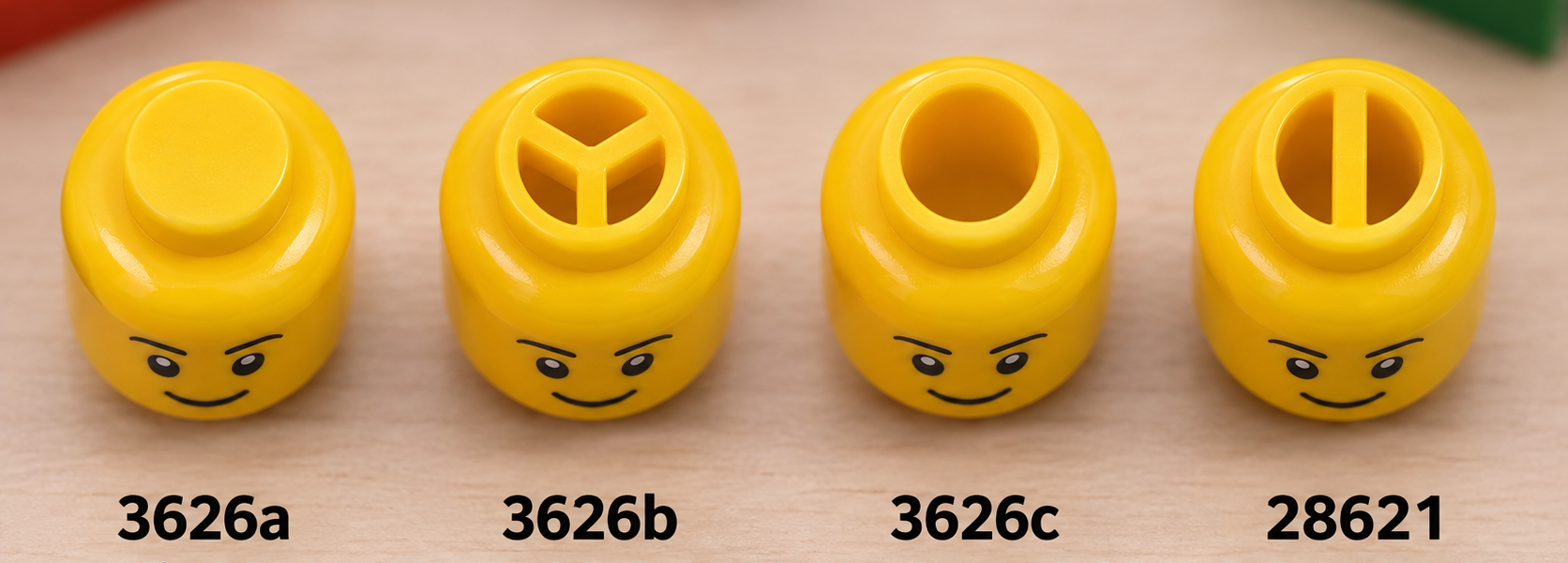
Two LEGO minifigure heads can have the same colour, size and facial expression, yet reveal different moulds when you remove the hair or helmet. One has a solid stud. Another has three tiny openings. A third has a hollow stud, while a fourth is divided by a bar into two vents. For everyday building, those distinctions may scarcely matter. For someone restoring a vintage minifigure or buying a precisely matching replacement, they can be the detail worth checking.
Collectors commonly identify these four shapes as 3626a, 3626b, 3626c and 28621. They form a useful case study in how a familiar LEGO component has changed—and how the databases used to buy and catalogue it have changed too. Importantly, these are not four neatly separated production eras. Their catalogue date ranges overlap, and the same set number or facial print is not, by itself, proof of an individual head’s mould.
Identify the stud first: a four-shape reference
Place the head upright with the top stud facing you, under good light. The distinction is inside the circular stud rather than in the face print. The names below follow the familiar Rebrickable terminology also documented by Brick Architect.
| Common part reference | Stud designation | What to look for from above | Historical context |
|---|---|---|---|
| 3626a | Solid Stud | A closed, solid top stud without an opening | Catalogued from 1975 to 1987 |
| 3626b | Blocked Open Stud | Three openings separated by a roughly Y-shaped divider | Introduced around 1987; listed through about 2016 in a historical overview |
| 3626c | Hollow Stud | One relatively large circular opening | Documented from approximately 2008 |
| 28621 | Vented Stud — 2 Holes | Two openings divided by a thick I-shaped bar | A later variant; the precise production debut should not be inferred from a single database year |
BrickNerd gives the broad chronology above, while BrickLink separately lists the plain solid-stud 3626a as appearing in sets from 1975–1987. Those are catalogue associations, not a complete factory timeline. Some variants overlapped in use, and a particular minifigure could have had its head replaced after purchase.
The part-number trap: BrickLink and Rebrickable do not catalogue these heads the same way
This is the most important point for anyone shopping for a replacement. A search for 3626b, 3626c or 28621 does not necessarily lead to three separate purchasing categories on today’s BrickLink.
In early 2024, BrickLink announced a broad consolidation of mould variants. Changes affecting vented studs included the tops of minifigure heads. Its current plain minifigure head listing, 3626, includes 3626b, 3626c and 28621 as alternate numbers. The notes describe the Y-shaped opening, hollow stud, thick I-shaped divider, and other less common details. The older solid-stud 3626a remains a distinct catalogue entry.
By contrast, Brick Architect’s head reference links to separate Rebrickable names for all four forms: 3626a Solid Stud, 3626b Blocked Open Stud, 3626c Hollow Stud, and 28621 Vented Stud – 2 Holes. The same page demonstrates that LEGO’s own Pick a Brick naming and design IDs can differ again.
Neither approach makes the physical variations disappear. But a merged marketplace listing means the title alone may not guarantee which stud mould a seller will supply. An accurately described 3626 can be right for a build and still be the wrong version for a historically exact restoration. Sellers may specify the mould in their own notes; where they do not, ask.
Why the original 3626a matters to vintage collectors
The plain solid-stud head appeared with LEGO’s early static figures in 1975, before the articulated minifigure introduced in 1978. Its closed stud is easy to recognise once the headwear is removed. BrickLink’s historical catalogue associates the unprinted form with sets released between 1975 and 1987.
For a collector recreating an early display or evaluating a figure assembled from spare parts, the solid stud can be one piece of supporting evidence. It is not an authentication shortcut. Correct colour and facial printing, the appropriate torso and accessories, and the provenance of the complete figure still matter. A vintage-looking head may have been swapped, and an older figure can contain replacement parts.
One practical habit is to keep a note of both the set or minifigure reference and the observed mould. Recording only ‘yellow head’ or ‘part 3626’ loses information that may become important later.
The three-opening 3626b and hollow 3626c did not form a clean handover
The 3626b version changed the solid stud into an opening divided by a Y-shaped structure. BrickNerd places its introduction around 1987 and describes its use lasting to approximately 2016.
The later 3626c uses a simpler hollow opening, without that internal Y. BrickNerd dates it from about 2008. That creates a period when the historical ranges overlap. It would be misleading to label every 2009 head as 3626c or every 2010 head as 3626b based solely on the year printed in a set database.
The lesson is straightforward: identify the actual mould in the part you have. Year ranges make useful starting points, but production changes need not have occurred simultaneously across all colours, prints, sets and manufacturing batches. The public catalogue does not establish an exact changeover date for every version.
28621: why a two-hole stud is not just a transparent head
The 28621 has a thick, approximately I-shaped divider that leaves two openings in its top stud. It is often associated with transparent heads, but that association is not an exclusive rule.
In October 2023, New Elementary documented numerous plain 28621 Vented Stud – 2 Holes heads on LEGO Pick a Brick, including opaque examples in tan, light aqua and dark turquoise. Those listings are useful independent evidence that the mould has appeared in opaque colours, not only transparent ones. They do not establish that the same variants remain available to order today.
What about the date 2013 sometimes assigned to 28621? BrickNerd uses that year in its overview, but it should be read as a catalogue-era reference rather than definitive proof of the first manufacturing run. Retrospective inventory updates and overlapping variants complicate first-appearance claims. Unless a particular release can be documented more precisely, it is safer to say that 28621 is a later form whose exact introduction is uncertain.
Why add holes to a minifigure head at all?
There is a documented safety explanation. In 2013, Fast Company quoted an earlier LEGO response reported by Gizmodo: the top opening was intended to allow airflow if a head became lodged in a child’s throat.
That explains the general purpose given for an opening, but it does not prove a separate engineering rationale for every later geometry—the Y-shaped divider, completely hollow stud, or two-hole version. Nor does it mean that a small LEGO head is safe to swallow. Small parts remain a choking hazard, and the presence of a vent cannot guarantee a safe outcome.
It is an illuminating example of a design detail that may be almost invisible in an assembled figure while still being important to its development.
How to buy the correct mould on an international marketplace
Before paying extra for an older head or ordering a part from another country, use this inspection process:
- Start with the set and minifigure identification. Find the exact model or figure in a reliable inventory. Note the release period, expected head colour and facial print before searching by mould code.
- Compare catalogue systems. Use Rebrickable’s more specific variant names, Brick Architect’s cross-reference and BrickLink’s current listing notes. Do not assume a number means exactly the same thing in every database.
- Request a top-down photo of the actual part. The stud geometry should be visible without hair, helmet or other headwear. A stock image of the front of the face cannot distinguish the four moulds.
- Check the face print and physical condition independently. A correct top stud does not compensate for the wrong expression, colour, worn printing, cracks or teeth marks.
- Ask whether the listing promises a specific mould. If a BrickLink seller offers only the merged 3626 entry, explain whether you need a solid, Y-divided, hollow or two-hole stud. Written confirmation helps prevent misunderstandings.
- Document your restoration. Save photographs of the head from the front and top, its catalogue references, and the seller’s description. This makes later provenance questions easier to resolve.
- Consider the delivered cost and uncertainty. Shipping, import charges, seller location and condition can matter more than a small difference in listed part price. Do not treat an unverified mould as a guaranteed collector-grade match.
For example, suppose an online listing offers a ‘vintage yellow LEGO head’ with a familiar smile but shows only the face. It might be right for a casual build. If you need a 3626a for a particular mid-1980s restoration, however, the missing top view is an unanswered question. Ask for it before ordering rather than making a confident guess from the seller’s use of the word ‘vintage’.
There are more details than these four labels suggest
These four forms offer an accessible introduction, not the full universe of mould differences. BrickLink’s 3626 notes also mention a hollow stud with a centre hole, a possibly rare thin I-shaped divider, and a shorter-stud variant associated with alternate number 88475. Collectors working at a high level of historical accuracy may need to investigate these extra details separately.
This also explains why cataloguing decisions provoke debate. A unified part number makes ordinary shopping and wanted lists simpler, while a detailed mould record preserves information useful for restoration and research. The best approach is to use both: a broad catalogue entry to locate a part, and a physical description or separate variant database to confirm what will arrive.
A small design change with a long collector history
The LEGO minifigure head retains its recognisable silhouette through decades of changes in prints, colours and characters. Its stud tells a quieter story. A solid top became an opening with internal supports, then a hollow form; a later vented version introduced a different divider. Those variants overlap in the historical record, and marketplaces do not always give them separate listings.
For collectors, the useful conclusion is not that one of these four moulds is automatically rarer or more valuable. It is that the right part depends on what you are trying to preserve. A casual custom figure may only need the correct look. A documented restoration may require the correct mould, print, colour and condition. Turning a head upward is a small step that can make the difference between the two.
Sources and reference material
- BrickLink — Minifigure Head (Plain), Solid Stud 3626a, including the 1975–1987 catalogue range.
- BrickLink — Minifigure Head (Plain) 3626, alternate numbers and mould notes.
- Brick Architect — Minifigure Head 3626, cross-references to Rebrickable, BrickLink and LEGO part naming.
- BrickNerd — LEGO Minifigure Skin Tones Over Time, including the head-mould chronology.
- New Elementary — Elements Exclusive to LEGO Pick a Brick, October 2023, documented 28621 colour variants.
- Fast Company — Why LEGO Minifigures Have a Hole in Their Heads, reporting LEGO’s explanation.
- Brick Fanatics — BrickLink’s 2024 mould-variant listing changes.