
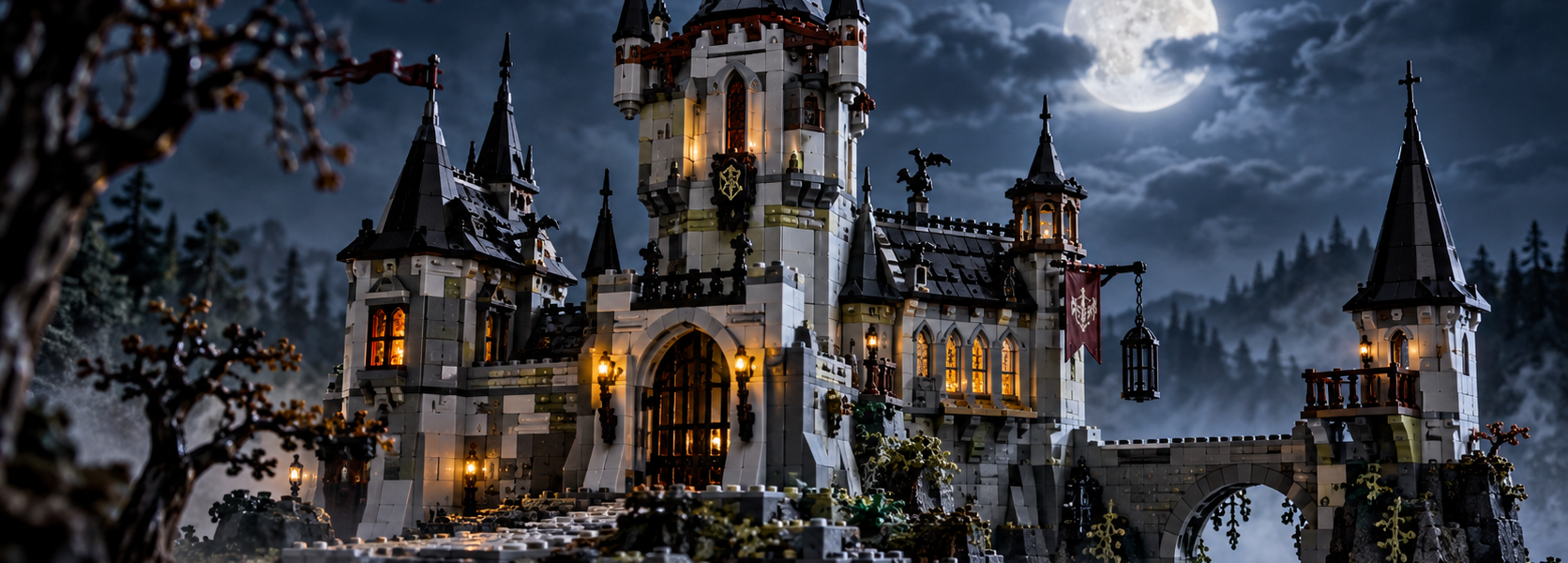
How LEGO Monster Fighters Was Created: The Vampire Castle That Started It All

A castle, a ghost train, a scientist’s laboratory and a team of monster hunters make LEGO Monster Fighters look like a theme developed from a complete adventure script. The 2012 sets came with a common objective: keep magical moonstones away from Lord Vampyre. Yet according to LEGO designer Adam Grabowski, the story was not the starting point. Much of the early model design preceded the named characters and the quest connecting them.
That reversal is what makes Monster Fighters an illuminating case study in LEGO design. Buildings and vehicles were not merely illustrations of a fictional world; they helped define what that world could become. The best evidence is an official LEGO interview with Grabowski, which can be read alongside a Brickset report from January 2012, when the finished storyline was already being presented to the public. The two sources document different stages of the same creative process.
The assignment was a crooked vampire castle, not a complete mythology
Grabowski traces the beginning of the project to a request from Matthew Ashton. Rather than another conventionally arranged square fortress, Ashton wanted a castle that seemed irregular, full of towers and appropriate for a vampire. Grabowski’s first major response was the concept that would become 9468 Vampyre Castle.
In the interview, Grabowski remembers imagining an S-shaped layout. He says the released castle remained fairly close to his original sketch, but the early design included a science laboratory inside it, and the later collectible gems were not yet part of the concept. Those two missing elements reveal a great deal: one location was still being reorganised, and the broader narrative system had not been decided.
We should not treat the S-shape as a verified measurement of the final model’s footprint, nor assume that 9468 reached stores before every other set because Grabowski sketched it first. His account establishes its importance in the design sequence. The official LEGO instructions listing identifies 9468 as a 2012 set; it does not document the exact day of the first concept sketch.
What a building can communicate before it has a plot
A vampire castle carries expectations even without a character biography. Uneven towers, steep roofs, narrow passages and an exaggerated silhouette suggest that this is somewhere ordinary rules do not quite apply. Monster Fighters used these visual cues in a playful, theatrical way, not as a realistic recreation of horror cinema.
From a design perspective, an irregular castle can do narrative work before anyone writes dialogue. Its approach, entrance and elevated rooms create possible chases and confrontations. A laboratory suggests experiments; a railway suggests movement and a destination. These are editorial observations about the functions of the models, not a claim that Grabowski described every architectural decision in precisely those terms.
The castle also offered a focal point. Once the moonstone story was added, it became Lord Vampyre’s destination for the final conflict. The physical model and the later adventure reinforced each other: one gave the story a memorable setting, while the other gave the setting a reason to matter.
A LEGO Studios set provided a specific earlier influence
After work on the castle, Grabowski began preliminary sketches for 9467 The Ghost Train and 9466 The Crazy Scientist & His Monster. His recollection points to an unexpected source: 1382 Scary Laboratory, a LEGO Studios set from 2002. He had bought that earlier laboratory after returning to the LEGO hobby, and described it as a direct influence on what he drew for Monster Fighters.
The connection is particularly revealing because LEGO Studios approached monster imagery as a film set. A scientist’s apparatus, an oversized experiment and the visual language of old cinema could be translated into an interactive building toy. Monster Fighters took that theatrical vocabulary and surrounded it with adventure vehicles, destinations and protagonists.
There had also been darker LEGO Castle sets well before 2012. Fright Knights in 1997, including 6097 Night Lord’s Castle, used bats and gothic-fantasy imagery. That is a useful historical comparison, but it is not evidence that Fright Knights directly inspired Grabowski. The documented design connection here is specifically with Studios 1382.
When the storyline caught up with the models
In Grabowski’s retrospective account, the early creative work was driven by the appeal of familiar movie monsters and the idea of hunters opposing them. The team had not yet established Doctor Rodney Rathbone, Lord Vampyre or a quest to collect gems. He recalls that many designs and sketches had already taken shape before the characters and the moonstone storyline were introduced.
By the time the sets were shown to journalists, however, the adventure was coherent. In a 24 January 2012 Toy Fair report, Brickset described heroes and monsters fighting over crystals that could be taken to the vampire castle to unleash evil. This is a contemporary snapshot of the finished public concept, not a record of the internal order in which the sets were designed.
The moonstones provided a shared goal without forcing every model to represent the same kind of location. A swamp creature, a mad scientist, a train full of ghosts and a vampire’s fortress could each carry a separate encounter while belonging to one larger story. This is an interpretation of how the published theme operated; it should not be mistaken for an unpublished design brief.
Vehicles made classic monsters part of an adventure world
The theme did not rely on buildings alone. Its cars, train and hearse turned familiar horror archetypes into situations that could move across a layout. Grabowski named two automotive references in his interview: a Citroën 2CV for the light-blue car associated with the scientist’s set 9466, and a Jaguar E-Type for the car supplied with Vampyre Castle 9468. These were loose visual inspirations, not licensed scale replicas.
He also described an idea that did not survive: a stagecoach with a large V8 engine for a werewolf, inspired by the custom hot rod Boothill Express. The deliberately absurd combination of an old coach and a powerful engine fits the theme’s mixture of period horror and comic-book action. But it was rejected in that form.
There is a necessary authorship distinction. Grabowski explicitly explained that, apart from 9464 The Vampyre Hearse, he did not design the final versions of most of the cars. Likewise, an early sketch for a building or train should not automatically be credited as sole authorship of the released set. Brickset’s catalogue records design contributions by Adam Grabowski and Raphael Pretesacque on models including 9467 The Ghost Train. The theme emerged through collaborative development rather than a single designer completing every object.
Why the designs feel like classic cinema without copying one film
The recognisable ingredients are easy to identify: Dracula-like vampires, a mad scientist, werewolves, ghosts and theatrical laboratories. Yet Monster Fighters was not presented as a licensed adaptation of one horror film. Its strength lay in giving those archetypes the proportions, mechanisms and playful exaggeration of a LEGO adventure.
That translation mattered at two scales. At the minifigure scale, faces and costumes identified creatures quickly. At the building scale, a crooked castle, an elaborate experiment or a haunted train gave those characters something to do. Brickset’s contemporary 2012 coverage remarked on the return of a glow-in-the-dark ghost in a new form and on the mixture of classic monster designs. The article is a useful record of how the range appeared at launch, rather than proof that every monster was invented from scratch for 2012.
What makes the theme interesting for builders today is the combination of readable shapes and opportunities for action. A model can be deliberately strange without losing the clarity needed for imaginative play. The distinction is worth making: this is a design observation based on the models and contemporary descriptions, not a claim to have tested their mechanisms ourselves.
Haunted House 10228 gave the monsters a life beyond the chase
The later 10228 Haunted House offers a particularly useful comparison with 9468. The castle supported an overarching monster-hunting conflict. Haunted House, released later in 2012, instead invites the viewer to examine the creatures’ home. LEGO’s own Monster Fighters retrospective notes that it was a major set without a moonstone, outside the central collectible-gem mechanism.
The official product documentation describes a crooked, opening building with three interior floors, boarded windows, a working gate and a staircase released by a lever concealed in the chimney. Its six minifigures include a vampire couple, two ghosts, a zombie chef and a monster butler. Rooms such as the kitchen, office and bedroom shift the focus from defeating monsters to imagining where they live.
That difference is more revealing than a comparison of piece counts. In 9468, the gothic building supports a climactic encounter. In 10228, the unusual rooms and domestic details are the subject. Both use architectural storytelling, but they ask the builder to imagine different situations.
A later haunted mansion is a comparison, not a sequel
Classic monster imagery did not disappear from LEGO after 2012. For example, Creator 3in1 Haunted Mansion 31167 from 2025 can be rebuilt into a haunted house, ship or train, and includes figures such as a vampire, werewolf and ghost. The official LEGO description confirms those three alternate builds.
Its train and haunted building make an appealing comparison with Monster Fighters, but the overlap does not establish a shared storyline or a direct design lineage. We have no source showing that 31167 was developed as a Monster Fighters sequel or that its designers reused Grabowski’s original castle sketches. The comparison is about the continued usefulness of familiar gothic and monster motifs, not an official continuation of the 2012 theme.
The lasting design lesson of Monster Fighters
One could tell the history of Monster Fighters by listing its monsters or comparing the finished sets. The designers’ account offers a different, and arguably more useful, perspective: a strong model concept can precede and help shape a fictional world. Here, a request for an irregular castle opened the door to further sketches, an earlier LEGO Studios set informed new designs, and the characters and moonstone quest connected the resulting locations.
This is not evidence that every LEGO theme is built in the same sequence. It is one documented example, supported by a participant’s recollection and a contemporaneous account from the launch period. For builders, the broader idea is simple: an unusual roofline, a memorable vehicle or a room with a particular purpose can suggest a story without requiring a fully written script in advance. Monster Fighters is worth revisiting for that creative process well beyond 31 October.
Sources and further reading
- The LEGO Group — How we made LEGO Monster Fighters with Adam Grabowski: primary designer account of the original castle brief, sketches, later story development and automotive influences.
- Brickset — Toy Fair report, part 4: Monster Fighters (24 January 2012): contemporary reporting on the theme’s launch presentation and storyline.
- The LEGO Group — Monster Fighters retrospective: official historical overview, including the role of 10228 and the moonstones.
- The LEGO Group — building instructions for 9468 Vampyre Castle: set number and year.
- Brickset — 1382 Scary Laboratory (2002) and 6097 Night Lord’s Castle (1997): earlier design contexts, with different levels of documented influence.
- Brickset — 9466 The Crazy Scientist & His Monster, 9467 The Ghost Train and 9464 The Vampyre Hearse: set identification and design credits.
- The LEGO Group — Haunted House 10228 and Brickset — Haunted House unveiling, June 2012: construction details and contemporary background.
- The LEGO Group — Creator 3in1 Haunted Mansion 31167 and Brickset — 31167 review (2025): later comparison, not a confirmed continuation of Monster Fighters.