
LEGO Monorail Explained: Three Classic Sets, a Unique Drive System and Why It Disappeared

The most striking thing about the classic LEGO Monorail was not simply that it rode above the ground. A conventional LEGO train runs along a pair of rails; this vehicle followed a single moulded guideway with a toothed drive rack. That made inclines, elevated stations and automated end-of-line movements possible with a compact, self-contained motor unit. It also made the entire system dependent on components found in almost no other LEGO models.
Today, the original Monorail is often discussed as a lost classic. But there are two different questions behind that description. Why did the original range end after only three major sets, and why would bringing it back require more than putting an old train design into a new box? The answers begin with the mechanics rather than the nostalgia.
What made the original LEGO Monorail different from a LEGO train?
Introduced in 1987, the system combined a narrow, specially shaped track with a 9V battery-powered motor carried on the train. Unlike later metal-rail 9V LEGO trains, the Monorail did not take electricity from its guideway. The track carried and guided the vehicle; the electrical supply travelled with it.
The track had a row of teeth along the centre. A gear driven by the train’s motor engaged those teeth, producing a positive mechanical drive rather than relying only on friction between smooth wheels and rails. This was crucial on the specially moulded rising sections: the train could travel between levels without a separate lift or a long, nearly flat conventional railway gradient.
There was also a form of automatic control. A special track section could actuate the motor’s direction switch as the vehicle passed, bringing it to a stop or reversing its travel. LEGO sold a 5039 Monorail Stop / Reverse Switch service pack; the associated track assembly is catalogued as 2772c01. The effect was clever but essentially mechanical. It was not digital train control, and it did not involve software deciding where a train should stop.
For anyone identifying a motor today, the catalogue distinguishes 2684c01a, the 9V unit with short couplings, used in the first generation, from 2684c01b with longer couplings, associated with the later vehicles. The differences matter when restoring a train because the components around the power unit have to match. Likewise, the lower and upper ramp pieces, 2677 and 2678, are specifically shaped parts rather than generic slopes.
Three major sets, from Space to an airport
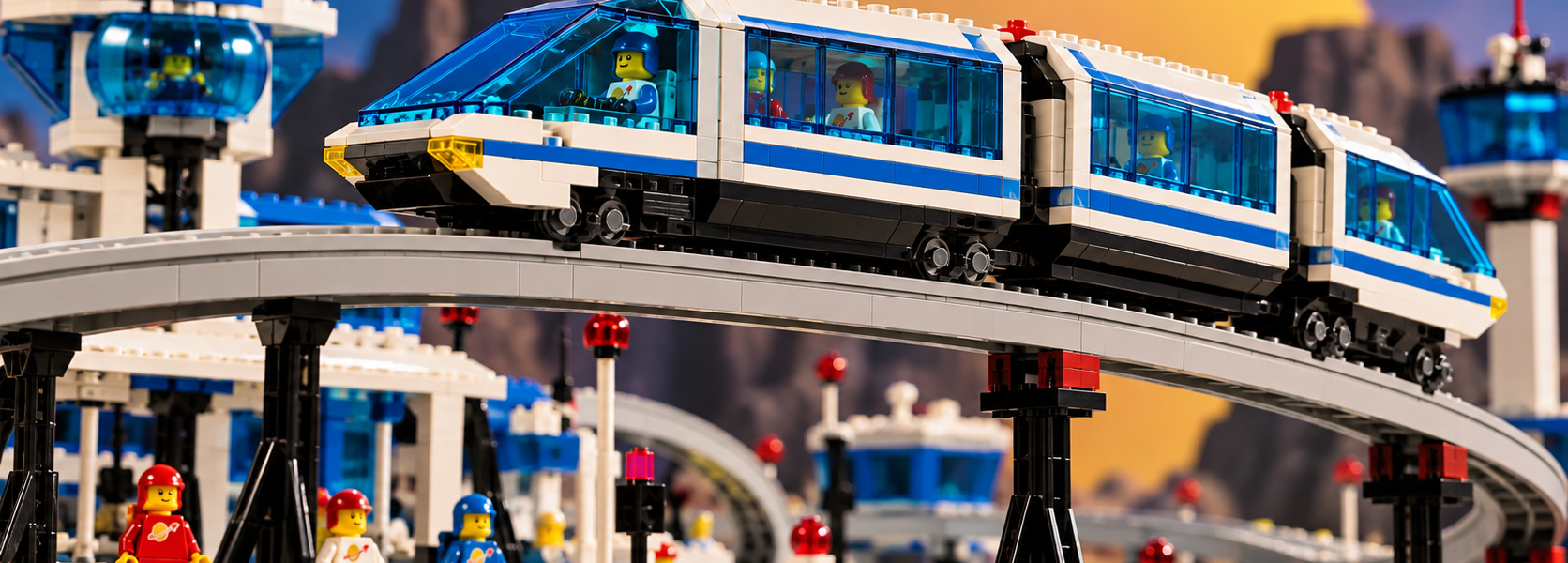
LEGO used the technology to tell three rather different stories. The system began as futuristic transport, moved into a recognisable public-transport setting, and ended back in a science-fiction base.
| Year | Set | Theme | Role of the monorail |
|---|---|---|---|
| 1987 | 6990 Monorail Transport System | Space / Futuron | Elevated transport between futuristic structures |
| 1990 | 6399 Airport Shuttle | Town | A passenger shuttle serving a miniature urban airport setting |
| 1994 | 6991 Monorail Transport Base | Space / Unitron | Transport integrated with a multi-level space base |
Brickset’s catalogue records 6990, 6399 and 6991 under those years. The shift from Futuron to Town is especially revealing. The same specialised hardware could evoke a distant space colony or a perfectly recognisable airport people mover. In either case, raising the route above the rest of the layout made the train’s movement a prominent feature rather than background scenery.
There is a qualification to the frequently repeated phrase only three sets. These were the three complete, large Monorail systems, not the full list of official products associated with the technology. Track expansion sets 6921 Monorail Accessory Track (1988) and 6347 Monorail Accessory Track (1991) provided ways to extend a route. LEGO also offered service packs, including the 5039 switch and 5040 motor. The accessories are part of the system’s history and important when evaluating surviving layouts.
Did LEGO Monorail recover energy when it slowed down or ran downhill?
No credible documentation located for the production Monorail shows regenerative braking or battery charging during a descent. Its recorded features are a battery supply, a geared motor, specially designed track and mechanically actuated stopping or reversing. Those features should not be confused with an energy-recovery system.
In a regenerative electric vehicle, a motor can act as a generator under the right electrical and mechanical conditions. Some of the vehicle’s kinetic energy is then converted into electrical energy and routed to a suitable recipient, such as a rechargeable battery or an external power network. It takes more than a motor capable of turning: the overall circuit must be designed to accept, control and store the generated power.
The Monorail’s stop-and-reverse mechanism was intended to change the vehicle’s operation at a specified point. Its presence does not demonstrate that energy flowed back into its batteries. Nor does the ability to descend a slope prove regeneration. A moving motor might theoretically generate electricity in some circumstances, but that is not the same thing as a complete, functioning recovery-and-storage system in a commercial toy.
We have not found complete original electrical schematics for every motor revision, nor an inventory of unpublished LEGO prototypes. It would therefore be unjustified to declare that no LEGO engineer ever considered the idea. The narrower, well-supported conclusion is that regenerative braking is not a documented feature of the classic 1987–1994 Monorail sets. Brick Current has not carried out electrical measurements or disassembled a motor to test it.
Why was the original Monorail discontinued?
The production timeline is straightforward: 6991 in 1994 was the last of the three major classic Monorail sets. A precise corporate explanation for the range’s end is harder to establish. There is no publicly verified, complete financial report for the Monorail range in the sources reviewed for this feature, and various figures repeated in fan discussions lack sufficient documentation.
An important historical account survives in a 2014 Eurobricks discussion. Forum participants reproduce and discuss remarks attributed to LEGO designer Mark Stafford, said to have appeared in a 2012 Brickset forum discussion. According to the reproduced account, the specialist motor and track tooling had reached the end of its useful life, replacement would have been costly, the old sets had not been commercially successful, and later research suggested limited demand among children.
These claims are more informative than a generic rumour about LEGO deliberately ‘destroying Monorail’, but the attribution matters. The original 2012 discussion was not independently accessible during this research. The surviving material is a quotation and summary shared by other forum users, not a verified LEGO press statement or audited set-by-set sales data. It provides a credible line of explanation, not permission to invent exact restart costs, unit sales or the fate of every mould.
Joe Meno of BrickJournal makes a related argument in his BrickNerd feature, originally published in 2021 and republished in 2024: recreating dedicated track and motor components would be a substantial undertaking. This is a knowledgeable contributor’s assessment, not fresh confirmation of LEGO’s historical accounts. Taken together, the sources point toward a combination of specialised manufacturing and uncertain commercial justification, rather than a single dramatic event that eliminated the system overnight.
Why is rebuilding a classic layout still difficult?
It is often possible to rebuild an old LEGO set by sourcing standard bricks in the right colours. Monorail presents a different problem. The guideway, drive unit, ramps, curves and switching pieces form an interdependent system. Replacing a missing track section with an ordinary railway rail or a few Technic beams will not produce a direct substitute.
The distinction between individual pieces matters. A straight section, a curved section, a turnout and a sloped element do not serve the same purpose, even if a listing simply calls all of them ‘monorail track’. Part identifiers and inventory photographs are therefore more useful than an unspecific description. An owner reconstructing the original operating layout should establish which shapes are present and whether the train’s coupling and drive variant match the rolling stock.
Condition is just as important as completeness. A visually impressive train may still have a motor that does not run, a missing switch component, damaged couplings or cracked track. Conversely, the absence of original scenery bricks does not necessarily make the underlying mechanical system unusable. For collectors, separating cosmetic completeness from mechanical completeness is a more useful assessment than quoting an undated resale price. Regional availability, condition and the exact parts involved vary too much for a universal valuation.
How fans built monorails without the original track
One of the more creative responses to the lack of replacement parts has been to design a new rail system using standard LEGO elements. In his BrickNerd article, Joe Meno describes how Japanese builder Masao Hidaka developed such a system beginning in 2003. Rather than depending on the original moulded guideway, Hidaka used a narrow, two-stud-wide structure constructed from common bricks, plates and tiles. Curved sections and other track arrangements were refined over the following years.
The crucial innovation is not that every builder can copy an old Monorail without adjustment. It is that a track made of ordinary parts can be altered, extended or repaired without waiting for one obsolete element to return to production. Meno also discusses vehicles built around a structural chassis, making them adaptable to different motor and battery technologies, including Power Functions and Powered Up. The motor system may change while the general approach to the guideway remains useful.
These are independent fan-built systems. They are not official continuations of LEGO’s 1987 engineering, and there is no basis for assuming that their gearing, gradients or operating characteristics are identical. What they demonstrate is more interesting than a replica: builders have preserved the idea of a one-rail vehicle while freeing themselves from many of the historical system’s proprietary components.
The 2026 LEGO Education track: a return of the idea, not the original product
There is now a further chapter. LEGO Education introduced its Computer Science & AI educational platform in 2026. Within that new generation of classroom parts, reviewers identified straight and curved track pieces with a toothed driving surface suitable for powered vehicles running along a single guideway. A January 2026 Brick Fanatics report explains why these pieces attracted attention from Monorail enthusiasts.
This does not mean the classic 1987–1994 track, motor, ramps and switches have been reissued. The Education components belong to a different design system, intended for contemporary construction and classroom activities. The two systems share an engineering concept, not a verified direct compatibility between their specialised elements.
An unusual retail episode followed. New Elementary documented the appearance of three relevant LEGO Education gear-track parts on Pick a Brick on 4 August 2026, then added an update that those three pieces had been removed from Pick a Brick on 6 August. The report does not establish why they disappeared or whether they would return. It also does not mean LEGO Education’s underlying kits were withdrawn. Availability of the separate parts should not be extrapolated beyond that dated report.
The distinction helps resolve a common misunderstanding. The Monorail idea has continued through fan projects and new educational parts, but the original product ecosystem has not thereby returned. A vehicle riding a single toothed guideway in 2026 is not automatically interchangeable with a Futuron train from 1987.
The legacy of three unusually ambitious sets
The classic LEGO Monorail occupied a rare position in the company’s history. It was a building toy, a powered mechanism and a miniature transport network all at once. Its visual appeal came from the elevated route, but the technical achievement lay in integrating motive power, changes in elevation and simple automatic controls into one system that children could assemble.
The available evidence suggests why this design proved difficult to sustain: it depended on numerous dedicated components, while the reported market for another expensive large-scale system was limited. What cannot responsibly be added are precise claims of losses or tooling costs without documentary support. The same discipline applies to energy recovery: the historic models stopped and reversed, but no sourced evidence shows that they recharged their batteries while doing so.
The lasting lesson is that the Monorail system was both inventive and unusually dependent on its own hardware. Fan builders have shown that the transport concept can survive without that hardware, and LEGO Education’s 2026 track has reopened the discussion in a different form. The three classic sets remain a concise chapter of LEGO history, but the engineering question they posed — how to move a vehicle along one elevated rail — is still being explored.
Sources and further reading
- Brickset — 6990 Monorail Transport System, 6399 Airport Shuttle and 6991 Monorail Transport Base: set identification, themes and release years.
- BrickLink — Monorail catalogue: accessory tracks 6921 and 6347, motor pack 5040, switch pack 5039 and other components.
- BrickLink — 2684c01a motor with short couplings and 2684c01b motor with long couplings.
- BrickLink — lower ramp 2677, upper ramp 2678 and monoswitch assembly 2772c01.
- Eurobricks — 2014 discussion preserving a quotation attributed to Mark Stafford; secondary account of an inaccessible 2012 Brickset forum discussion, not a primary financial record.
- BrickNerd / Joe Meno — LEGO Monorail: Bring It Back or Build Your Own?: historical perspective, technical discussion and an interview with Masao Hidaka; originally published in 2021.
- LEGO Education — Computer Science & AI Kit 45522: official context for the 2026 educational platform.
- Brick Fanatics — LEGO Education’s new line offers path for monorail comeback, 13 January 2026: independent report on the new gear-track construction.
- New Elementary — Pick a Brick August 2026 new elements: 4 August listings and 6 August update concerning removed track components.
- Brick Fanatics — New LEGO monorail track removed from Pick a Brick, 7 August 2026: independent corroboration of the delisting.