
Beyond Halloween: How LEGO Brings Irish Folklore and Mexico’s Día de Muertos to Life

A skeleton wearing a flower-covered hat is not necessarily a Halloween decoration. Nor does a lantern carved into a vegetable always mean the same thing as the smiling pumpkin on a doorstep. In LEGO creations, all three can appear in the same autumn season. Their histories, however, lead in different directions: Irish folklore, a widely shared popular image of Halloween, and Mexico’s distinct traditions of remembering the dead.
Brick-built models make those differences unusually easy to notice. A few recognizable shapes can prompt a much larger question: what does this figure mean to the people whose traditions inspired it? The most revealing examples are not necessarily the largest sets. One is an independently built scene tucked into an Irish museum; another began as the idea of a Mexican LEGO fan who wanted to represent a familiar cultural figure.
Before the Halloween pumpkin, there was an Irish turnip
Modern Halloween is often presented through North American imagery: orange pumpkins, ghosts, costumes and sweets. Its history is more complicated. The National Museum of Ireland describes Irish seasonal customs associated with Samhain, the traditional transition toward winter, including disguises, divination and stories about the supernatural. Later religious traditions, migration and popular entertainment also shaped what is now called Halloween. It would be misleading to claim that every modern custom comes unchanged from one ancient celebration.
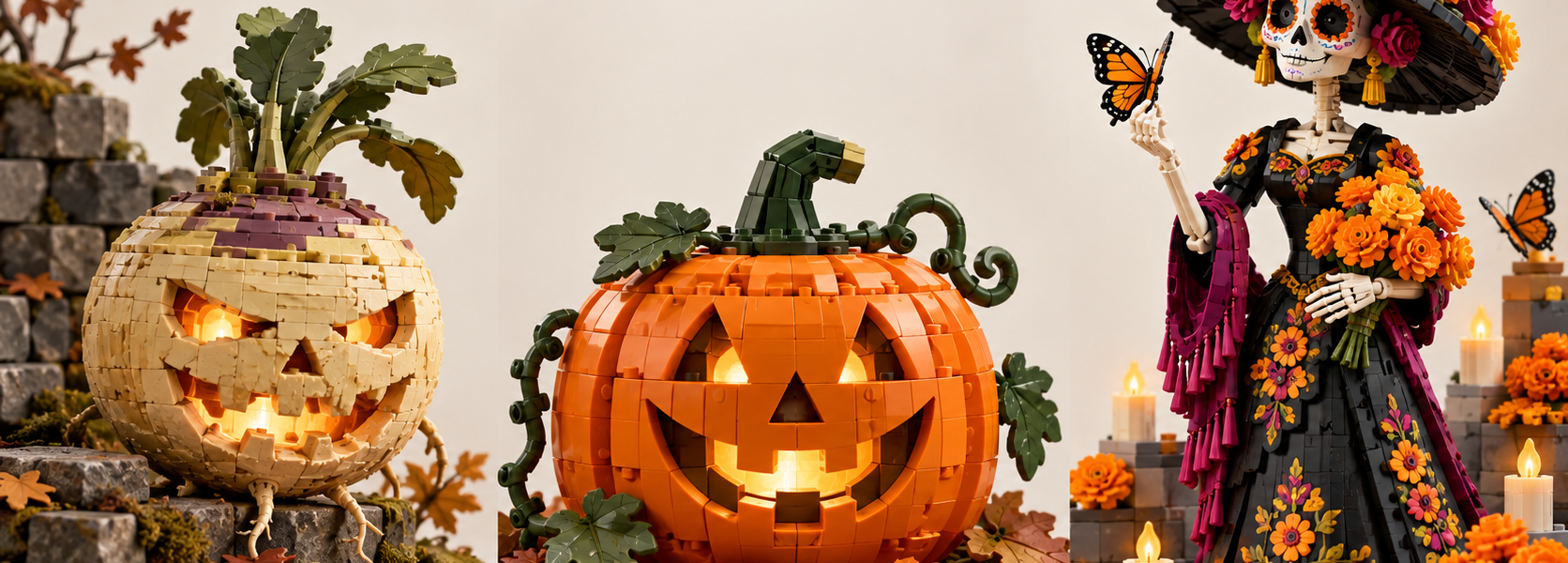
One older practice is especially tangible. People in Ireland and Britain carved frightening faces into large turnips and put candles inside them. They displayed the glowing lanterns around homes and pathways, sometimes specifically to startle passers-by. A ghost turnip documented by the National Museum of Ireland recalls the practice near Fintown, County Donegal, around 1900. In 1943 a local teacher sent the museum a turnip lantern, and museum artist Eileen Barnes made a plaster-cast model of it.
When Irish immigrants carried the lantern tradition across the Atlantic, pumpkins became a more practical material in North America: they were abundant and easier to hollow out. The name jack-o’-lantern survived the change. The familiar glowing pumpkin is therefore a transformed expression of an older story, not the original form of the Irish lantern.
An Irish legend told in LEGO bricks at Galway City Museum
According to versions of the Irish folktale, a cunning man named Jack becomes trapped between Heaven and Hell. Condemned to wander, he carries a burning ember inside a hollowed-out turnip to light his way. This is folklore, not a historical account, and the details differ between retellings.
On 20 October 2026, Galway City Museum described a small LEGO-brick scene by artist Jessica Farrell showing Jack with his turnip lantern at the Gates of Hell. The work was hidden among the museum’s displays as part of a miniature treasure hunt. It was not an official LEGO set, nor a photograph of an old Irish object; it was an artist’s interpretation of a local tradition.
Rather than assembling the usual pumpkin-and-bat imagery, Farrell used bricks to recall a story that predates the modern orange lantern. The work connects a contemporary creative medium with a documented piece of regional folklore. It also shows how a Halloween-themed LEGO creation can be about cultural memory, not just seasonal decoration.
How did Halloween become a recognizable visual language?
Many contemporary LEGO Halloween models use a deliberately familiar collection of symbols. Halloween Wreath 40825, a 2025 release, brings together pumpkins, a bat, a ghost and a spider’s web. The Jack-O’-Lantern Pickup Truck 40822, also from 2025, takes the pumpkin face into a playful vehicle scene. Neither model has to recount a specific folktale. Their shapes tell viewers immediately which season they evoke.
Popular culture often keeps a recognizable image while leaving most of its original context behind. The important point is not to assume that every autumn skeleton or skull belongs to the same system of meanings. The Halloween pumpkin and the Mexican skull may appear side by side in a collection, but they are not interchangeable cultural symbols.
Día de Muertos is not another name for Halloween
Mexico’s Día de Muertos, commonly translated as the Day of the Dead, is observed around the end of October and beginning of November, with especially familiar commemorations on 1 and 2 November. UNESCO describes the Indigenous festivities dedicated to the dead as occasions when families commemorate the temporary return of deceased relatives and loved ones. The traditions have Indigenous roots and developed in dialogue with the Catholic calendar. They vary across Mexican communities; no single display represents them all.
Household ofrendas, or offerings and memorial altars, are among the best-known features. Photographs, candles, food and meaningful objects remember individual people and welcome them symbolically. Flower petals may mark a path. These are not decorations chosen simply because they look eerie. A skeleton can be part of a celebration that honours relationships between generations rather than a character intended to frighten.
A flower often seen on these altars is cempasúchil, especially Tagetes erecta, commonly referred to in English as a Mexican marigold. Mexican cultural and agricultural sources connect its vivid yellow-orange petals and scent with the customary idea of guiding spirits home. The word marigold can describe several plants; it does not mean the symbolic Mexican flower is the European pot marigold, Calendula officinalis.
Decorated skulls and monarch butterflies also appear in some observances. Smithsonian Folklife explains that the seasonal migration of monarchs to Mexico has been associated in some Indigenous traditions with the spirits of ancestors. These meanings depend on community and context. Their presence in a brick model can introduce the tradition, but the pieces cannot provide an exhaustive account of it.
La Catrina: a skeleton with a history in satire
Perhaps the most widely recognized figure associated with Día de Muertos is La Catrina, an elegantly dressed female skeleton, often shown in an elaborate hat. It is tempting to imagine that the character emerged directly from centuries-old ritual. Her particular visual history is instead rooted in Mexican printmaking and social criticism.
Artist and caricaturist José Guadalupe Posada created an image known as La Calavera Garbancera, a skull in a fashionable hat that mocked pretensions to European identity and status. The skull had no full dress in Posada’s original depiction. In his 1947 mural Dream of a Sunday Afternoon in Alameda Central Park, Diego Rivera gave the figure the dressed appearance and name by which La Catrina became famous. This development is documented by Mexican governmental cultural sources, including FONART.
Her subsequent association with Día de Muertos brought the image into another setting, where satire, artistic identity and remembrance now overlap. Reducing La Catrina to a generic spooky character removes precisely the history that makes her distinct from a Halloween costume. Her elegant clothing also carries a pointed reminder: social rank means little in the face of mortality.
From a Mexican fan’s inspiration to LEGO Ideas 21372
This background helps explain why LEGO Ideas 21372 La Catrina, released on 1 August 2026, is a more interesting cultural story than a conventional product announcement. The 1,212-piece model emerged from a LEGO Ideas submission by Mexican fan designer José Miguel Medina Pérez, known as yop1172. As reported from his LEGO Ideas account, he was inspired by clay Catrina figures seen during a visit with his parents to Capula, Michoacán, a place associated with ceramic interpretations of the character.
His task was not merely to construct a skull. He wanted to suggest fabric, posture and the movement of a dress using rigid building elements. The eventual LEGO set was reworked by the company’s designers rather than reproduced as a literal copy of his fan submission. The finished figure has an ornate outfit, brick-built marigolds, printed sugar-skull decorations and two monarch butterflies, one on the base and another in the figure’s hand.
A July 2026 Brick Fanatics roundtable with the LEGO Ideas design team adds perspective. Designers discussed drawing on advice from Mexican colleagues and the fan creator while working through colours, proportions and visual symbols. Cultural references were actively considered during design, rather than selected solely because they looked decorative.
One telling choice was the pink used in the model. In a separate designer discussion about colour, graphic designer Melody Flores explained the significance of Rosa Mexicano, or Mexican pink, in the visual culture she grew up with. The team related the shade to the older BrickHeadz interpretation of La Catrina. This is an example of a design decision carrying context not visible from a set number or piece count.
Neither consultation nor a detailed model means one build can speak for the whole country. Mexico contains a range of local Día de Muertos practices. But documented decisions behind 21372 make the model a case study in how a global toy company and an individual fan can engage with a particular cultural image.
Three LEGO interpretations of the Day of the Dead
Looking at three official sets shows that LEGO has not presented Día de Muertos in just one way. Their most interesting differences are about subject and emphasis, not price or size.
LEGO BrickHeadz La Catrina 40492 (2021): a recognizable character
The small BrickHeadz figure uses the line’s angular proportions and printed facial details, with a dark-pink flowered hat providing an immediate clue to its subject. The simplified design concentrates on a recognizable cultural character. It says little on its own about the history of Posada or Rivera; those stories become visible once the viewer asks who La Catrina is.
LEGO Altar of the Dead 40811 (2025): the practice of remembrance
The double-sided model places a flower-decorated skull on one face and an altar with a floral arch and food offerings on the other. The ofrenda side matters most for cultural interpretation: rather than illustrating an individual character, it points toward a practice through which families honour loved ones. It is a simplified reference to traditions that carry personal meanings for real people.
LEGO Ideas La Catrina 21372 (2026): an expanded visual vocabulary
The larger figure returns to La Catrina but adds details that link her to the wider imagery of Día de Muertos: cempasúchil-inspired flowers, butterflies, skull motifs and carefully considered colour. It also has the documented perspective of its original Mexican fan designer. The three models offer different entry points: a character, a memorial practice and an elaboration of the character’s cultural symbols.
How Día de Muertos is understood beyond Mexico
The difference between Halloween and Día de Muertos matters particularly for international readers. In the United States, for example, public awareness of the Day of the Dead has grown partly through the work of Mexican-American and Chicano artists and community organizations. The Smithsonian American Art Museum traces how public observances also became expressions of cultural identity and community history. The tradition’s visibility abroad is itself a story shaped by people, not just by colourful imagery.
For a global audience, a LEGO creation may be a first encounter with La Catrina or an ofrenda. It can invite curiosity, but it should not become the final explanation. The same shape can have different meanings in different settings, and an object resembling a Halloween decoration may belong to a family remembrance practice with another purpose.
What bricks can tell us—and what they cannot
There is a telling contrast between Jessica Farrell’s turnip-lantern scene and the LEGO Ideas La Catrina figure. The Irish model points back to a local folktale obscured by the global popularity of pumpkins. The Mexican model looks toward an artistic tradition that passed from satire to a widely recognized symbol and eventually to a fan-designed build. Both use LEGO elements, yet neither is simply about being spooky.
Bricks can make a story approachable, communicate a recognizable symbol and open a conversation across cultures. They cannot capture all the meanings of a living tradition, nor should they be asked to. The reward is in following the questions they raise: whose lantern is this, whose memory is being honoured, and what history sits behind that beautifully dressed skeleton?
Sources and further reading
- National Museum of Ireland — Ghost turnips, the púca, fortune-telling and evil abductions.
- National Museum of Ireland — Ghost turnip.
- Galway City Museum — Turnip Lantern Tradition, 20 October 2026.
- UNESCO — Indigenous festivity dedicated to the dead.
- Smithsonian Folklife — Winged Messengers: How Monarch Butterflies Connect Culture and Conservation in Mexico.
- Smithsonian American Art Museum — Traditions and Change.
- Secretaría de Bienestar / FONART — the history of La Catrina.
- Secretaría de Agricultura — Flor de cempasúchil.
- LEGO — Halloween Wreath 40825 and Jack-O’-Lantern Pickup Truck 40822.
- LEGO — La Catrina 40492, Altar of the Dead 40811 and LEGO Ideas La Catrina 21372.
- Brick Fanatics — La Catrina designer interview, 15 July 2026.
- Brick Fanatics — La Catrina colour choices, 13 July 2026 and fan designer’s response, 15 July 2026.