
Six LEGO Bricks, 915 Million Builds: Why Mathematicians Keep Counting

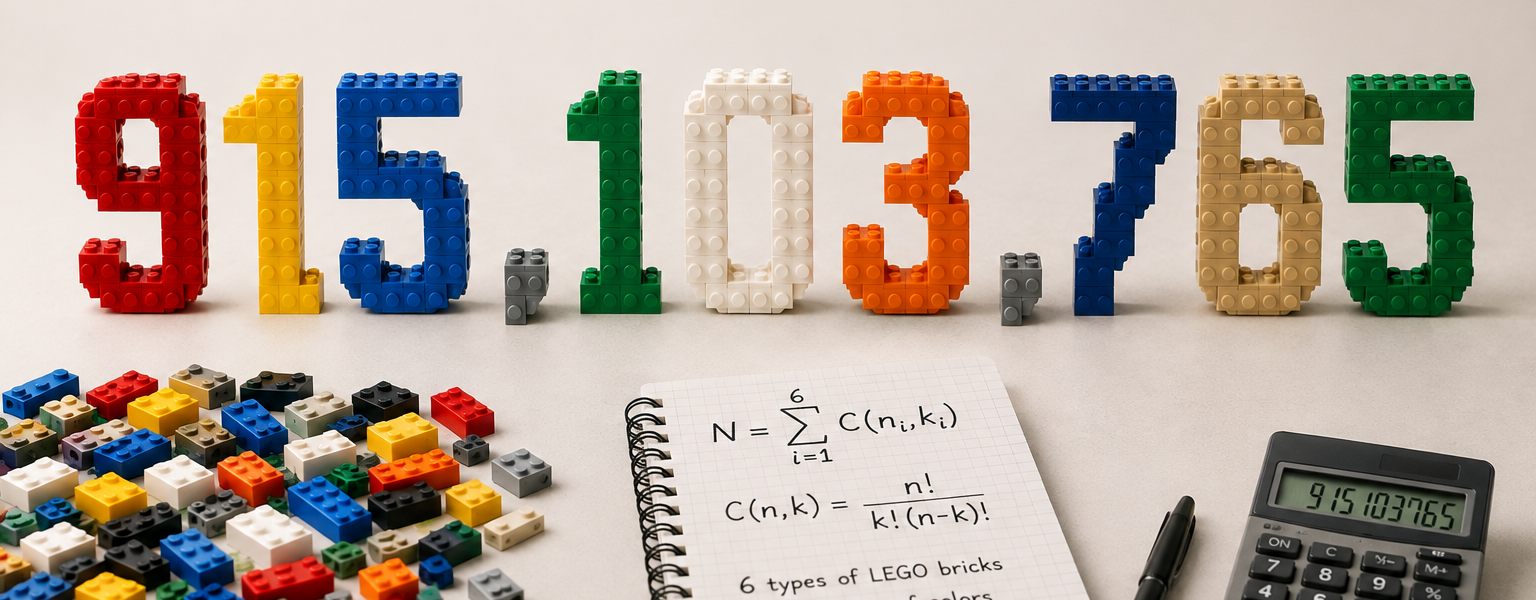
Six identical 2×4 LEGO bricks look almost trivial. Mathematically, they are anything but. Under the classic counting rules, those six bricks can form exactly 915,103,765 distinct connected structures.
The LEGO Group has used the “over 915 million” figure for years as a shorthand for the creativity of the basic brick. In 2026, however, researchers returned to the underlying counting problem in a new paper, Counting LEGO configurations, extending the discussion far beyond one famous number.
The 915 million figure has a correction built into its history
A LEGO company newsletter from 1974 gave a much smaller figure: 102,981,500 ways to combine six 2×4 bricks of the same color. The problem was not the arithmetic so much as the definition. That older calculation counted only structures of height six, effectively requiring each added brick to create another level.
That leaves out valid connected builds with lower overall height, where multiple bricks can occupy the same layer. Later work corrected the total to 915,103,765, the value now recorded in OEIS sequence A112389 and reflected in official LEGO materials.
What counts as a different LEGO structure?
The number is not simply “every way of placing six bricks somewhere in space.” The objects being counted are connected structures: the bricks must form one interlocking build. Structures that differ only by moving or rotating the entire object are not counted as new ones.
In the classic 2×4 problem, bricks can be oriented along two perpendicular directions, which creates a genuinely three-dimensional family of possibilities. That extra freedom is one reason the count grows so rapidly.
The numbers explode almost immediately
OEIS A112389 gives a striking progression. One brick gives one structure. Two bricks give 24. Three produce 1,560. With four bricks the count reaches 119,580, and with five it rises to 10,166,403. The sixth brick takes the sequence to 915,103,765.
At seven bricks the number is already above 85 billion. At eight, it passes 8.27 trillion. The growth is not linear; the sequence is dominated by an exponential term.
What the 2026 paper adds
The new paper does not replace the six-brick result. Instead, it studies how families of LEGO configurations behave as the number of pieces increases. For the three-dimensional 2×4 structures, the authors estimate a growth constant of μ = 117.25 ± 0.05.
That does not mean every extra brick simply multiplies the exact count by 117.25. It is an asymptotic parameter describing large-n behavior. The researchers also present numerical evidence supporting growth of the form A·μn/n3/2.
The distinction matters: the paper is estimating the long-run mathematical behavior of the sequence, not offering a simple closed formula that produces an exact answer for every brick count.
Why LEGO becomes a combinatorics problem
A 2×4 brick is geometrically simple, but each new brick can attach in many positions, at several offsets, and in different orientations. Some apparent arrangements collapse to the same object after rotation. Some fail because the build is not connected. Others create genuinely new three-dimensional geometries.
That makes enumeration much harder than the object itself suggests. The physical rules of the brick create a compact combinatorial system in which a small number of parts generates an enormous search space.
More than a marketing fact
“Over 915 million combinations” works well as a memorable LEGO fact, but the mathematics behind it is more interesting than the slogan. It demonstrates how a small set of simple constraints can create extreme complexity.
The 2026 research also shows why the question remains open-ended. Once the six-brick total is known, the natural next question is not merely how many builds exist for seven or eight pieces, but how the entire space of possible structures grows as the brick count increases.
That is where the humble 2×4 brick stops being just a toy component and becomes a clean, surprisingly deep problem in combinatorics.