
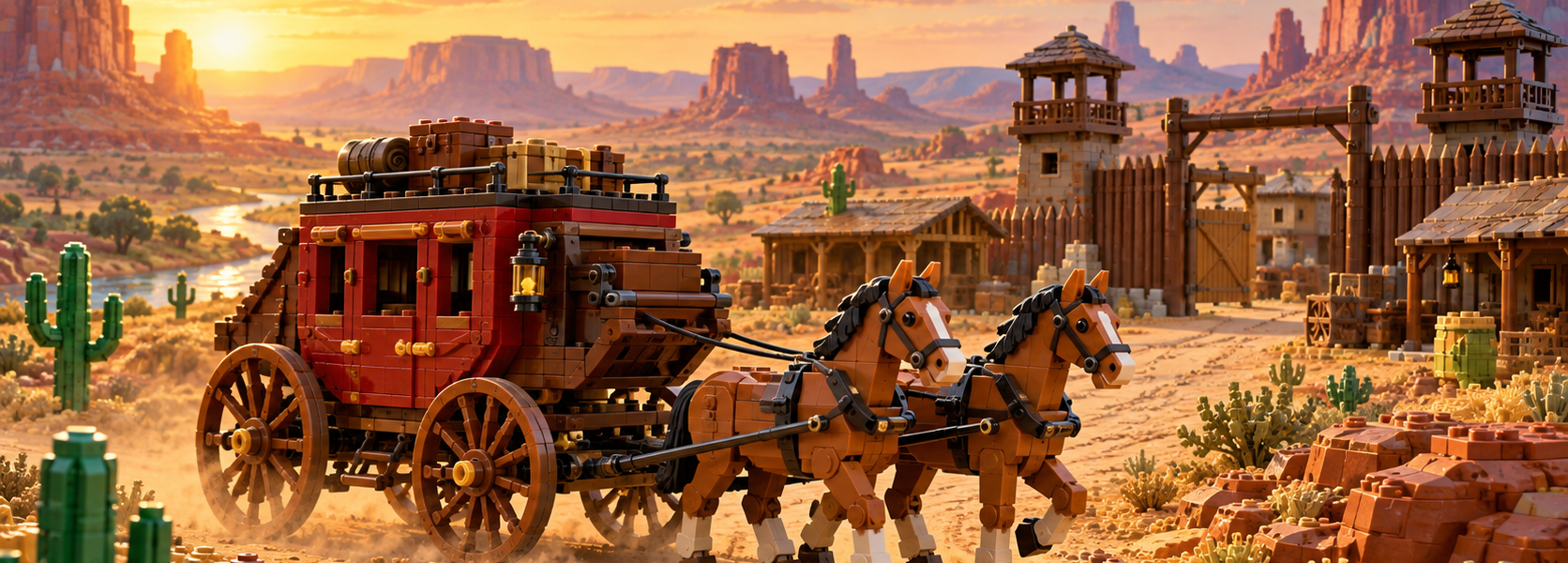

Pick up a vintage LEGO stagecoach and you can almost hear a theme tune from an old Western. The carriage, the horses, the broad-brimmed hat: they belong to a world of frontier towns, sheriffs and adventure stories that once appeared frequently in toy catalogues. One of the memories behind the Polish edition of this article comes from a collector who owned a stagecoach in the 1970s, complete with a little figure whose arms did not move. LEGO’s 697 Stage Coach from 1976 fits that description, although the collector’s exact set number has not been established.
The difference between that small carriage and the LEGO Western range of the 1990s is striking. By 1997, children could build riverside villages, tipis, canoes and figures that LEGO’s catalogues grouped under the name Indians. Those sets are now part of the company’s history rather than an ongoing theme. So what happened? Did the Wild West lose its audience, or did the way toy companies portrayed Indigenous peoples become harder to justify? Both possibilities deserve examination. Neither should be presented as an official LEGO explanation without evidence.
First, LEGO did make Native American-themed sets
The assumption that LEGO never represented Indigenous peoples of North America is simply wrong. The history goes back well before the familiar 1990s minifigures. In the American Samsonite-branded range, 805, historically titled 3 Little Indians, was released in 1964. Its figures were built from ordinary bricks. LEGO also offered 215, marketed with another now-dated name, in 1977. The wording on these old products is relevant historical evidence, not terminology we need to repeat as a present-day description of actual people.
Meanwhile, LEGO’s own history of role-play figures explains why a 1970s stagecoach might have featured a rigid little character: early figures introduced in 1975 had no movable arms or legs. The modern articulated minifigure arrived in 1978. Those early figures help connect LEGO’s pre-minifigure frontier scenes with the later Western theme, but a stand-alone 1970s stagecoach should not be confused with the cohesive 1990s product line.
1996–1997: when LEGO built an entire Western world
The Western theme introduced in 1996 used the familiar vocabulary of screen Westerns: cavalry, lawmen, outlaws and dusty settlements. Its defining large model was 6769 Fort Legoredo, released in 1996. A year later, LEGO added a subtheme that catalogues label Western Indians. Its products included 6746 Chief’s Tepee, 6748 Boulder Cliff Canyon and 6766 Rapid River Village.
Rapid River Village was an especially substantial scene: the Brickset catalogue records 343 pieces and seven minifigures, with canoes, horses, a river setting and tipis. For collectors, it remains a recognizable artifact of late-1990s set design. LEGO later brought the same concept back as 6763 Rapid River Village in 2002. The reissue matters: the story was not one of a theme disappearing overnight and every related product immediately becoming off-limits.
The sets presented a playful fictional frontier, not a researched portrait of one clearly identified Native nation. That distinction is central to the debate about their legacy.
Not a blanket ban: the figures continued after Western
Several later releases rule out a simple claim that LEGO prohibited all Native American characters after 1997. Collectible Minifigures included characters labelled Tribal Hunter in Series 1 (2010) and Tribal Chief in Series 3 (2011). Series 15’s Tribal Woman, released in 2016, included a baby figure.
In 2013, a different category of product appeared: LEGO sets licensed from Disney’s The Lone Ranger. The line included 79107 Comanche Camp and the character Tonto, as well as other characters connected to the film. Movie licensing is not the same as the return of LEGO’s own ongoing Western world; nor do those appearances prove how the company would design a new Indigenous-themed range today.
These are three different editorial and business decisions: running an original Western theme, releasing a single collectible minifigure, and adapting a film under licence. Treating them as interchangeable would hide the more interesting question of why the comprehensive 1990s range was not continued.
Explanation one: did Westerns stop selling to children?
The marketing argument begins with a plausible observation. Toy play does not exist apart from television, movies and popular characters. A generation raised on Western films or cowboy adventures might instantly recognize a fort, stagecoach and sheriff. A child surrounded by contemporary games, fantasy series and cinematic franchises has a wider—and different—set of familiar stories from which to choose.
There is solid evidence that LEGO pays close attention to recognizable themes and entertainment partnerships today. In its March 2026 report on 2025 results, the company identified City, Technic, Star Wars, Icons and Botanicals among its leading themes, while describing collaborations involving Minecraft, Super Mario and other entertainment properties. That tells us something about a successful modern portfolio. It does not tell us how the 1997 Western range sold.
To establish that children no longer knew what the Wild West was—or that weak demand caused Western’s cancellation—we would need contemporaneous research, internal product decisions or reliable sales records for the theme. We have not found sufficient public evidence to make that claim. A short-lived range may have faced difficult market conditions; a short life by itself is not proof of a failed launch.
The marketing explanation is therefore a plausible hypothesis: stand-alone frontier adventures may have become a lower priority than other themes competing for attention. It remains a hypothesis rather than a documented reason for Western’s disappearance.
Explanation two: cultural representation and the limits of the old toy Western
The cultural question is more specific than whether historical adventures are allowed in children’s toys. It asks what happens when a toy line takes diverse Native peoples—each with distinct histories, languages, traditions and contemporary lives—and presents a generalized set of costumes, tipis, chiefs and symbols under one collective label.
The Smithsonian National Museum of the American Indian’s Native Knowledge 360° framework emphasizes that there is no single American Indian culture or language. Its guidance on terminology advises referring to particular nations and communities when possible, avoiding broad stereotypes and recognizing Native peoples as present-day communities rather than figures frozen in the nineteenth century.
Viewed through that lens, the 1997 line deserves a more careful reading. The combination of recognizable Western imagery could be entertaining in a playset while still failing to tell readers which particular Native communities it supposedly represented. The issue is not that tipis or traditional clothing are inherently inappropriate subjects. It is that treating them as universal signs of an imagined, interchangeable ‘Indian’ identity erases differences between living peoples. A toy can be nostalgic for its owners and simplified in troubling ways at the same time.
For an especially relevant perspective, read Lorren Loveless’s Native American Heritage and LEGO Representation in BrickNerd, originally published in 2022 and featured again in 2023. Loveless identifies his own background as Ojibwe/Anishinaabe from the Turtle Mountain Band of the Chippewa. His article documents several generations of LEGO portrayals, acknowledges changes between releases and encourages the company to consult and credit particular Indigenous nations if it creates such sets again. That is a grounded contributor’s perspective—not a statement representing every Indigenous person, and not an announcement of LEGO policy.
Was Western cancelled because of ‘political correctness’?
That phrase is sometimes used to explain why older entertainment ideas no longer appear in exactly the same form. But here it can disguise an unsupported causal leap. The historical products are real, and cultural criticism of generic portrayals is understandable. What is missing is a verified statement from the LEGO Group tying the end of its regular Western theme to a particular cultural objection, company rule or political campaign.
It is also misleading to turn the discussion into a choice between respecting collectors and respecting Indigenous communities. Many fans have warm memories of the sets without intending harm. Equally, those memories do not settle whether the depictions were accurate. An argument that future sets could provide greater cultural specificity is a proposal for better design, not evidence that the old line was banned.
Market considerations and cultural considerations could interact in a company’s product decisions. Without records of the actual decision, however, presenting either one as the confirmed explanation would be guesswork.
What we can establish—and what remains open
| Claim | Assessment |
|---|---|
| LEGO made sets featuring Native American-themed figures. | Confirmed: catalogues document products from 1964, 1977 and the 1990s, plus later releases. |
| Rapid River Village appeared again after 1997. | Confirmed: 6763 was released in 2002. |
| LEGO banned all such minifigures after Western. | Contradicted: releases in 2013 and 2016 show later appearances. |
| Western ended because children stopped understanding the setting. | Not established: no cited sales study or representative audience research proves this. |
| Western ended because LEGO adopted a cultural prohibition. | Not established: no verified public corporate statement has been identified giving that cause. |
| Older designs relied on broad portrayals of different Native cultures. | Defensible criticism: it can be assessed against the actual sets and Indigenous-informed cultural guidance. |
The distinction between an observed product history and an inferred motive is not a minor technicality. It is the difference between a useful retrospective and a story that merely sounds certain.
Could a new LEGO Western work today?
There is nothing about a brick-built stagecoach, saloon, railroad, frontier street or landscape that automatically requires a caricature of Indigenous peoples. A new historical or fictional Western setting could focus on adventure and construction without repeating every convention of twentieth-century cowboy movies.
If LEGO chose to create products about identifiable Indigenous nations, it could also consider a different process: engage with representatives of those communities, name them correctly, avoid mixing unrelated traditions for visual effect, and include characters with everyday lives and agency rather than treating them as scenery for someone else’s adventure. Those are editorial recommendations informed by the Smithsonian’s guidance and Loveless’s argument, not details of a confirmed LEGO development project.
Such an approach would not erase the old sets or collectors’ affection for them. It would acknowledge that a good construction toy can be both entertaining and more thoughtfully researched than its predecessors.
So why did LEGO’s Native American Western sets disappear?
The careful answer is that the regular Western range ended, but we cannot demonstrate a single official reason for its end. The wider toy market changed, and expectations of how Indigenous peoples should be portrayed have also changed. Neither of those observations alone tells us what a particular LEGO decision-maker concluded in the late 1990s.
What the surviving sets do show is a long and uneven history: brick-built figures in the 1960s, the rigid-armed stagecoach era in the 1970s, a detailed Western world in the 1990s, a 2002 reissue, licensed characters in 2013 and a collectible figure in 2016. The interesting question for the future is not simply whether LEGO will revisit the Wild West. It is what kind of story a new generation of builders might tell with it.
Sources and further reading
- The LEGO Group — Role Play (LEGO History): early rigid figures and the 1978 articulated minifigure.
- Brickset — 697 Stage Coach (1976): vintage stagecoach reference.
- Brickset — 805 (1964) and 215 (1977): historical product names and brick-built figures.
- Brickset — 6769 Fort Legoredo (1996).
- Brickset — 6746 Chief’s Tepee (1997) and 6766 Rapid River Village (1997).
- Brickset — 6763 Rapid River Village (2002): reissue.
- Brickset — 79107 Comanche Camp (2013) and 71011-5 Tribal Woman (2016): later releases.
- Lorren Loveless, BrickNerd — Native American Heritage and LEGO Representation: collection history and an Ojibwe/Anishinaabe author’s perspective.
- Smithsonian NMAI — Essential Understandings and The Impact of Words: cultural diversity and terminology.
- The LEGO Group — 2025 Full Year Results (10 March 2026): today’s portfolio context, not an explanation for the Western line’s end.