
From Wind-Up Keys to Pull-Back Racers: LEGO’s Spring Motor History

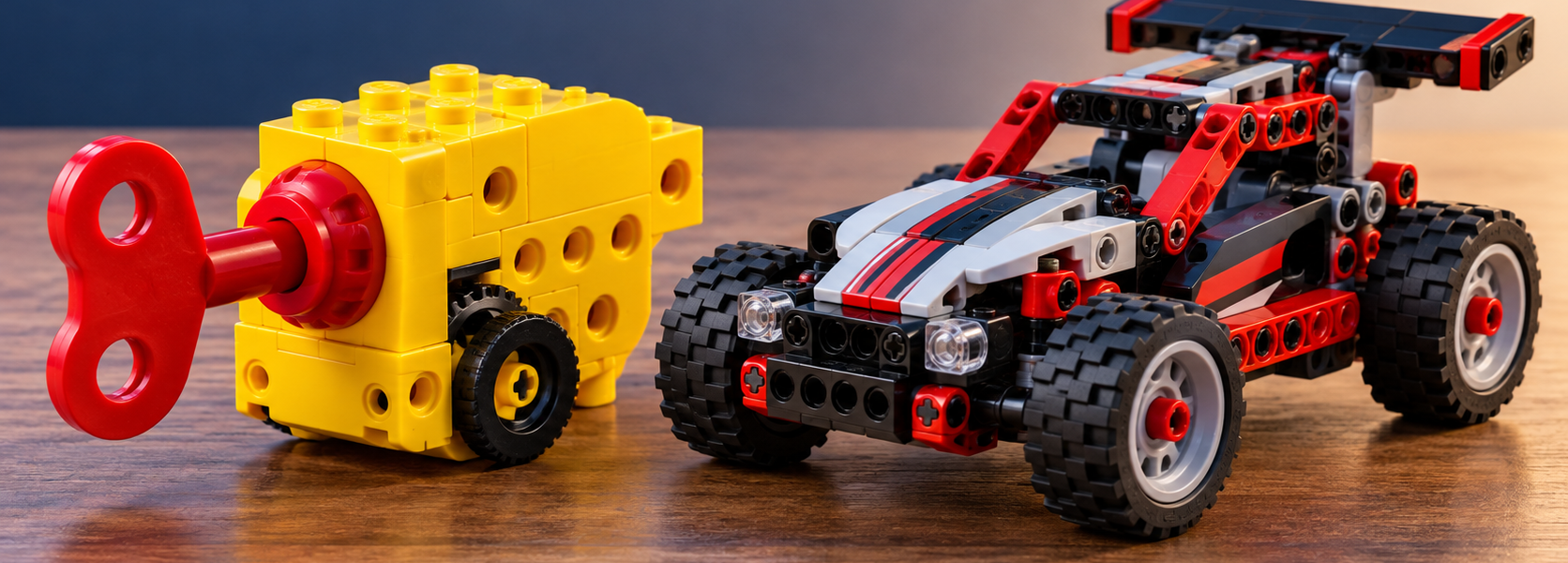
Picture a yellow LEGO motor and a red winding key. Without batteries or electronic controls, a child could power a wheeled duck, a homemade vehicle or a completely different invention. That was the appeal of 890 Wind-Up Motor from 1981: it was an ingredient for building, not a finished racecar.
Meanwhile, Takara’s miniature Choro-Q cars had launched in Japan in 1980 with spring-powered pull-back action. Why, then, did LEGO seem to wait so long to embrace the same idea? The answer is more surprising than a simple story of delayed invention. A published transcription of a 1981 UK LEGO catalogue says the yellow motor could also be wound by moving a model backwards. A separately sold LEGO Pull-Back Motor arrived in 1990, with complete racing vehicles around 2000 and a recurring Technic pull-back series from 2013. The development was as much about the role of a motor in play as the method of storing energy.
Wind-up and pull-back: similar energy, different interactions
Both approaches put energy into a spring. Turning a key stores mechanical energy directly; rolling a vehicle backwards can transmit that work through its wheels and gearing. On release, the spring drives the output. A pull-back toy is therefore a specific way of using spring power, not proof of an entirely separate energy source.
Neither name guarantees that two historical motors share the same internal parts, gears or clutch. Nor should they be confused with flywheel-powered toys, which store energy primarily in a rotating mass, or with vehicles propelled by external launchers.
The overlooked 1981 catalogue clue
BrickLink dates 890 Wind-Up Motor to 1981. The motor appeared as a general-purpose building accessory; the packaging suggested varied creations, including a wheeled duck and windmill. Its yellow housing could be incorporated into different brick-built models.
The Brickset catalogue archive lists a UK catalogue from 1981, identified as c81uk. A published transcription of that catalogue describes the motor found in Basic set 577 or sold separately as 890 as windable using its key or by pulling the model backwards first.
The important qualification: this statement was checked in the published transcription, not against a visually inspected original scan of the specific catalogue page. If faithfully transcribed, it establishes that backward winding was part of the advertised play pattern in 1981. It does not prove that the mechanism inside 890 was mechanically identical to a later, dedicated pull-back unit, nor that its performance was equivalent. No original motor was disassembled or physically tested for this article.
Why keep the key? One reasonable explanation lies in the toy’s flexibility. A windmill or a stationary contraption cannot necessarily be rolled backwards over a floor. Turning a key offers a more direct way to energize an otherwise stationary build. That is an editorial inference from the product’s possible applications, not a recorded explanation from LEGO’s original designers.
LEGO continued selling wind-up motors in the mid-1980s
Another supplementary product, 895 Wind-Up Motor, continued the approach. There is a minor dating discrepancy: BrickLink lists the set as 1986, while BrickEconomy lists 1985. Rather than assert one universally agreed release year, the most defensible description is 1985–1986, depending on the catalogue, or simply the mid-1980s. The discrepancy does not alter the wider chronology.
What Choro-Q offered in 1980
In an official 2022 retrospective, Takara Tomy describes the original Choro-Q as a spring-powered pull-back miniature car launched in 1980. Its appeal was immediate. Move the small vehicle backwards, let go, and it runs ahead. The toy does not first ask the child to construct a vehicle around the mechanism.
LEGO’s 1981 product invited a different question: What can I make this motor drive? Choro-Q asked: What can this finished little car do? It is plausible that this distinction helps explain the marketing of the yellow motor, but it would be misleading to claim that LEGO deliberately rejected a rival’s design, lacked the technology or was blocked by patents. We have not found primary corporate evidence supporting any of those explanations.
1990: a dedicated LEGO Pull-Back Motor
The next clear milestone is 818 Pull-Back Motor, Red, listed by Brickset as a 1990 Basic supplementary set. Its product name explicitly uses pull-back; the BrickLink inventory documents the red motor assembly and related pieces. This was still principally a reusable accessory, rather than a fully dressed Technic racer.
Similar ideas appeared in other categories. DUPLO 2318 Pullback Motor is dated 1991, while 636 Pull Back Motor appeared as a Basic accessory in 1996. These releases contradict the notion that LEGO first discovered pull-back action in the 2010s.
From accessories to complete racecars, 2000–2001
6616 Rocket Dragster and 6714 Speed Dragster were released in 2000. BrickLink identifies the 32283c01 pull-back motor assembly among their parts, confirming a motor integrated into complete racing sets. An indexed description of the archived 2000 UK catalogue also advertises these vehicles as pull-back powered. We did not inspect every page of that large catalogue scan, so the parts inventories provide important independent support.
The Technic 5223 Wind-Up Motor from 2001 is a useful reminder that product naming can be misleading: despite the broader wind-up wording, its catalogue inventory associates it with the pull-back motor family. LEGO was not moving from keys to pull-back in one neat leap. Different spring-driven products overlapped across themes and age groups.
2013: the pull-back racer becomes a Technic product format
For many builders, the best-known examples are 42010 Off-road Racer and 42011 Race Car, both from 2013. Technicopedia describes them as the beginning of a recognizable recurring family of compact Technic pull-back racers. Their message was direct: build a car, roll it backwards, release it and race.
That made the motor the headline play feature of the entire model rather than simply an optional construction component. But 2013 is neither the invention date of pull-back in general nor the first LEGO application of spring-powered rearward winding. It marks a clearer recurring range of vehicles designed around that action.
Why did the product strategy evolve so slowly?
Three explanations are worth considering, provided they remain labelled as editorial hypotheses, not verified LEGO decisions.
One motor, many creations
The keyed motor was suitable for experimental moving constructions. A child could wind a stationary or unconventional model without rolling the whole assembly across a surface. This flexibility may have suited LEGO’s emphasis on open-ended building.
Instant racing has its own appeal
A pull-back car compresses its interaction into a simple gesture: roll back and release. That suits short sprints and repeated races, while other mechanisms may be more convenient for models intended to perform a different movement.
A successful racer is more than its drive unit
Weight, traction, chassis construction and repeated-impact durability matter. Owning a reusable spring motor does not automatically create a robust, appealing racecar. Public product listings document the outcome, not why particular management or design choices were made in any given year. We have no reliable basis to blame patents, cost or lack of inventiveness for the timeline.
A timeline worth remembering
| Year | Product | Significance |
|---|---|---|
| 1980 | Takara Choro-Q | Spring-powered pull-back miniature cars sold outside LEGO |
| 1981 | LEGO 890 | Keyed universal wind-up motor; backward winding mentioned in a published catalogue transcription |
| 1985–1986 | LEGO 895 | Continued wind-up motor range; catalogue dates differ |
| 1990 | LEGO 818 | Explicitly named Pull-Back Motor sold separately |
| 1991 | DUPLO 2318 | Pull-back motor for another LEGO building system |
| 1996 | LEGO 636 | Additional Basic pull-back motor |
| 2000 | 6616 and 6714 | Complete dragster sets using a pull-back motor |
| 2001 | Technic 5223 | Supplementary wind-up-labelled product with a catalogued pull-back assembly |
| 2013 | Technic 42010 and 42011 | Start of a recognizable recurring Technic pull-back racer line |
The real evolution: what the motor was meant to do
The story is not one of LEGO overlooking an obvious mechanism for decades. Its 1981 catalogue transcription already suggests backward winding, a purpose-named pull-back motor was sold in 1990, and motors became part of complete racers well before 2013. What changed most visibly was how the products invited children to play: from making almost anything move to constructing a particular kind of vehicle and launching it again and again.
The little red key still makes sense for a different reason. It lets the builder decide what deserves to come alive, whether or not the creation happens to have wheels.
Sources and further reading
- Brickset — Historical LEGO Catalogue Library and 1981 UK catalogue transcription.
- BrickLink — 890 Wind-Up Motor (1981).
- BrickLink — 895 Wind-Up Motor (1986) and BrickEconomy — 895 (1985).
- Brickset — 818 Pull-Back Motor (1990), BrickLink — DUPLO 2318, and Brickset — 636.
- LEGO — 6616 Rocket Dragster, 6714 Speed Dragster, motor 32283c01 inventory, and UK catalogue 2000.
- Brickset — Technic 5223 (2001) and Technicopedia — Pull-Back Racers from 2013.
- Takara Tomy — Choro-Q history (2022 retrospective).