
How LEGO Engineers Giant Creatures: Godzilla, Bowser and Two T. rex Models

A giant LEGO creature has to solve two competing problems: it should look alive, but it also has to stay standing. Every movable joint adds expressive possibilities and another point that may bend, slip or transfer unwanted loads. A wider stance, a supporting tail or a display stand can make a huge model more reliable, but may also limit the poses it can achieve.
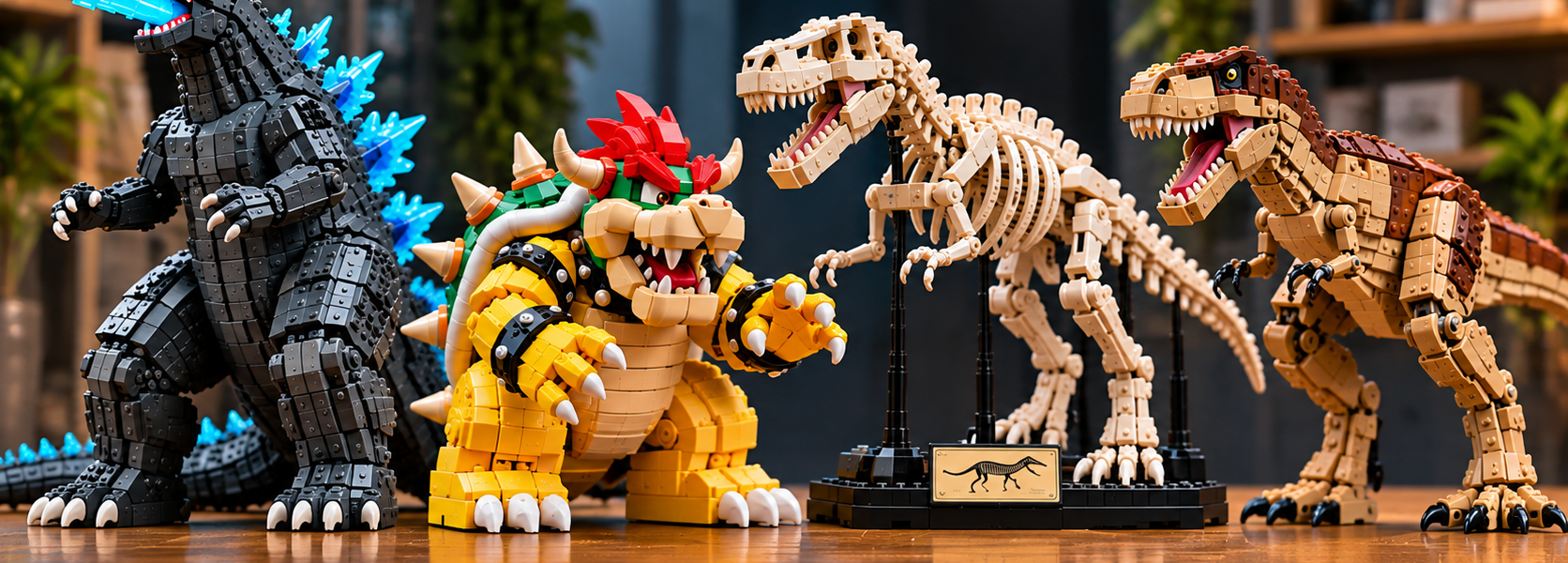
That tension makes the newly announced LEGO Ideas 21375 Godzilla an unusually interesting comparison with 71411 The Mighty Bowser, 76968 Dinosaur Fossils: Tyrannosaurus rex and 75936 Jurassic Park: T. rex Rampage. These are not four interchangeable figures. One prioritises a monumental silhouette, one puts interactive mechanisms inside a dense body, one openly relies on museum-style supports, and one uses a largely fixed stance to give a complete dinosaur plenty of movement elsewhere.
This is a design analysis, not a laboratory ranking. We use official specifications, designers’ comments and independent build reviews; we have not assembled, weighed or load-tested the four sets ourselves. Where the evidence suggests an engineering trade-off without proving the designers’ intentions, we identify it as an editorial interpretation.
Start with the support system, not the piece count
Four numbers are frequently compared: Godzilla has 5,363 pieces (2026), Bowser 2,807 (2022), the T. rex skeleton 3,145 (2025) and T. rex Rampage 3,120 (2019). But 75936 also includes a substantial Jurassic Park gate, minifigures and scenery. Its total is not the number of bricks in the dinosaur alone. Nor does a larger count establish greater joint strength or mechanical sophistication.
| Set | Primary support approach | Where movement is concentrated | Important limitation |
|---|---|---|---|
| 21375 Godzilla — 5,363 pieces | Self-supporting, upright creature; feet and tail contribute to its stance | Head, shoulders/arms, wrists, fingers and tail positioning | Brickset reports no hip articulation; commercial model not yet released |
| 71411 The Mighty Bowser — 2,807 pieces | Dense body, broad feet and tail; can stand off the supplied display base | Mechanically operated head and jaw, plus arms and other details | Standing leg positions are much more constrained than the upper-body movement |
| 76968 Dinosaur Fossils: T. rex — 3,145 pieces | Exhibition base and structural support columns | Adjustable skeletal sections, including a heavily supported skull joint | Exposed bones and long spans require careful handling |
| 75936 T. rex Rampage — 3,120 pieces in the entire set | Broad feet and deliberately rigid leg structure | Body, neck, jaw and segmented tail | Independent review finds a running pose unavailable |
These descriptions are grounded in LEGO’s Godzilla announcement and specialist reviews from Brickset and New Elementary. They compare design strategies, not measured load capacity.
Why a joint that moves can become a structural liability
Imagine a heavy brick-built head at the end of a long neck. Its weight creates a turning force at the joint. Moving that head farther from the point of support increases the torque the connection has to resist. Arms and tails create similar leverage; movement can also shift the model’s overall centre of mass relative to the points touching the table.
A builder can respond by using more resistant joints, redistributing mass, lowering the centre of gravity, widening the stance, making some connections rigid or adding an extra support. Those solutions have costs. A tighter joint is harder to move; an internal brace uses space; a stand may change the intended appearance; a fixed hip gives up a dramatic walking pose.
These are general mechanical principles, not measurements of the sets below. They help explain why the marketing term poseable does not tell a buyer whether a giant model can walk, twist at the waist or simply turn its head. Local articulation and whole-body poseability are different design goals.
Godzilla 21375: the tail becomes part of the architecture
Announced on 3 November 2026 for release on 27 November 2026, Godzilla is the largest LEGO Ideas set announced to date by piece count. The LEGO Group gives its height as 70 cm (27.5 in) when posed with the Heat Ray, rather than as an unconditional height in every configuration. Its details reference Legendary’s Monsterverse design, including textured skin and blue dorsal plates. The announced international prices are $449.99 / £349.99 / €399.99; availability and local pricing differ by market.
The mechanically revealing comparison is not just with other creatures: it is with the original LEGO Ideas submission by Matthew Esposito (MattE720). As documented by Brick Fanatics, that smaller fan build leaned forward in a walking or running stance and used a transparent support beneath its tail. The production model stands taller and more upright. Its tail itself provides support, without that separate clear prop.
LEGO’s detailed product description identifies adjustable head, arms, wrists, fingers and tail positioning. Its broader press announcement also refers to poseable legs. Brickset’s reveal analysis, however, specifically observes that the model has no hip articulation. Those accounts should not be silently merged into a claim that Godzilla can take arbitrary walking poses. Until detailed hands-on assessments establish the actual range, the safest description is that the upper body is expressive while the fundamental standing posture appears more constrained.
Our interpretation: making the model much larger while eliminating a separate tail stand appears to favour a predictable load path and display stability over the more aggressive lean of the fan submission. It is a visible design trade-off, not proof of any particular internal reinforcement or an official explanation of the designers’ priorities. The production model’s long-term joint durability cannot be inferred from announcement photography.
Bowser 71411: movement is engineered into the torso
The Mighty Bowser takes a different route. Rather than requiring the builder to grab and reposition the head for every expression, it places mechanical controls behind the shoulders and inside a substantial Technic core. Brickset’s hands-on review describes a cross-body mechanism for turning the head and a separate control for moving the jaw. Bowser can also launch a fireball from his mouth.
The distinction is more important than the number of moving pieces. This is controlled animation: inputs hidden within the model produce intentional movements without dismantling the character’s appearance. New Elementary reported that its completed review build weighed a little over 2 kg and that the mechanism remained manageable to operate. That mass is a reviewer’s observation, not a manufacturer-supplied weight or our own measurement.
The supplied platform is a display accessory, not a requirement for keeping Bowser upright. Brickset confirms that he stands without it, while other reviewers describe the tail as contributing to support. The legs are not a freely poseable humanoid frame when the figure is standing, even though the arms have substantial articulation.
This makes Bowser an important counterpoint to Godzilla. Bowser spends structural complexity on operating mechanisms; Godzilla spends much more of its piece budget on a larger body and an imposing surface. Neither strategy can be declared more technically advanced without first deciding whether the goal is interaction, appearance or adjustability.
The 76968 T. rex skeleton: the stand makes a more ambitious shape possible
LEGO’s 76968 Dinosaur Fossils: Tyrannosaurus rex is over a metre long, but it deliberately avoids the broad, solid surfaces that make Godzilla and Bowser look heavy. An open rib cage, a long vertebral column and an extended tail create an entirely different problem: slender-looking elements must form a coherent model that can be handled and displayed.
The answer is not to pretend that the entire skeleton could stand on two narrow skeletal legs. It uses a museum-style base with support pillars. Those supports are part of its visual language as well as its structural solution. New Elementary notes the importance of lifting the build by its support columns rather than pulling on exposed ribs.
A notable component is the new XXL joint used at the neck to carry the heavy skull. New Elementary documents the joint family, including the tan XXL Joint — Clutch Joint Click Gear (LEGO element 6525546, design 69787), and describes how firmly it resists movement. LEGO designer commentary reported by Brick Fanatics confirms that the joint was developed more broadly for large creature builds, not solely for this T. rex.
The review also points out the compromise: the skull can hold an adjusted position, but the reviewer would have liked additional side-to-side movement. More freedom might have come at the expense of stability. A rigid support is not automatically a design failure; in a display skeleton, visible bracing can preserve proportions that would be difficult to maintain through unsupported joints.
T. rex Rampage 75936: a fixed lower body can still look alive
At first glance, the complete dinosaur from 75936 Jurassic Park: T. rex Rampage appears closer to Godzilla than the museum skeleton does. It is an approximately 69 cm (27 in) long, fully fleshed-out brick-built animal standing on broad feet. Brickset documents the robust connection between body and legs, as well as the multiple ball-jointed sections of the tail.
The surprise is in the lower body. New Elementary’s build review finds that the leg joints are rigid to carry the weight, meaning the dinosaur cannot be placed in a running pose. Meanwhile the body can lean, the neck can bend, the jaw opens and the tail swings sideways. The dinosaur gains visual expression from a collection of smaller movements rather than unrestricted hip and leg articulation.
That is a valuable comparison with the new Godzilla because it shows this is not a uniquely 2026 compromise. A much earlier giant LEGO creature also restricted its leg stance while giving the viewer enough movement elsewhere to suggest personality and action. Once again, a product’s overall description as ‘poseable’ needs to be unpacked joint by joint.
Four different load paths, four different kinds of movement
| Engineering question | Godzilla | Bowser | Fossil T. rex | T. rex Rampage |
|---|---|---|---|---|
| How is the main load supported? | Upright legs/feet, assisted by tail | Dense, freestanding body with broad stance | Base and dedicated support pillars | Feet and rigid leg-to-body structure |
| What creates the impression of life? | Head, arms, hands and tail | Mechanically operated head/jaw and articulated arms | Adjustable skull and skeletal positioning | Neck, body tilt, jaw and tail |
| Where is movement constrained? | Apparent hip range; pending closer product testing | Standing leg configuration | Heavy joint and supported display configuration | Legs cannot be posed for running |
| Most transferable lesson | Make the tail structural | Conceal controls inside a rigid body | Use a stand to protect proportions | Get expression without moving every load-bearing joint |
This is an editorial framework distilled from published set documentation and reviews. It is not a comparative strength test and does not establish a numerical ranking of balance, durability or maximum joint torque.
What large-creature MOC builders can take from the comparison
- Decide whether the model is a sculpture or an action figure. A wide choice of poses creates a different engineering brief from a reliable museum-style display. Do not promise both without testing the necessary support.
- Draw the load path before finishing the skin. Identify how the head, body, arms and tail transfer weight to the feet, tail contact points or base. Decorative shell pieces cannot substitute for a sound internal structure.
- Consider the tail as a useful support, not merely a silhouette. In a large creature, another contact point may reduce the demands on its feet. The trade-off is that the available stance and tail positions become part of the structural design.
- Match joint stiffness to the leverage it must resist. A long neck carrying a substantial skull is not the same problem as a wrist or finger. The XXL joint in 76968 demonstrates the value of specialised resistance for a major load.
- Use hidden mechanisms for deliberate movement. Bowser’s internal controls show how a character can be animated while its external form remains largely intact.
- Test the least favourable poses, not just the publicity pose. For a personal MOC, check stability after the head, arms and tail have been adjusted. A design that stands in one configuration may behave differently in another.
These are design lessons, not instructions to modify any particular commercial set. Actual safe movement and handling should follow each set’s published instructions.
Is Godzilla the most sophisticated giant LEGO creature?
That depends on the definition of sophistication. Godzilla has extraordinary scale and textured coverage, while Bowser is a more explicit demonstration of integrated mechanical animation. The skeletal T. rex uses visible bracing and a heavy-duty joint to make a long, delicate-looking specimen viable. T. rex Rampage shows how a relatively fixed lower body can coexist with expressive head and tail movement.
What links them is not a contest to maximise the number of joints. It is the need to choose which movement matters, where the weight goes and how the finished creature will be displayed. Godzilla’s 5,363 pieces make it a landmark for LEGO Ideas, but its most revealing feature may be a less glamorous one: a tail and standing posture that appear to do structural work. The four models offer a more useful lesson than a simple ‘biggest wins’ comparison—good creature design is the art of choosing the right compromises.
Sources and further reading
- LEGO Group — official Godzilla 21375 announcement, 3 November 2026.
- LEGO — Godzilla 21375 product page, features and dimensions.
- Brickset — Godzilla reveal and discussion of hip articulation.
- Brick Fanatics — fan submission versus production Godzilla.
- LEGO — The Mighty Bowser 71411.
- Brickset — The Mighty Bowser review and mechanisms.
- New Elementary — construction and weight of The Mighty Bowser.
- LEGO — Dinosaur Fossils: Tyrannosaurus rex 76968.
- New Elementary — T. rex skeleton supports and XXL joint.
- Brick Fanatics — designer explanation of the XXL joint.
- LEGO — Jurassic Park: T. rex Rampage 75936.
- Brickset — T. rex Rampage review.
- New Elementary — T. rex Rampage movement and rigid legs.