
How a $20 Vintage LEGO Sticker Sheet Turned Into a $300 International Hunt

Vintage LEGO collecting has a strange way of turning apparently insignificant items into major logistical problems. A rare brick can survive decades in a storage bin. A minifigure can be bought, sold and traded many times. An unused sticker sheet is different: its intended purpose is to stop being a separate item the moment the set is built.
That is why one of the most complicated acquisition jobs I ever organized for a client involved something as simple as an original, unapplied sticker sheet for a 1990s police set.
Why unused vintage sticker sheets are so scarce
Most owners applied the stickers when they built the set. Others threw away the backing sheet with the box or instructions. Some sheets were lost during moves or simply disappeared over time.
Three decades later, that leaves a very small pool of surviving originals that are still complete and unapplied.
This is a different kind of scarcity from a rare brick. The part was designed to be consumed by normal use. Every sticker sheet that was used correctly effectively disappeared from the secondary market as an intact collectible item.
One seller in Texas
After searching multiple marketplaces and collector channels, I eventually found the exact sheet. The seller was in Texas, and at the time it was the only matching offer I could find.
The price of the sticker sheet itself was about $20.
That should have been the easy part. Instead, the seller — an older gentleman — explained that he would not ship outside Texas.
The acquisition route became the real product
Flying from Europe to Texas for a $20 sticker sheet was obviously not a sensible solution, so I had to build a route around the seller’s limitation.
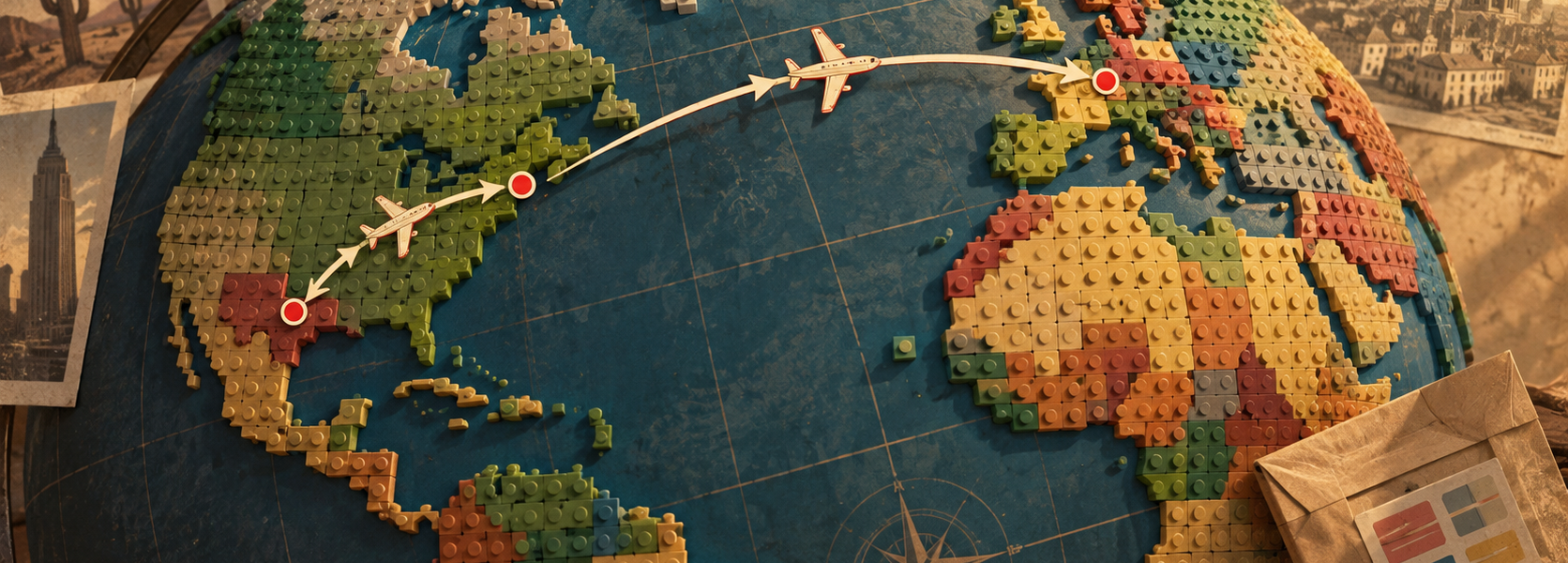
I did not have a direct friend in New York. I reached someone there through mutual acquaintances — effectively, a friend of friends. That New York contact then found someone in Texas who was willing to make the local purchase.
The chain ended up looking like this:
Texas seller → Texas contact → New York contact via mutual acquaintances → Poland.
The Texas contact bought the sheet locally. It was then moved to New York, and from there the international leg to Poland was arranged.
Two and a half months for one sticker sheet
Every step added time. There were messages, handoffs, domestic transport, international shipping and import formalities.
The entire process took about two and a half months.
By the time the sheet reached Poland, the original $20 asking price had become almost irrelevant compared with the total acquisition effort.
From $20 to more than $300
This is where secondary-market economics gets interesting.
The sticker sheet itself was worth around $20 to the seller. That was the item’s market price in that transaction.
But the actual acquisition cost was much higher. There were intermediaries, domestic transport, international shipping, customs charges and the time required to find, coordinate and manage the entire chain. My own work organizing the purchase and transport also had to be part of the final cost.
Once everything was included, the total rose to more than $300.
That does not mean the sticker sheet suddenly had a $300 market value. It means delivering that specific surviving example to that specific collector in Poland cost more than $300.
Market value and acquisition cost are not the same thing
This distinction matters in serious collecting.
- Market value is what the item itself is trading for.
- Acquisition cost is what it actually costs to get that exact item into your collection.
In a liquid market with many sellers, those numbers can be very close. In a thin market with one available seller, geographic restrictions and multiple intermediaries, they can diverge dramatically.
The client knew what he was paying for
The client understood from the start that this was not a normal parts order. He paid up front, accepted the costs and was prepared to wait.
What mattered was not finding the cheapest workaround. He wanted the original, unused sticker sheet.
After roughly two and a half months, it arrived in Poland. The job was complete, and the client was satisfied.
Why a sticker sheet can be harder to replace than a rare brick
This story captures something important about the vintage LEGO market: the hardest item to replace is often not the largest or most expensive part in the set.
An unused sticker sheet can have extraordinarily low surviving supply because normal ownership destroys the very condition collectors later want.
A brick can survive decades of play and still remain a brick. A sticker sheet usually cannot survive ordinary use and remain a sticker sheet.
Scarcity is sometimes logistical, not just numerical
The final lesson is that rarity is not only about how many examples exist. It is also about whether the surviving examples are accessible.
In this case, the item existed and the asking price was low. The real challenge was that the seller would not ship it where it needed to go.
The value of the service was therefore not merely finding the sheet. It was creating a functioning acquisition route where none existed.
Texas → New York → Poland.
About two and a half months, several people, more than $300 in total, and one unused sticker sheet that most owners of a similar set in the 1990s would never have thought to preserve.