

I’m not the sort of LEGO Technic part people admire first. The gears get studied. The engines get turned over. The cranes get photographed. I usually disappear behind a beam with my ends pushed onto two tiny fittings.
I’m a pneumatic hose. Just a flexible tube, really. No teeth, no motor, no heroic sound effects. My job is to carry air from one part of a machine to another without letting it escape. When a cylinder lifts a bucket, the bucket gets the applause. I get a sharp bend and another day at work.
Still, I’ve seen things. Or, if you prefer the technically precise version, generations of hoses like me have seen things. And our story begins in 1984, when LEGO Technic discovered that a model could do more with air than simply trap it inside its tyres.
1984: I Had One Connection and Two Very Different Jobs
My first workplace wasn’t especially comfortable. It was full of studded beams, switches, a hand pump and cylinders that looked wonderfully important. The 8040 Pneumatic Universal Building Set, 8843 Forklift and 8851 Excavator were among the first machines to give me something useful to do. In the excavator, three pneumatic cylinders helped move the boom, dipper and bucket. I snaked through the structure trying not to get in anybody’s way.
The original system was clever, but it asked quite a lot of a small hose. Each working cylinder had just one air connection. When the pump forced air into the cylinder, pressure pushed the piston and extended the rod. So far, so simple. But a bucket also needs to come back down, and a cylinder must sometimes pull rather than push.
For that, I had to help carry something that sounds like the opposite of air: vacuum. A special distribution block, with one-way valves, allowed the pump and switch to either pressurize the cylinder or remove air from it. When air was drawn out, atmospheric pressure acting on the other side of the piston helped retract the rod. I wasn’t delivering a mysterious pulling force. I was helping create a pressure difference.
That distinction mattered. The atmosphere can only push so hard, which limited the pulling force. The early system was also more involved to plumb. Imagine my job description: deliver pressure, help create suction, keep the connections airtight and please don’t get pinched behind that excavator arm. A fairly ambitious career for a piece of tubing.
Yet the result was remarkable. A builder could operate a digging arm without having to run a long mechanical drive through every joint. I could bend around corners where an axle simply couldn’t go. For once, being flexible was a professional qualification.
1989: The Best Thing Happened to Me — Another Hose Arrived
Five years later, my working life changed. LEGO introduced double-acting pneumatic cylinders, with an air port at each end. I finally had a colleague.
We didn’t talk much. Hoses rarely do. But we worked beautifully together.
Here was the new arrangement: a switch sent compressed air through me into one end of the cylinder, while my partner provided an escape route for air at the other end. Reverse the switch, reverse our jobs. The piston moved in the other direction because compressed air now entered the opposite chamber. We no longer needed the old vacuum distribution block to reverse the cylinder.
There was a small technical catch: the piston rod takes up space on one side, so the cylinder doesn’t develop exactly the same force in both directions at the same pressure. Still, this was a substantial improvement over depending on atmospheric pressure for the return stroke.
You could see what it made possible in 8854 Power Crane and 8862 Backhoe Grader. More controlled lifting, digging and movement meant more reasons to route us around the machinery. I had acquired a partner and, somehow, twice as much work.
1992: Nine Volts Joined the Team
Until then, I had been accustomed to the rhythm of a hand pump. Press. Release. Press again. I never complained, although the operator occasionally did.
Then along came 8868 Air Tech Claw Rig in 1992, a big truck with a pneumatic crane and a gripping claw. Under its body was an entirely new kind of colleague: an electrically driven air compressor. A 9V motor drove a small pump, which supplied compressed air to the pneumatic circuit. The switches still directed the flow. The cylinders still did the pushing and pulling. I still carried the air.
It’s worth saying that last part clearly. Electricity did not travel through me, and the motor did not magically turn every joint of the crane on its own. The motor ran the pump; the air system did the pneumatic work. Mechanical power and compressed air were finally sharing a particularly busy truck.
And busy is putting it mildly. The original model routed 23 flexible pneumatic hoses around its structure, including lines running through the crane’s turntable. The routing mattered: leave too little slack and the rotating equipment could tug at the hoses. Some of the crane’s turning movement was pneumatic, too. For a hose, this was a prestigious assignment with some rather inconvenient working conditions.
I didn’t mind. The Claw Rig proved that air power could be part of a wonderfully intricate Technic machine rather than a single party trick at the end of an arm.
1997: I Met Someone Who Could Save Air for Later
In 1997, I encountered a blue component with an unexpectedly calm personality: the air tank. One of its appearances was in 8459 Pneumatic Front-End Loader.
While I was forever moving air onward, the tank could hold a reserve of compressed air. Pump it up, and the stored pressure could supply cylinder movements without another immediate stroke of the hand pump. It also helped smooth the delivery of air. It wasn’t a source of free energy, of course; somebody still had to compress the air first. But it let the system use that effort a little more conveniently.
For the first time, someone in the circuit seemed happy to do absolutely nothing for a moment. I was almost jealous.
2003–2011: I Became Part of a Crowded Network
There’s a point at which a pneumatic model stops looking like a few connected parts and starts looking like a small city’s underground services. For me, that point was 8455 Back-hoe Loader in 2003.
It used ten pneumatic cylinders and seven control switches. Ten. Seven. Try keeping your connections straight with that many possible destinations. The front loader, rear excavator and stabilizers all needed carefully routed air lines. A misplaced connection could send the wrong cylinder into action. I was no longer just the route from a pump to an arm; I was part of an entire control network.
Technic construction was changing around me as well. Studless beams and pin-based assemblies were becoming increasingly important, and pneumatic components evolved to fit the newer building language. That gave me different mounting points and increasingly inventive places to hide. If you’ve ever wondered why a hose sometimes seems to vanish deep inside a Technic model, I assure you I haven’t gone on holiday.
My old friend the motor-driven compressor turned up again in 8110 Mercedes-Benz Unimog U 400 in 2011. A motor powered its air pump, leaving the pneumatic circuit to operate the relevant functions. It was a welcome reminder of the lesson I’d learned in the Claw Rig: gears, motors and air do their best work when none of them insists on doing everything alone.
2015: Someone Called Me ‘V2’ and I Had Questions
Then came 42043 Mercedes-Benz Arocs 3245 in 2015. A huge truck, a crane, a grabber, a motor-driven compressor — and a redesigned family of pneumatic parts under the name Pneumatic System V2.
V2? I thought. Didn’t I already get a second generation back in 1989?
The naming needs a little care. The cylinders introduced in 1989 were historically the second major generation of the LEGO Technic pneumatic system. The V2 name on the 2015 upgrade was a product designation, not a claim that nothing had changed in the intervening decades. I’d changed homes, routes and fittings more than once by then.
The new parts brought practical improvements. Longer pneumatic cylinders expanded the range of movement available to builders. Revised, beveled connection ports made it easier to attach hoses. That last improvement might sound minor unless you’ve spent your entire career gripping tiny plastic fittings. To me it was headline news.
The Arocs also showed how much could happen in one model. Its motor could power different mechanisms through the gearbox, including the pneumatic pump, while switches controlled the crane’s pneumatic movements and grabber. The flexible hoses had to find their way into a rotating structure and around an elaborate arm. The spectacle belonged to the truck; the responsibility for delivering air still belonged, in part, to us.
Even the experience of building with me had changed over the years. Older sets supplied long lengths of pneumatic tubing for builders to cut themselves. More recent sets supplied hoses already cut to the required lengths. LEGO confirms the change, although I can’t give you a reliable year for when the practice began. What I can say is that a hose has always had mixed feelings about being introduced to a pair of scissors.
2023: Apparently, Retirement Is Not for Me
Four decades after my first appearance, I was still finding work. The 42157 John Deere 948L-II Skidder, released in 2023, used pneumatic functions to operate its blade and gripping claw. Different machine, different shapes, familiar principle: create pressure, control its destination, move a piston.
Sometimes people mistake a pneumatic cylinder for a hydraulic one because both can look like the actuators on construction machinery. I understand the confusion. Real excavators commonly use pressurized hydraulic fluid; LEGO Technic has often used compressed air to model similar movements. I carry air, not hydraulic oil. That difference is part of what makes my story interesting.
I’m not a collector’s showpiece. I don’t have the dramatic silhouette of a crane or the satisfying click of a gearbox. And no, I cannot lift a load on my own. But leave me out of a pneumatic circuit, or let me come loose from a fitting, and the impressive machinery suddenly has a problem.
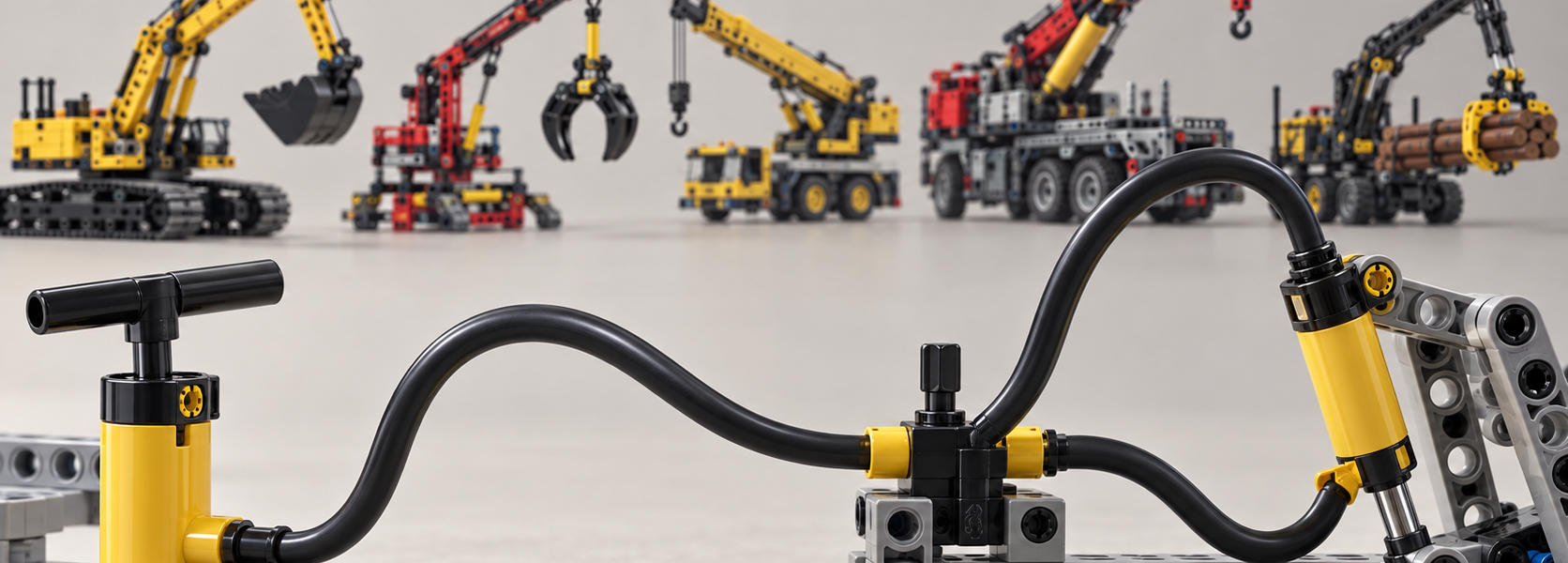
So next time you see a Technic excavator, crane or log-handling machine, take a closer look at the small flexible lines disappearing behind the beams. One of them might be me, quietly passing air along while everyone watches the bucket.
And if you ever take an old model apart, pull me off the fittings gently. After forty-plus years of helping things move, I’d appreciate a little consideration.
If You’d Like to Check My Memory
I’m a storyteller, so I’ve given the hoses a voice. The engineering and dates, however, are grounded in documented LEGO history. You can trace the earliest systems in Technicopedia’s 1984 archive and its 1989 account, explore the wider development in BrickNerd’s history of LEGO pneumatics, and read LEGO’s own explanation of pneumatic tubing. Just remember that the jokes are mine. The dates aren’t.