
60 Years of Motorized LEGO Trains: From 4.5V Batteries to Bluetooth

Imagine an operating LEGO railway with two stations, a freight yard and trains running throughout a long exhibition day. The familiar challenge is not simply how to make a locomotive move. It is where the electricity should come from, how the driver controls speed, and how much of the railway’s infrastructure must work together to keep the trains running.
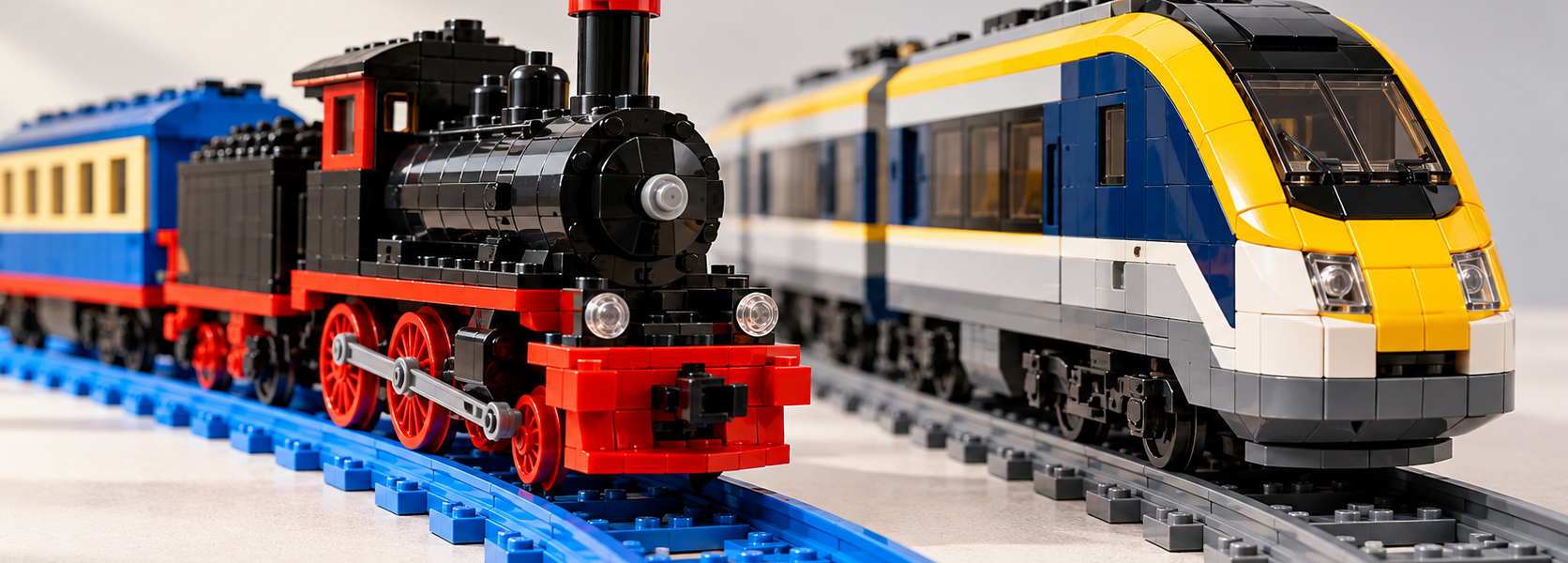
Over six decades, the LEGO Group has offered strikingly different answers. Its trains have carried batteries, collected electricity from a central conductor, drawn current through metal running rails and responded to infrared or Bluetooth controllers. Each shift changed what builders could do easily—and what they gave up.
2026 marks 60 years since LEGO’s first battery-powered trains running on track debuted in 1966. It is not the 60th anniversary of every LEGO train. The distinction matters, and it offers a better starting point for understanding how the hobby evolved.
Before the motor: LEGO trains are older than 1966
The company’s train history reaches back to its wooden-toy years. According to the LEGO Group’s historical archive, wooden trains were among the company’s products from the 1930s. The first fully movable brick-built plastic train followed in 1964, after the introduction of LEGO wheels. Those trains were pushed along by hand, rather than powered by an electric motor on a dedicated railway.
The 1966 development therefore marked a different kind of breakthrough: a child could build a train, place it on the newly introduced blue rails and watch it propel itself. That transformed the railway from something to push into a system to operate.
1966: 4.5V put the electricity on board
In the first motorized generation, a 4.5-volt battery supply powered the train itself. Blue plastic rails guided the wheels but did not deliver electrical current. This separation between track and power made the basic idea easy to understand: the locomotive brought its own energy source and followed a route assembled from track sections.
It came with practical limitations. Batteries needed replacing, the power pack occupied valuable space and controls were much simpler than those of later layouts. But LEGO was experimenting almost immediately. In 1968, the company introduced an Electronic Train that reacted to a special whistle. Blowing the whistle could start, stop or reverse the train. Acoustic control may seem unusual now, but it shows that the desire to control trains without directly touching them predates modern remotes by decades.
1969–1980: a railway powered through its infrastructure
In 1969, LEGO added a 12V alternative. Electricity came from a transformer and ran through additional conducting elements placed between the running rails. The train no longer had to carry the same battery arrangement as a 4.5V locomotive. This was more than an electrical change: it shifted the focus from a self-contained toy toward a powered model railway.
The company expanded that idea in 1980, when it introduced a dedicated train product line and changed the track’s familiar color from blue to grey. LEGO’s historical archive records 28 sets in the first year of this new line, including locomotives, rolling stock and train sets. The grey-track 12V era is remembered by enthusiasts for its elaborate railway accessories, including ways to operate points, signals and other infrastructure.
For a builder interested in a station or a freight yard, this could make the railway feel like a miniature transport system rather than a single train circling a table. The cost was complexity. Transformers, conductors, switches, wiring and clean electrical contacts all became parts of the layout that needed attention. A preserved 12V system is not simply an older-looking version of today’s plastic track: it uses its own electrical arrangements and accessories.
1991: the 9V railway made the running rails conduct electricity
The next major change came in 1991. LEGO replaced the older electric train systems with 9V track, in which the running rails themselves had metal conducting surfaces. A speed regulator supplied power through those rails to the motor’s metal wheels. Unlike 12V, there was no separate central power rail.
For adult hobbyists, track power offered a compelling operational advantage. A train could run for extended periods without having to stop for replacement batteries. It also reduced the amount of battery equipment that had to be fitted into the locomotive. This mattered when builders wanted more of the interior devoted to a detailed cab, boiler or passenger space.
But the railway now depended on its electrical network. Dirty rails and contacts, loose connections or voltage loss across a complex layout could interrupt running. Long track-powered systems could be rewarding to maintain, yet diagnosing an unreliable locomotive might mean examining the route as well as the motor. The later move away from conductive rails therefore solved some problems while bringing others back.
2006: battery-powered remote-control trains returned
When LEGO moved away from the 9V metal-rail system, the power supply moved back on board. The Passenger Train 7897 is dated 2006 in LEGO’s official building-instructions catalog. It belongs to the short-lived remote-control (RC) generation, with onboard batteries and infrared control.
Some retrospective accounts describe the RC period as running from 2007 to 2009, but the official release date of set 7897 demonstrates why a collector should distinguish broad era labels from the actual dates of individual products. Michael Gale’s BrickNerd engineering history characterizes the RC hardware as an interim arrangement with a specialized train chassis that integrated batteries and electronics.
What changed for layouts was fundamental: plastic track could be used without a powered metal rail network. The train carried the electronics needed to move and respond to commands. The trade-off was the return of battery replacement, the space taken up by the integrated components, and reliance on a particular controller.
2010: Power Functions made the hardware more modular
The Passenger Train 7938 and Cargo Train 7939, released in 2010, are useful reference points for the Power Functions train generation. A motor, battery box, infrared receiver and remote formed a more flexible system than the earlier dedicated RC train chassis. Builders could use compatible Power Functions components in custom train designs, choose how to fit them into the body and experiment with motorized rolling stock.
That flexibility was particularly appealing to the international adult fan community, where custom locomotives, longer trains and public exhibition layouts are important parts of the hobby. However, infrared control brought its own limitations. The receiver needed to pick up a signal and remote channels had to be matched correctly. LEGO’s support guidance explains how Power Functions remotes and receivers use four selectable channels.
There is also an important nuance to the date: 2010 refers to the well-known Power Functions train sets, not the invention of Power Functions itself. LEGO also offered the enthusiast-oriented Emerald Night locomotive (10194) in 2009. The company’s train history recounts discussions between adult LEGO train fans and designers concerning that model. These examples show that the train community influenced the product culture as well as building with the resulting parts.
2018: Powered Up brought Bluetooth to the rails
In 2018, Powered Up appeared in trains including Passenger Train 60197 and Cargo Train 60198. Rather than the older infrared receiver and Power Functions plugs, the system used a Bluetooth-enabled hub, compatible motors and a matching remote or supported app control.
LEGO’s official 60197 product description highlights a ten-speed Bluetooth remote and specifically notes that it is not compatible with earlier infrared-controlled LEGO trains. This is not a minor footnote. The Powered Up motor uses a different cable and plug arrangement from the Power Functions motor; the respective electronics and controllers are not directly interchangeable.
Bluetooth can make train operation convenient, especially when a layout has several moving trains or a builder wants to explore app-based controls. It also places more of the railway’s functionality inside the locomotive and the digital system around it. That invites new questions about component compatibility, available space for a hub and how the train can be controlled if a particular app or device is not being used. A battery-powered Bluetooth railway is not automatically easier for every collector than a well-maintained analog system.
The compatibility trap: track gauge is only the beginning
The LEGO Group’s train support page says it has maintained the width of its railway track across generations. This explains a remarkable continuity in the LEGO train experience. It does not mean that every rail segment from every decade connects directly to every other segment, nor that all the electrical systems can be exchanged freely.
There are at least four separate compatibility questions:
- Gauge and wheel geometry: will the rolling stock run correctly on this track profile, including curves, points and clearances?
- Track-section connections: can these physical track pieces actually be joined in the proposed layout, or would a transition need a separate solution?
- Electricity: is the train powered from conducting rails, a central conductor, or its own battery box?
- Control electronics: is the motor compatible with the receiver, hub and remote or app being used?
A 9V locomotive that relies on electrical pickup cannot obtain power from the non-conductive running rails of a modern plastic track system. Older 12V trains need their own appropriate power infrastructure. In contrast, a newer internally powered Power Functions or Powered Up train can travel over suitable old track without drawing current from it. Even then, the builder must verify the joints and physical fit of the particular parts involved.
LEGO is explicit about another boundary: Powered Up hubs do not directly support Power Functions motors, and older Power Functions receivers cannot directly drive Powered Up motors. Changing a remote is not enough to turn one system into another.
Six generations compared
| Generation | Power source | Typical control | Main consideration |
|---|---|---|---|
| 4.5V (1966) | Onboard batteries | Simple controls; separate whistle experiment in 1968 | Vintage battery hardware and track components |
| 12V (1969; grey-track era from 1980) | Track-centre electrical conductors | Transformer and railway accessories | Dedicated conducting track and wiring |
| 9V (1991) | Metal running rails | Track power regulator | Clean contacts and conductive track |
| RC (2006) | Onboard batteries | Infrared remote | Specialized electronics and battery space |
| Power Functions trains (2010) | Onboard batteries | Infrared remote and receiver | PF-specific components and plugs |
| Powered Up trains (2018) | Onboard batteries and hub | Bluetooth remote or app | PU-specific hub, motor and controls |
This table simplifies overlapping release periods into representative milestones. The practical question for any individual train is which motor, power source and controller are actually fitted, rather than which label an online seller uses.
How international train builders approach the different systems
For collectors in Europe, North America and elsewhere, choosing a railway generation is also a choice about preservation and availability. An original 12V installation appeals to people who enjoy mechanical and electrical railway operations, but it depends on functioning old equipment. A 9V layout can offer continuous running from the rails, yet the condition and availability of metal track are critical. Modern battery-powered trains are less dependent on conductive infrastructure, but their electronics, battery space and compatible control equipment become essential.
Adult fans often build far beyond the simple loop included in a retail box. Long trains, yard switching, public exhibitions and highly detailed custom locomotives turn maintenance and power architecture into meaningful design decisions. Michael Gale’s technical comparison notes that the motor-bogie format has remained broadly recognizable for decades even as the cable systems and internal hardware changed. It is a useful reminder that mechanical familiarity does not mean plug-and-play electrical compatibility.
Buyers of retired train sets should therefore inspect more than the model’s appearance. The condition of rails and electrical contacts, battery holders, cable insulation, plugs, remote controls and motors can determine whether a set is usable. A vintage locomotive sold as complete may still need testing before it can run reliably. Resale asking prices, inflation-adjusted historical retail prices and the cost of assembling an operating layout are different measures; we do not infer collector value or likely investment performance from age alone.
Sixty years of choices, not a straight line of progress
The most surprising aspect of LEGO train history is its recurring dilemma. Battery-powered trains in 1966 gave builders freedom from electrified track. Twelve-volt and nine-volt systems moved that complexity into the railway itself, enabling new forms of control and long-running layouts. RC, Power Functions and Powered Up shifted the power back into the train while expanding the options for remote operation.
None of these approaches is universally superior. The elaborate station controls of a vintage 12V layout, the steady running of a 9V track-powered locomotive and the flexibility of a Bluetooth-equipped modern train serve different ideas of what makes a LEGO railway satisfying. The constant, across those sixty years, is the pleasure of building a railway that actually moves—and discovering just how many engineering choices sit behind that movement.
Sources and further reading
- LEGO Group historical archive — LEGO Trains, 1930s–1991 and fan-built examples
- LEGO Customer Service — train-system compatibility, Power Functions and Powered Up
- LEGO — Passenger Train 7897 (2006) official instructions
- LEGO — Passenger Train 7938 (2010) official instructions
- LEGO — Passenger Train 60197 (2018) official instructions
- LEGO — 60197 Bluetooth remote control specifications and compatibility note
- Michael Gale, BrickNerd — Making Trains Move: a technical history of track and motors
- BrickLink — historical train-set catalog by year and system