

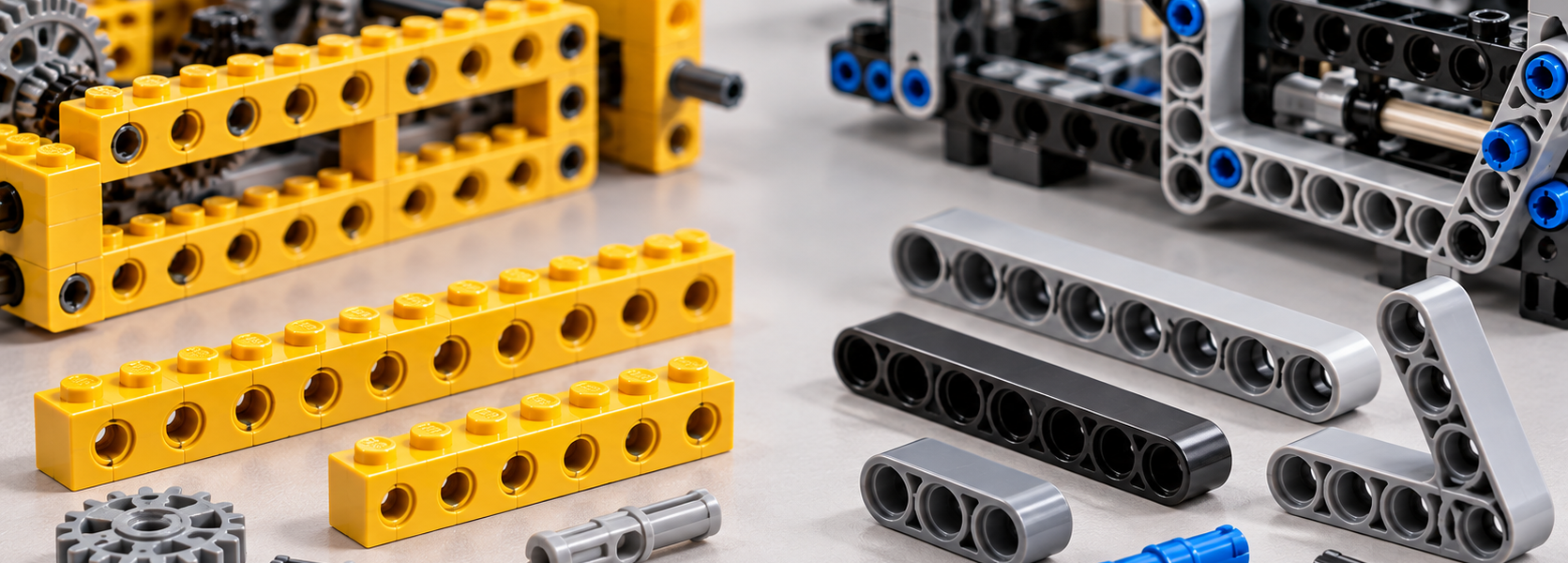
LEGO Technic’s Studless Revolution: From Studded Beams to Liftarms

Take a classic LEGO Technic chassis from the 1980s and a more recent liftarm-built frame. Both can carry gears, axles and working mechanisms, but they ask the builder to think differently. On the older chassis, rows of studs make the structure grow upwards in recognizable layers. On the newer one, smooth beams meet at pin holes, and supports can extend in several directions before the frame is closed.
Calling this the studless revolution is useful, provided we do not imagine a single year when LEGO simply removed the studs. Thin liftarms arrived years before full-size ones, the first larger studless elements appeared within mostly traditional models, and the transition took much of the late 1990s and early 2000s. The more interesting story is how an expanding family of parts changed the engineering language of Technic.
The original Technic idea combined two building systems
The first models in the range that later became LEGO Technic appeared in Europe in 1977. Early versions were sold under descriptions including Technical Sets in the United Kingdom and Expert Builder in the United States, where the initial models arrived in 1978. The now-familiar Technic brand name was introduced in 1982. That naming history matters when collectors search for early instructions and boxes: a model can belong to the origins of Technic without carrying the word on its packaging.
Studded Technic beams were ingenious hybrids. Their top studs worked with conventional bricks and plates, while side holes accepted axles and connecting pins. A builder could stack beams as structural courses, then add gears, steering linkages, suspension components and supports. The resulting models often left the machinery exposed, making the relationship between structure and function easy to see.
That approach remained capable of complex engineering. It also came with geometrical constraints: a conventional beam has the height of a brick rather than the more nearly square cross-section of a full-thickness studless liftarm. When mechanisms are arranged vertically or at unusual angles, hole positions and plate offsets have to be planned carefully. Changing the available part geometry would eventually make a different kind of chassis practical.
1989: a liftarm was a useful component, not a new era
One early milestone was the thin 1 × 4 liftarm or modified connector known as part 2825, documented in sets from 1989. The piece lacked the familiar row of upper studs and could form compact links and moving arms. But the existence of a small studless part did not mean that LEGO Technic suddenly had a complete studless structural system.
The distinction between thin links, full-thickness beams and models predominantly built from those beams is central to the timeline. Specialist histories by Brickset and BrickNerd both describe this as a gradual change. A part can be valuable inside a traditional chassis long before there are enough related parts to replace that chassis.
1996: the Space Shuttle demonstrated the new shapes
The Space Shuttle 8480, released in 1996, offers a clear illustration. LEGO’s official instruction archive dates the set to that year and lists 1,366 pieces. The model is remembered for its elaborate working systems, especially the payload-bay doors. Its design used the full-thickness angled studless beam 6629, catalogued as a 4 × 6 angular beam. According to Brickset’s retrospective, the shuttle used ten of these parts in white to form the distinctive bay-door structure.
Why is that more important than simply having a new element? An angled beam establishes a relationship between holes without requiring a stack of rectangular bricks to approximate the shape. It can support a curved or sloping assembly while keeping the pin connections part of the structural geometry. For the shuttle, the angled pieces helped achieve the intended outline and movement within the constraints of the build.
Yet 8480 was not a fully studless model. Its importance lies in being a transitional design: a mostly familiar Technic construction incorporating a part that hinted at how later frames could be assembled. The part itself did not reveal the complete direction of the theme. That becomes visible only when we look at the next several years.
1997–2000: the parts range began to form a system
Brickset’s part-by-part timeline shows another full-thickness angled beam arriving in 1997 (32009). In 1998, some small Technic models were already built without traditional studded structural beams. A right-angle beam followed in 1999 (32140), and the transition accelerated in 2000 with straight, full-thickness liftarms in 5L and 15L lengths (32316 and 32278).
Straight beams were a particularly important addition. Angular pieces could solve special problems, but a structural building language needs ordinary lengths that can be repeated, joined and braced. With straight liftarms, angled elements and connectors available together, builders could increasingly create a complete chassis around pins and axles. By 2001 and 2002 further lengths filled gaps in that range.
There was no universal switch-over date. Larger models continued using traditional beams alongside newer parts while smaller products experimented more freely. That overlap also makes some contemporary claims that Technic ‘became studless in 1996’ misleading. A landmark part appeared then; a broad change in construction practice followed later.
2003: Back-Hoe Loader 8455 shows a complete design language
By 2003, the system had matured. The Back-Hoe Loader 8455 is a useful case study because its engineering is immediately visible in its moving equipment. LEGO dates the 703-piece set to 2003. Technicopedia describes its pneumatic architecture as using ten cylinders, controlling functions including the loader, excavator and outriggers.
This is exactly the type of model that benefits from mounting mechanical and pneumatic subsystems in three dimensions. A working excavator assembly must hold its pivot points in relation to its cylinders and linkage arms. Studless liftarms allow builders to position those elements through aligned pin holes and supporting frames, without relying on a tall stack of traditional studded beams as the primary chassis.
Technicopedia identifies 2003 as a watershed for fully studless Technic models and notes that updated pneumatic components adopted studless-friendly mounting points. That second detail is especially revealing: the evolution was no longer limited to the beams. The mechanisms attached to them were also being adapted to a pin-connected construction system.
Calling 8455 a milestone should not obscure the wider point. It was possible because numerous beams, pins, frames and compatible mechanisms had appeared across preceding years, not because one entirely new construction method arrived in a single box.
Studded versus studless: the geometry behind the change
The two approaches share compatible LEGO building dimensions but organize their structures differently. In a typical studded Technic build, studs and plates define layers, with holes running through brick-height beams. A thick studless liftarm, by contrast, follows a more regular, approximately one-stud module in cross-section, with holes spaced on the LEGO grid. It can be placed vertically, horizontally or diagonally using pins and connectors.
That sounds like a small difference, but it changes the planning process. With traditional beams, the builder frequently starts from a solid base and attaches assemblies to it. With liftarms, the builder can start at a pivot point or gearbox and develop a framework around the mechanism. Frames are closed with cross members and bracing to hold axes and joints in the right relative positions.
It also means that connections to ordinary studded bricks need thought. A five-hole liftarm and a five-stud studded beam cannot be assumed to behave identically in every orientation simply because their nominal length sounds similar. The heights, connection locations and available clearances must align. Pins with studs, connector bricks, plates and other transition parts make mixed construction possible, but the resulting geometry has to be checked rather than guessed.
Strength depends on the whole frame—not the absence of studs
One persistent misunderstanding is that every studless structure is automatically stronger than every studded one. Neither the historical record nor ordinary engineering principles support that conclusion. A frame’s behavior depends on the position of its loads, the joints and bracing, the number of connection points and how components resist bending or twisting.
A single long liftarm may bend. Two liftarms connected only at their ends can permit unwanted movement. A well-designed closed box structure, or a frame reinforced by diagonal members, can behave very differently. Studded beams can likewise form rigid layered frameworks when their connections are properly supported. Pins introduce useful modularity but also have their own clearances and degrees of freedom. The goal is not to select a winning beam in isolation: it is to create a stable path for forces through the model.
Technicopedia notes that studless builds can retain some flexibility, including under torsional loading. That is a useful counterweight to claims that newer construction must always be mechanically superior. Without controlled comparisons of equivalent structures, broad statements about greater strength or reliability are not measurements.
Part counts tell a different story after the transition
There is a less obvious consequence for people comparing classic and modern sets. Studless construction relies heavily on separate pins, axles and connectors. A frame that once used layered beams can now contain multiple small fastening pieces. That means a higher part count is not necessarily evidence of a physically larger model or a proportionate increase in functions.
This is particularly relevant to the collector’s habit of comparing ‘pieces per set’ across decades. A 1980s Technic vehicle and an early-2000s studless machine use different structural conventions. Price-per-piece calculations, too, lose much of their meaning without considering which pieces do the structural work, which are connectors and what the finished mechanism can actually do.
The practical MOC choice is often to combine both methods
For today’s custom builder, the useful question is where each connection system earns its place. Studded beams can make it straightforward to attach conventional brick-built cabins, floors or body panels. Studless liftarms are valuable for suspension arms, gearboxes, steering linkages, excavator mechanisms and compact frames with multiple directions of connection.
Three practical design checks follow from that distinction. First, locate the critical pivot points and gear axes before arranging decorative panels. Second, consider whether the frame can resist twisting once the model is lifted or a mechanism is loaded. Third, plan access to the pins and axles that must be inserted late in the assembly; a connection that looks possible in an isolated drawing may be blocked by a completed surrounding structure.
For collectors restoring an older model, mixing generations is also a question of authenticity. A replacement beam may achieve the same functional result while departing from the original construction or color. That is an individual collecting choice, not proof that modern parts are invariably the better answer. BrickLink and archived LEGO instructions can help identify the intended parts for a specific set.
A revolution in construction, not a verdict on the past
The early studded beams gave LEGO Technic its identity as a bridge between ordinary LEGO building and working machinery. Thin liftarms in 1989, angled full-thickness beams in the 1996 Space Shuttle, expanding straight-beam options in 2000 and the studless Back-Hoe Loader in 2003 gradually established a different way of designing mechanisms.
The real achievement was not a smoother surface. It was the freedom to assemble structures around the geometry of moving parts rather than primarily building upwards from stacked bricks. Classic beams did not become useless, and studless assemblies did not remove the need for careful reinforcement. They expanded the builder’s toolbox. The most interesting Technic models—official or fan-made—still depend on understanding what each kind of connection can and cannot do.
Sources and further reading
- Brickset — 1996: The Beginning of the End (Huw, 2016), chronology of studless liftarms.
- BrickNerd — When Technic Wasn’t Technic (Ronald Vallenduuk, 2024), early Technic branding and history.
- LEGO — Space Shuttle 8480 official instructions and set record, 1996.
- LEGO — Back-Hoe Loader 8455 official instructions and set record, 2003.
- Technicopedia — 2003: New Pneumatics, studless models and mounting parts.
- Technicopedia — Backhoes, mechanism comparison and model 8455.
- BrickLink — sets containing thin liftarm / modified connector 2825.