
From Wooden-Style Shutters to Modern Hinged Panels. How LEGO Changed One Tiny Detail Over 50 Years

Some LEGO elements are tiny, ordinary and instantly nostalgic. Classic shutters are a perfect example.
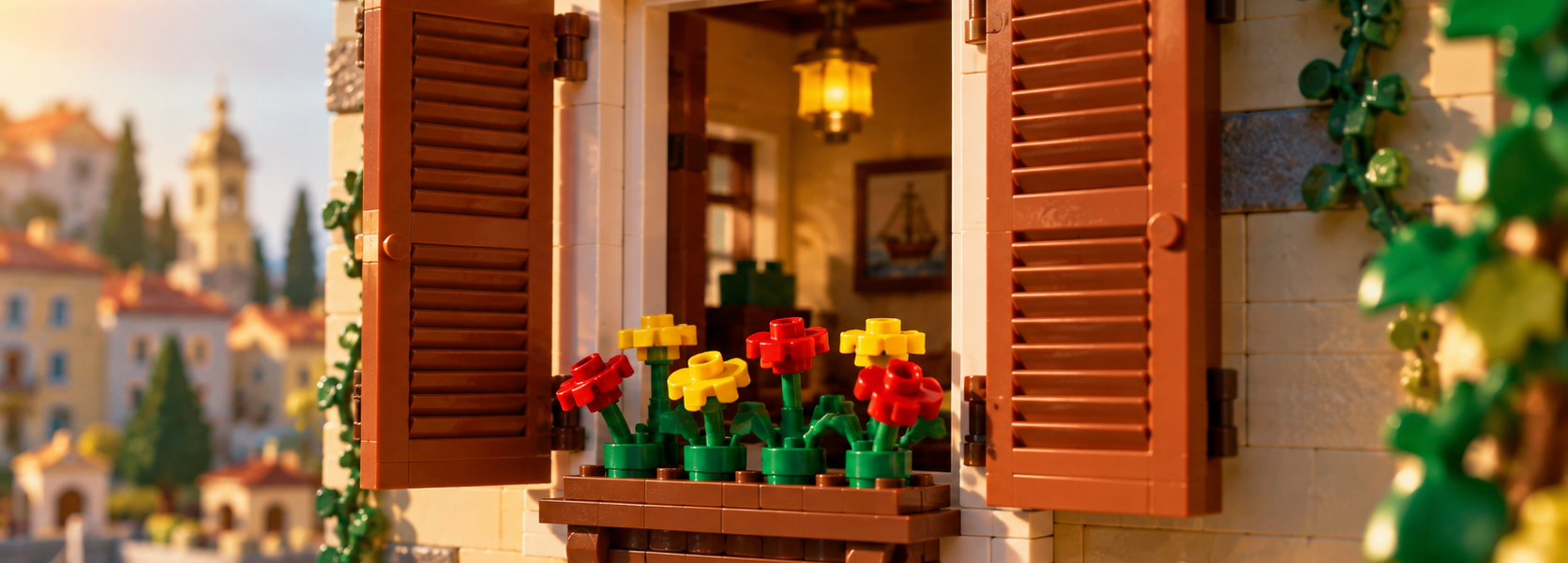
For many builders, they were one of those details that made a simple façade feel like a real house. The oldest versions had narrow horizontal slats that strongly suggested traditional wooden shutters or louvered panels.
LEGO never officially called them “Mediterranean” or “Spanish” shutters. That is simply a visual association. But it is a useful one, because these parts had a very distinctive architectural character.
3582 — the small shutter that appeared in 1973
One of the earliest and most recognizable examples is Shutter for Window 1 x 2 x 2, part 3582.
BrickLink lists it from 1973 to 2003 and records it in 97 sets.
Its narrow slats immediately make it read as a miniature wooden shutter. It appeared across LEGOLAND, Town, Train, Castle, Western, Technic and Universal Building Set categories.
That range is important. Although the part had a very specific visual identity, designers found uses for it far beyond one kind of house.
3856 — the larger classic shutter
The most iconic classic shutter may be the taller 1 x 2 x 3 version, part 3856.
BrickLink dates it from 1978 to 2007 and lists it in 148 sets.
This is the element many fans associate with classic Town, Pirates, Castle and other older architectural builds. Its proportions and horizontal slats make the wooden-shutter effect even stronger than on the smaller 3582.
In ships, forts, shops and houses, it could give a simple wall instant atmosphere without requiring a large number of decorative pieces.
A collector detail: grooved and non-grooved variants
Part 3856 also has an interesting catalog detail.
BrickLink notes that the part exists in versions with and without grooves around the shutter edge.
That difference does not radically change how the element functions, but it is exactly the sort of production variation that matters to part collectors and people cataloging older LEGO inventories.
The old shutter was unmistakably a shutter
One reason these classic parts are so memorable is that they were highly specific.
When you look at 3582 or 3856, the visual message is immediate. They look like architectural shutters. They carry a strong sense of style before they are even installed in a model.
That could transform a simple façade. A few shutters could make a building feel warmer, more traditional, more coastal or more old-fashioned.
It is a good example of an older design philosophy: a part might be less neutral and less universal, but it could have far more character.
Why the old system began to disappear
The classic shutters worked with older window-frame systems and were tied closely to a particular type of construction.
Over time, LEGO increasingly moved toward parts that could serve several roles.
A component that can function as a shutter, door, flap or decorative panel gives set designers and MOC builders more flexibility than one intended almost exclusively for one window system.
60800 — a short transitional stage
A new generation appeared in 2008 with part 60800.
Its construction was fundamentally different, using its own side hinges instead of relying on the older shutter-and-window system.
This original version had a relatively short life, associated with only a small number of sets in the 2008–2010 period.
Looking back, it feels like a transitional part between the old specialized shutter system and the more flexible approach that followed.
60800a — the modern hinged shutter
The longer-lived successor is 60800a, cataloged as Shutter for Window 1 x 2 x 3 with Hinges and Handle.
BrickLink lists it from 2008 through 2026.
Its design is more modular. Because the element has integrated hinges and a handle, it is easier to use beyond a conventional window.
It can work as a shutter, small door, flap, wall panel or decorative surface. That makes it much more in line with modern LEGO part design: less tied to one interpretation and easier to repurpose.
Where the modern shutter appears
Part 60800a shows up in very different kinds of sets.
10228 Haunted House uses four reddish-brown shutters, where they reinforce the worn, traditional architecture of the building. 3677 Red Cargo Train uses the part in dark bluish gray, while 41318 Heartlake Hospital uses it in white.
It also appears in The Lone Ranger sets such as 79109 Colby City Showdown and 79110 Silver Mine Shootout.
That spread demonstrates the part’s versatility. The same basic shape can read as an old wooden shutter, an industrial flap or a clean modern panel depending on color and context.
From decoration to multipurpose element
The evolution of LEGO shutters mirrors a broader shift in part design.
The older elements were:
- highly stylized,
- strongly tied to one architectural role,
- rich in visual character,
- excellent for creating atmosphere quickly.
The newer designs are:
- more modular,
- easier to use outside a window,
- more visually neutral,
- more flexible for MOCs and contemporary set design.
Neither approach is inherently better.
The old shutter is memorable precisely because it looks unmistakably like a shutter. The newer one is useful because it can become several different things.
A tiny part with a long design history
From part 3582 in 1973, through the classic 3856, to the modern 60800a, LEGO shutters show more than 50 years of change in the building system.
It is a small detail, but the trend is clear: from strongly stylized, purpose-specific architectural parts toward elements that are more modular and multifunctional.
That may be why the old shutters still trigger so much nostalgia.
They did not merely close a window.
They gave a building a personality almost instantly.