
LEGO Replay Explained: Where Donated Bricks Go and What the Numbers Mean

Imagine clearing out a cupboard and finding a box of loose LEGO bricks. There are wheels but no car, a few minifigures with mismatched accessories, and hundreds of pieces whose original sets are long forgotten. You could sell them, give them to someone nearby, or put the box back on the shelf. In several countries, there is another option: LEGO Replay.
It sounds like a straightforward donation scheme. Send in old bricks, and children get to play with them. But following that box reveals a much larger operation: carriers, sorting and cleaning, independent charities, classroom distribution and different rules in different countries. There is also a twist. LEGO Replay in the UK does not operate in the same way as the programme in the United States and Canada.
This is part six of Brick Current’s series exploring what the LEGO world does beyond selling sets. This time, instead of listing charitable initiatives, we’re following one programme and asking who runs it, how it works, who pays, who benefits and what the available evidence can actually tell us.
One name, two very different routes for old bricks
First, the essential distinction. In the United States and Canada, donors send eligible used elements into a system that sorts, checks, cleans and redistributes bricks for children to build with. The recipient is not promised the same set or a particular family’s complete donation: the point is to keep usable elements in play.
The United Kingdom uses a different model in its take-back pilot. The LEGO Group says donated bricks are transformed into other useful items, including storage boxes for toys. These new containers are then filled with LEGO bricks and supplied to schools and charities. The donated material that becomes a container is not itself being handed to a child as the same intact brick.
That is the difference between reuse and material recycling. Both may have a role in keeping resources in circulation, but they are not interchangeable outcomes. Treating every Replay donation as a brick that goes straight to another builder would misrepresent the UK initiative.
How the LEGO Group started Replay in 2019
The LEGO Group launched the US programme on 8 October 2019 as a pilot. Its announcement named Give Back Box as a partner in handling the donated bricks and Teach For America and Boys & Girls Clubs of Boston among the initial organisations involved in reaching children. These are independently run partners, not divisions of the LEGO Group.
That corporate distinction matters. LEGO Replay is a LEGO Group initiative, not a LEGO Foundation grant programme and not a LEGO Education product. The LEGO Foundation is a separate organisation with its own purpose and finances. Here, the commercial company organises and promotes the take-back programme, while outside organisations perform crucial logistical and social-delivery work.
The company describes Replay as a way to extend the useful life of durable bricks and make play more accessible to children. It also fits the LEGO Group’s stated ambition to make its business more circular. It is reasonable to see a reputational benefit for a manufacturer that invites people to return products they bought years earlier, but that is an editorial observation, not proof of an undisclosed motive. A programme can serve a social purpose and the brand at the same time.
Donating in the United States: what can you actually send?
For US readers, Replay is a practical service rather than an abstract corporate project. Its published process is simple: choose your eligible bricks, disassemble finished models, pack them in a cardboard box, obtain the prepaid UPS label and drop off the parcel. Under the US terms last modified on 18 March 2025, participation by individual donors is limited to adults aged 18 or over who own the elements or are entitled to transfer them. The service covers every US state, including Alaska and Hawaii.
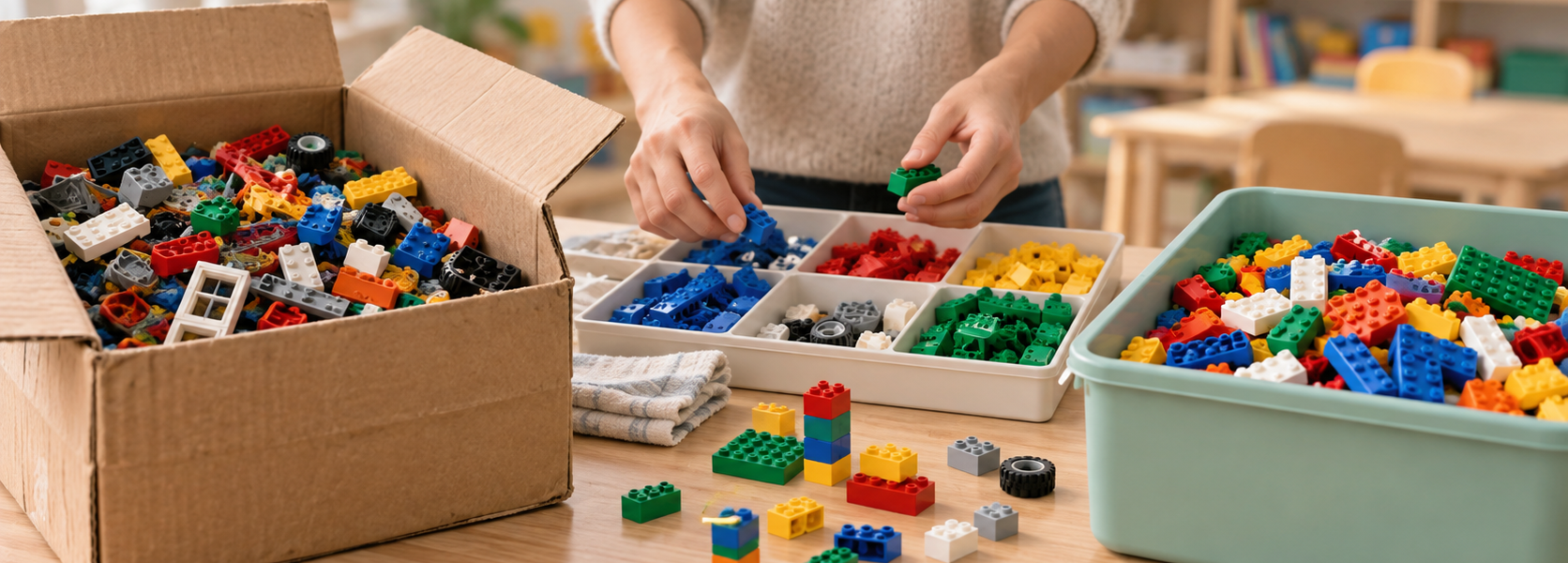
The eligible pieces include LEGO System, DUPLO and Technic elements, minifigures, mini-dolls and baseplates. Loose wheels and compatible LEGO parts can be included. Bricks do not need to form a complete set or be in mint condition. Donors do, however, need to remove electronics and batteries, items made by other brands, building instructions, packaging and unrelated merchandise. Built or partially built sets must be taken apart first. The programme may remove pieces that are badly damaged or create safety concerns.
Donors do not have to clean everything before shipping: the programme says donated pieces will be sorted and cleaned. LEGO’s published US terms also contain details that are easy to overlook. The donation is voluntary and unpaid, and the programme does not provide donation-related tax paperwork. Ownership transfers to the organiser when the carrier receives the parcel. Items judged ineligible are not returned to the sender.
Those conditions deserve attention from anyone clearing out a valuable old collection. Replay is not a valuation service, a trade-in for store credit, or a way to track what happens to a rare part. A collector with sought-after elements may prefer to identify and redistribute those pieces separately before sending a mixed donation.
What happens after the UPS box leaves your hands?
According to LEGO’s programme materials, the bricks go through inspection, sorting and cleaning before being packed into new Replay boxes. These are assorted collections of elements for open-ended building, accompanied by activity ideas rather than the instructions for the original sets.
Importantly, the US terms permit the organiser to combine different donations and include other used or new LEGO bricks where needed to create a useful play experience and meet commitments to charity partners. That means the contents of one household’s parcel cannot be assumed to travel intact to one particular classroom. It is a pooled redistribution operation.
Give Back Box is identified in LEGO’s own materials as a donation-handling partner, while First Book is central to reaching educators. The US terms specify that Replay boxes are distributed through First Book’s membership network to teachers and programme leaders in Title I school communities. First Book is an independent educational-equity nonprofit. It brings an existing relationship with schools and educators that a toy manufacturer would not necessarily have on its own.
The classroom context is significant. A box can be used repeatedly by a group of children; it need not become the property of a single recipient. That can be a very efficient way to provide hands-on resources, but it makes the simplistic question ‘How many children received a box?’ harder to answer.
What a partner’s figures tell us: First Book’s classrooms
First Book has published a particularly useful account of its work with the LEGO Group’s Build the Change educational activities. On its partnership page, it reports that 27,717 Brick Play Boxes were donated to its classrooms through LEGO Replay during the 2025–26 school year. The same page separately describes an earlier campaign in which 18,006 Brick Play Boxes supported participating classrooms.
These are partner-reported distribution figures for specified initiatives, not a reason to add both quantities together. They may cover different reporting periods or related programmes, and the page does not provide the reconciliation needed to establish a non-overlapping grand total. Nor should the 2025–26 course-pack and virtual-event reach of 702,240 children be relabelled as the number of children who individually received Replay boxes. That figure describes wider educational activities.
Still, the First Book data adds something valuable beyond a promotional statement. It identifies a distribution network, a concrete unit delivered to classrooms, and the educational work in which those resources are intended to be used. It does not, by itself, demonstrate that a particular number of children achieved a measurable long-term learning improvement.
Canada: the same broad idea, a different charity network
Canada also operates LEGO Replay for donated bricks to be prepared and passed on. Its current official page accepts LEGO System, DUPLO, Technic, minifigures, mini-dolls, baseplates, tyres, rims and axles while excluding electronics, batteries, other brands, instructions and packaging. As elsewhere, donors should use the local eligibility rules and shipping process rather than an American label.
The Canadian page identifies Right To Play, True North Aid, First Book Canada and the Canadian Red Cross among the organisations associated with the programme. Each name represents a different outside network, not a local subsidiary of the LEGO Group.
There is a small historical uncertainty worth preserving. One LEGO Group sustainability page states that Replay followed its US debut with a Canadian launch in 2020; the company’s January 2024 UK announcement instead says 2021. Those references may relate to different stages of a rollout, but neither source explains the discrepancy. We can establish the Canadian service; we should not invent one definitive expansion date.
In Britain, the donated brick may become something else
The UK pilot was announced on 18 January 2024. Rather than simply replicating the North American route, LEGO said it would explore turning returned plastic bricks into objects such as storage boxes. Those containers would then be filled with LEGO bricks and distributed through charitable partners to schools and community organisations. LEGO’s current UK guidance continues to describe transformation into new items.
For British donors, the present rules allow LEGO System bricks, minifigures, mini-dolls and baseplates, but exclude DUPLO and Technic. That differs from the US and Canadian lists. The UK page says donors in England, Scotland and Wales can use participating DPD drop-off locations, with a collection service for Northern Ireland. A mixed collection of Technic beams and ordinary bricks should therefore not be posted without checking the UK acceptance list.
The partner references have also changed across LEGO’s published materials. Its 2024 launch announcement and an Argos-related page name In Kind Direct; the main UK Replay page currently identifies The Multibank. These references establish participation in different documented contexts, not a verified date on which one partner replaced another. Presenting a neat handover story would go beyond the evidence.
The UK’s approach also raises an interesting policy question. If an intact brick is made into a new plastic container, that material continues to have value, but the original brick can no longer be reused as a brick. Which approach is preferable may depend on the condition of the donated pieces, the processing method and realistic alternatives. The programme’s name alone cannot answer that question.
191,000 boxes and 300 million bricks: the 2024 results in context
On 30 October 2024, the LEGO Group marked Replay’s fifth anniversary with a set of cumulative US figures: 191,000 Replay boxes distributed across the 50 states and Washington, DC; 300 million bricks put back into use; more than 10,000 educators reached; and nearly 400,000 children reported as benefiting from the programme.
These are company-reported results for the period up to that announcement, not live totals for October 2026 and not an independent study of educational impact. The boxes and bricks describe quantities moving through the system. The figure for children is a reach estimate, which requires a further methodological qualification.
The LEGO Group’s 2025 Annual Report, page 38, explains that some of its reported child-reach figures rely on partner estimates or company assumptions. Specifically, the number of children attributed to each Replay Box Donation is estimated using regional samples. In other words, a reported reach figure should not be read as a register of individually verified children who each received a specific box. Estimates can be useful, but readers deserve to know that they are estimates.
The reporting questions are straightforward. Do the counts refer to bricks collected or redistributed? Are boxes for individual children or shared classrooms? Do programme numbers overlap with partner education campaigns? And what exactly has been measured: delivery, participation, enjoyment, or lasting educational outcomes? A credible assessment of Replay must keep those categories separate.
Who pays to collect, clean and deliver used bricks?
The donor-facing US process includes a prepaid shipping label, and the UK advertises its own local freepost arrangements. Yet shipping is only one cost. Somebody must process parcels, inspect and clean pieces, remove unusable material, prepare assorted boxes, manage storage and reach recipient organisations.
The LEGO Group is the programme owner and describes how its charity and logistics partners contribute to the operation. The published material does not, however, provide a standalone, fully itemised annual Replay budget showing the split of all these costs among the company and every partner. We therefore cannot responsibly calculate a reliable cost per box, cost per child reached, or total annual spend from the available figures.
Nor should the budget be casually attributed to the separate LEGO Foundation. Reporting that the LEGO Group operates Replay is not the same as documenting which organisation paid each invoice in a complicated supply chain. Where financial detail is unavailable, the honest description is that the detail has not been established.
Is Replay better for the planet? A useful claim, but not a complete calculation
There is a clear and verifiable practical outcome in North America: usable bricks can be collected and passed forward to more play. That is a form of product reuse. The UK pilot demonstrates a separate route in which donated material can be repurposed through recycling into new objects. Both belong in discussions of circularity, but neither is proof that every journey through the programme necessarily creates a particular reduction in emissions.
Work by the Ellen MacArthur Foundation on circular design distinguishes keeping products in use from recovering materials when products can no longer serve their original purpose. Reusing a brick preserves its existing form; melting or processing it into a container does not. That principle helps frame the question, but it does not substitute for a comparative lifecycle assessment.
To evaluate the programme’s full environmental balance, we would need consistent data on shipping distances, washing and drying, sorting losses, the energy required to recycle material, the useful life of the redistributed bricks or new containers, and what alternative products or disposal routes were actually displaced. We could not verify one comprehensive, comparable public lifecycle analysis covering all regional Replay models. The figures released so far support descriptions of collection and redistribution. They do not justify inventing a precise CO2 saving.
There is a practical counterpoint. The LEGO Group itself encourages owners to pass bricks to family, friends, local schools or charities when that is suitable. If a nearby classroom can use an unwanted box, a long-distance parcel is not automatically the most sensible way to keep those bricks in play.
Where Replay is available—and where it isn’t
As of 25 October 2026, the official regional options documented for this article are the United States, Canada and the UK pilot. Replay is not an automatically worldwide mail-in programme, and a donation label issued for one country should not be assumed valid in another. Readers outside those markets should check LEGO’s current country-specific website or arrange a suitable local donation.
This matters especially for an international audience. A US collector with mixed DUPLO and Technic can follow rules that a British donor cannot. A Canadian school may work through an entirely different charity network from one in the United States. Same name; different operating details.
Replay is not Build to Give
In the previous instalment, we followed LEGO Build to Give: a campaign in which participants build and share a themed creation while the LEGO Group pledges new sets to charity under the particular campaign’s terms. Participants are not donating the bricks in their photographs.
Replay reverses that starting point. Here, people physically donate used elements, and the programme must inspect, prepare and move those donated materials through partner networks. The two initiatives may support access to play, but their mechanics, eligible items, costs and success measures differ. Their reported reach numbers should never simply be combined.
What LEGO Replay shows about the company beyond the toy aisle
LEGO bricks have always had a useful property: they can be played with long after the original box, theme and instructions have disappeared. Replay tries to put an organised system behind something families often do informally—handing toys on.
Its substance lies less in the slogan than in the mundane details. There are documented boxes delivered through First Book, country-specific charity networks, published donor terms and reported quantities of redistributed pieces. Those are observable activities. There are also unresolved questions about full operational cost, consistent global figures, the comparative environmental footprint of different routes and how educational benefits should be measured.
So the most revealing question may not be how many millions of bricks LEGO Replay has handled. It may be this: what has to happen between someone giving away a box of mismatched pieces and children actually being able to use them? Replay is a real attempt to bridge that distance. Understanding its partners, rules and evidence is what makes the story worth telling.
Sources and further reading
- The LEGO Group — LEGO Replay launch announcement, 8 October 2019.
- The LEGO Group — fifth-anniversary results, 30 October 2024.
- LEGO Replay USA — eligibility, packing and shipping guidance; US donor terms, updated 18 March 2025.
- LEGO Replay Canada — local rules and named donation partners.
- The LEGO Group — UK pilot announcement, 18 January 2024; LEGO Replay UK — current donation rules and The Multibank; UK / Argos material describing In Kind Direct.
- First Book — Build the Change partnership and classroom Brick Play Box figures for 2025–26.
- The LEGO Group Annual Report 2025, page 38 — child-reach methodology and regional sampling for Replay Box donations.
- The LEGO Group — Keeping bricks in play.
- Ellen MacArthur Foundation — Circulate products and materials.