
When LEGO Used Fiber Optics: The Forgotten 9V Lighting System of the 1990s

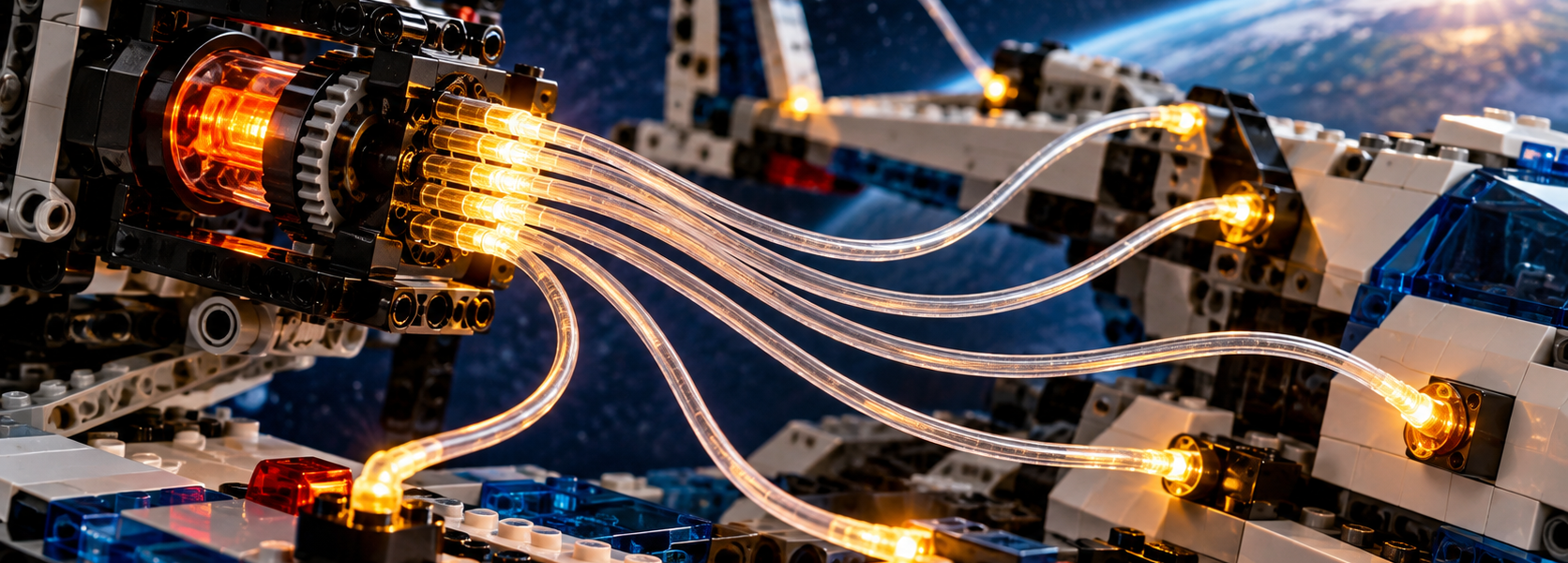
The engines of the 1996 LEGO Technic 8480 Space Shuttle did something unusual. Tiny red points of light appeared to travel around the rear of the model. There wasn’t a light bulb in each nozzle, or a separate electrical connection running to every glowing tip. Instead, a compact unit inside the Shuttle fed light into eight thin, transparent cables.
It was a wonderfully strange meeting of mechanics, electronics and optics. LEGO called the arrangement its Fiber Optic System (FOS). For a brief period between 1996 and 1998, it brought a distinctly futuristic effect to Technic, UFO Space and an early MINDSTORMS accessory set. Then the system disappeared from the regular catalog.
What makes it worth revisiting is the much larger story hiding behind those eight little cables. The principle of guiding light through a fibre had already helped transform medicine and telecommunications by the time LEGO adopted it. Today, optical fibres form much of the internet’s backbone, can act as highly sensitive measurement instruments, and are being redesigned to carry light through hollow, air-filled cores. And they raise an irresistible thought experiment: what if LEGO had developed its glowing cables into a system that let models exchange digital information using light?
The forgotten LEGO component: eight light paths, one powered unit
LEGO’s optical system was built around a compact grey electrical element, powered through the familiar 9V system, with eight sockets for clear optical cables. A cable could carry the light from the unit to a remote point in the construction. This was not a set of eight electric wires with miniature bulbs at their ends: the fibre cables carried light, not electrical current.
The unit also accepted a Technic axle. When that axle turned, the light appeared sequentially at the cable ends. If you stopped turning the axle, the programmed-looking sequence stopped as well. Electrical power and mechanical rotation therefore had different jobs: the former supplied light, while the latter selected which outlet was illuminated. The rotation could be driven by a hand crank, a motor or gearing elsewhere in the model.
To a child watching the Shuttle’s engines, the effect was a sequence of fiery pulses. To a builder tracing the mechanism, it was something even more satisfying: a physical selector that moved the light between different destinations.
A 1990s patent reveals the thinking inside the box
There is original engineering documentation behind this unusual LEGO component. Interlego AG’s US patent 5,733,167, entitled Building element having an incorporated source of light, claims priority from a Danish application dated 14 September 1995, was filed in the United States on 13 September 1996 and was granted on 31 March 1998.
The patent describes a light source mounted away from the axis of a rotating member, within a housing containing multiple light-exit openings. As the member rotates, the emitter lines up with successive openings. In a described implementation, the source is an LED, with electrical contacts designed to supply it while the mechanism moves. That offers a much more specific account than the loose idea that the unit simply contained eight independent LEDs switched in sequence.
A patent is not a teardown report, however. Its drawings and claims describe a protected design, not every material choice or possible revision of every manufactured unit. Independent descriptions of the finished LEGO element support the rotating-light principle, but we haven’t dismantled an original module or measured its internal performance. The distinction matters when explaining historical hardware rather than repeating a plausible-sounding guess.
Where did LEGO actually use fiber optics?
BrickLink’s inventory records identify the electrical unit in four model sets. Each made a different use of the same basic effect.
| Year | Set | Use of the optics |
|---|---|---|
| 1996 | 8480 Space Shuttle | Sequential lighting in the orbiter’s engine area |
| 1996 | 8456 Fiber Optic Multi Set | Light effects across five alternative models |
| 1997 | 6979 Interstellar Starfighter | Illuminated details on a LEGO UFO spacecraft |
| 1998 | 9732 Extreme Creatures | Lighting features in a MINDSTORMS add-on set |
There was also 5227 Cables for Fiber Optic, a 1997 service pack containing eight transparent optical cables. That pack is not a fifth complete optical model and should not be mistaken for the powered element itself.
8480 Space Shuttle: lighting that depended on the gearbox
The 8480 Shuttle remains the best demonstration of how the system could become part of a serious Technic mechanism. The model combined a main 9V motor with a four-function gearbox, a separate micromotor for its satellite and several manual functions. The light unit was wired into the main motor’s electrical circuit, but its sequencing axle was driven only when the appropriate gearbox position engaged.
That created a delightful engineering distinction. The optical unit could have power while the engine-light sequence remained stationary. Select the correct function, and the mechanical transmission finally rotated the optical selector. The cables ran towards the main engines, with the completed model’s optical layout also involving its smaller orbital-manoeuvring nozzles. The result was a moving light effect that looked like engine activity without any actual propulsion.
For anyone who enjoys that kind of mechanical integration, the Shuttle is also relevant to our separate history of the transition from studded Technic beams to liftarms. Here, however, the remarkable feature is not the Shuttle’s structure. It is the way a gearbox controlled a beam of light.
8456: five ways to use one strange part
The 8456 Fiber Optic Multi Set proved that the system was not limited to spacecraft. Its instructions offered five possible constructions: a helicopter, a hydroplane racing boat, a drag racer, a robot and a mechanical insect. In each, the optical unit acquired a different fictional role, from a simulated engine feature to an illuminated robotic brain.
The helicopter is particularly instructive. Turning a crank drove its rotor and, through bevel gears, the optical mechanism. The model did not need eight tiny electrical lamps in its body. Nor did the light sequencing require a computer program. Its timing came from the motion of a physical shaft.
This was the strongest creative argument for FOS: a child could use the same specialist component in several builds, inventing a different meaning for the same sequence of flashes.
From UFO to MINDSTORMS: the final two appearances
In 1997’s 6979 Interstellar Starfighter, the glowing cables helped make a LEGO UFO spacecraft look unusually alien. The system suited its science-fiction surroundings, but it also brought practical compromises. A retrospective contributor to Brickset praised the visual idea while criticizing the modest brightness, motor noise and the awkward way the relatively short cables held their shape. Those are observations from an owner’s experience, not laboratory measurements or proof that every unit behaved identically.
The last documented model-set appearance was 9732 Extreme Creatures (1998), associated with the first generation of MINDSTORMS. Its presence in that range is tempting to interpret as the beginning of an optical robot network. It wasn’t. The fibre unit was a lighting component, not a substitute for the RCX programmable brick, and the accessory pack was not a complete standalone robotics system.
That distinction is worth remembering when we turn to the digital possibilities later. A toy that looks electronic does not necessarily have a digital communication channel.
Why light can travel through a bendable fibre
The optical principle is easier to picture than many people expect. Light enters the end of a transparent fibre. With the right optical structure, it remains guided along the length instead of immediately escaping sideways. A typical communication fibre contains a core surrounded by a cladding with a lower refractive index. At suitable angles, total internal reflection helps keep the light inside the core. A fuller explanation describes the fibre as a waveguide supporting particular modes of light.
None of this means the fibre generates energy. Its job is to guide an optical signal created elsewhere. Real fibres also have losses: some light is absorbed or scattered, while excessive bending or damaged terminations can increase attenuation. This is why routing an optical cable through a model is not quite the same as routing an ordinary decorative string.
Industrial optical fibres can be made from extremely pure glass or from plastics. Glass fibres dominate long-distance telecommunications; plastic optical fibres can be useful for short connections, industrial devices and decorative illumination. We do not have a verified manufacturer specification for the exact polymer in LEGO’s original FOS cables, so it would be misleading to assign them a particular commercial fibre formulation.
And light guidance is not the same thing as glow-in-the-dark chemistry. A phosphorescent LEGO piece produces an afterglow after illumination; a FOS cable conducts light supplied to it. We covered the former in our history of glow-in-the-dark LEGO elements. The mechanisms should never be conflated.
Decades before the Shuttle: medicine, Charles Kao and the 1970 breakthrough
By the time FOS arrived in a LEGO box, optical-fibre research already had a long history. Experiments with flexible bundles of transparent fibres had led to methods of bringing illumination into difficult-to-reach places and, with properly arranged bundles, transmitting images. Work associated with researchers such as Harold Hopkins and Narinder Singh Kapany during the 1950s helped establish technologies that became valuable in medical instrumentation.
The much greater challenge was sending information across kilometres instead of centimetres. Early glass fibres lost too much light over long distances. In 1966, Charles Kao and George Hockham identified a path towards practical optical telecommunications: the losses could be dramatically reduced by improving the purity of the glass.
Then, in 1970, Corning researchers Robert Maurer, Donald Keck and Peter Schultz produced a low-loss glass optical fibre with attenuation around 16–17 decibels per kilometre. It sounds high against modern optical-network standards, but it crossed an important threshold for the era. The breakthrough helped turn fibre optics from a promising idea into a viable basis for long-distance communications.
The comparison with LEGO is not that the toy and a transoceanic cable were physically equivalent. They weren’t. The shared insight was that light could be created in one place and guided reliably to another. What engineers did with that insight depended on the materials, distances, signal electronics and purpose.
From the first networks to data crossing the ocean
Optical communications required much more than better glass. Engineers also improved transmitters, receivers, connectors, protective cables and signal regeneration. Practical fibre telecommunication systems developed through the 1970s. In 1988, TAT-8 became the first transatlantic fibre-optic telecommunications cable, a milestone in linking continents optically.
In a communications network, light is not simply there for someone to see. A transmitter encodes information into an optical signal; a receiver detects it and turns it into usable electronic data. Modern links can use sophisticated modulation and signal processing, with laser light often operating in the infrared, beyond what the human eye can see.
One major development is wavelength-division multiplexing (WDM). Several optical channels at different wavelengths can travel through the same fibre, each carrying its own data. Erbium-doped fibre amplifiers (EDFAs) help boost optical signals over long routes without converting each channel back to electrical form at every intermediate point. This is part of what allows a hair-thin fibre to support a vastly more demanding task than guiding a red glow across a LEGO spacecraft.
Today optical links support data centres, national networks and cables beneath the world’s oceans. According to the International Telecommunication Union (ITU), submarine telecommunications cables carry over 99% of international data exchange. This is a measure of international connectivity, not a claim that every last local Wi-Fi transmission or domestic data packet passes through the seabed.
These networks have vulnerabilities, too. Anchors, fishing activity, geological events and other damage can interrupt cables and require complex repairs. ITU’s work on submarine-cable resilience is a reminder that bigger capacity also means greater dependence on the physical infrastructure supporting it.
Fibre optics do far more than carry internet traffic
Medical instruments: illumination and imaging
Optical fibres can deliver light into a narrow instrument where a conventional lamp would be impractical. In fibrescopes, carefully arranged fibre bundles can transmit images as well. Many modern video endoscopes instead place a miniature camera near their tip, so it is inaccurate to claim that all present-day endoscopes carry the entire picture back through optical fibres. Some medical tools also use fibres to deliver laser energy to a treatment site.
The basic analogy to LEGO FOS is striking: keep the source somewhere convenient and deliver the light where it is useful. The materials, safety standards and scale are, of course, radically different.
Aircraft and bridges: a fibre becomes a measuring instrument
Fibres can also sense the conditions around them. Changes in strain and temperature affect measurable properties of optical signals. With suitable interrogation equipment, a single fibre can yield readings at many locations.
NASA’s Fiber Optic Sensing System (FOSS) provides a memorable example. NASA describes fibres up to 40 feet (about 12 metres) long offering as many as 2,000 data points to help assess structural loads, deformation and temperature. The technology has applications in aeronautics, rockets and structural monitoring. This is not a LEGO-style light pipe being used as an ordinary electrical sensor; it is precision optical instrumentation.
Earthquakes: listening along a cable
Distributed acoustic sensing (DAS) uses changes in light returned through a fibre to detect vibration and strain along its length. The US Geological Survey provides a map of experiments in which researchers use fibre-optic networks to investigate seismic activity and the subsurface. In the right configuration, a cable can act like an array of densely spaced measurements spread across kilometres.
That doesn’t mean every internet fibre is automatically listening to the ground. Appropriate equipment and analysis are essential. But it is a remarkable extension of what an optical path can do.
Navigation, factories and computing
Fibre-optic gyroscopes measure rotation through the differing behaviour of light sent around a loop in opposite directions, using an interferometric effect. They have uses in navigation and orientation sensing. Meanwhile, factories may use optical sensing and optical links in electrically noisy environments, and data centres rely heavily on optical connections between networking equipment. Short fibres also remain useful in display lighting and situations where the light source needs to sit away from the visible effect.
Across these examples the same physical medium may have very different jobs: guiding illumination, transporting encoded data, measuring motion or revealing changes in the surrounding structure.
The next frontier: moving more data, with less loss and delay
Modern optical research is not merely about making a cable more transparent. It also concerns more efficient lasers and detectors, denser wavelength channels, better signal processing and bringing optical links closer to computing chips. Technologies such as co-packaged optics explore how optical interfaces can be integrated near high-capacity network switching electronics. The goal is to improve bandwidth and energy efficiency, not to make every copper connection disappear overnight.
Researchers are also pursuing hollow-core optical fibres. Instead of guiding most of the light through a solid glass core, these use an intricately structured glass surround to guide light mainly through an air-filled region.
A Nature Photonics paper published in September 2025 reported an experimental hollow-core fibre with attenuation of 0.091 dB/km at 1,550 nanometres, together with an exceptionally broad low-loss window. The design also offers faster optical propagation than conventional solid-core silica fibre in relevant comparisons. It is a significant scientific result, but not a specification that can be assigned to all installed commercial fibre networks in 2026, nor a promise of a matching reduction in a household user’s entire internet latency.
The practical future will depend on how these breakthroughs scale: manufacturing quality, reliable joints, amplifiers, cost, deployment and compatibility with existing systems. The future of fibre optics is a systems problem as much as a materials problem.
The LEGO path that never developed: a town communicating through light
Return to that little grey FOS unit for a moment. It is difficult not to feel that a fascinating design avenue was left unexplored. This is an editorial reaction, not a claim that LEGO once announced and cancelled an optical-data product line. The documented FOS was for lighting effects, and we found no reliable evidence of an official plan to turn it into a digital network between models.
But consider an alternative version of LEGO’s technological history.
Imagine a brick-built spaceport. A shuttle docks and sends an encoded flash sequence down a transparent fibre. A receiving brick recognises the signal and illuminates the landing bay. Another connection alerts the cargo crane to begin moving. In a nearby LEGO town, a fire station could send an optical message to a railway crossing; the crossing could confirm that the barrier had lowered. Children would be building not merely moving models, but systems that exchange information.
For this to become real digital communication, an optical fibre by itself wouldn’t be enough. The construction would need a controllable transmitter, a receiver such as a photodiode, electronics capable of interpreting the timing or modulation of light, a power supply and a communication protocol. Two-way links would require an appropriate return channel or additional transceiver hardware. The 1996 unit provided none of that as a complete data platform.
There would be real trade-offs, too. Plastic optical connections can be bend-sensitive; users would need robust connectors, tolerances for misalignment and safe low-power light sources. Wiring up an entire city might be less convenient than wireless control. Nevertheless, the visible path of the signal could make such a system educational in a distinctive way: children could literally trace how information travelled from one model to another.
This is the missed opportunity that makes FOS compelling to revisit — not a secret canceled product, but a convincing possibility for learning through construction.
LEGO did build digital toys — using other technologies
There is an important correction to the more romantic version of that story. LEGO didn’t stop pursuing intelligent toys when FOS disappeared. In 1998, MINDSTORMS introduced programmable robotics to a much wider LEGO audience. Later generations expanded motors, sensors and programming options. Powered Up subsequently brought hubs, smart motors, sensors and Bluetooth control to different kinds of builds.
The story continues in 2026. On 5 January 2026, the LEGO Group announced SMART Play, combining a SMART Brick, SMART Tags and SMART Minifigures to produce interactive reactions during physical play. The first products were scheduled for release on 1 March 2026 in launch markets. The platform is a real example of the company making constructions respond to play — but it is not a continuation of the old fibre-optic hardware.
The distinction makes the counterfactual more interesting. LEGO explored interactive and programmable play through electronics, sensors and wireless technologies. Optical communication could have offered a different way to link modules, perhaps one that made the movement of information unusually tangible. We cannot say it would definitely have been cheaper, more durable or more popular.
Collector’s guide: identifying a complete LEGO FOS system
For a collector reconstructing 8480, 8456, 6979 or 9732, the first task is to distinguish the light-producing unit from the transparent cables.
- Electric optical unit: BrickLink catalog number 6637c01, with alternative item number 75815. This is the powered mechanism, not a single fibre.
- Transparent fibre cable: x165, also recorded under the alternate number 6640. The documented set inventories include eight cables with the optical arrangement.
- Service pack 5227: a pack of eight replacement optical cables from 1997, not a complete 9V light unit.
- Other dependencies: the original 9V leads, power components and mechanical drive arrangements must be checked against the inventory of the particular model. A loose unit and eight cables do not necessarily make an entire working set.
Condition deserves special attention. A Brickset owner rebuilding the 8480 described breaking a brittle optical cable and finding perished insulation on some electrical leads. That is a concrete account of one ageing set, not a statistical failure rate for all FOS parts. Avoid powering damaged wiring, forcing fibre ends into sockets, severely kinking the cables or improvising incompatible power supplies. We have not carried out hands-on tests of old electrical parts for this article.
Nor is there a verified official explanation for why the optical system stopped appearing after its brief catalog run. Short cables, limited brightness, motor noise and the cost or complexity of components are legitimate points to investigate, and some contemporary owners have criticized them. They should not be presented as the LEGO Group’s proven reasons for discontinuation.
The little LEGO light path and the much bigger story
FOS never became one of the great long-running LEGO component families. Its documented run was short; the parts are now a specialized chapter in the history of Technic and 9V electronics. Yet the principle behind them is almost impossibly far-reaching.
Light guided along a thin fibre can brighten a toy spaceship, transmit information across oceans or reveal tiny movements in a bridge or aircraft. The 1996 LEGO system wasn’t an early internet connection, and modern telecom fibres are not just enlarged versions of its transparent cables. What they share is the wonderfully versatile idea of putting light where it needs to go.
Perhaps the most intriguing question isn’t why the original lights disappeared. It’s what builders might have discovered if that visible path of light had become a way for their constructions to communicate.
Sources and further reading
- LEGO History — Space — the 8480 Space Shuttle and its fiber-optic engine effects.
- US patent 5,733,167 — Building element having an incorporated source of light — Interlego’s original rotating-emitter design.
- Technicopedia — 1996, 8480 Space Shuttle and 8456 Fiber Optic Multi Set — mechanical operation and set history.
- Brickset — 8480 Space Shuttle owner review and Brickset — Interstellar Starfighter retrospective — practical experience, strengths and limitations.
- BrickLink — optical unit 6637c01, cable x165 and set and service-pack appearances.
- Fiber Optic Association — Optical Fiber — how guided optical signals work.
- Corning — optical-fibre breakthrough — the 1970 low-loss fibre and its inventors.
- ITU — Submarine Cable Resilience — international connectivity and infrastructure risks.
- NASA — Fiber Optic Sensing Technology and USGS — Fiber Optic Seismology — distributed sensing applications.
- Ultrathin single-channel fiberscopes for biomedical imaging — medical optical imaging research.
- Nature Photonics (2025) — Broadband optical fibre with an attenuation lower than 0.1 decibel per kilometre — experimental hollow-core research.
- LEGO History — MINDSTORMS, LEGO Powered Up and LEGO Group — SMART Play announcement, 5 January 2026 — the company’s actual development of interactive play.