
LEGO Boats That Really Float: The History of Hulls, Ballast and Water Play

Imagine finding a bright red LEGO boat hull at a second-hand market. It has studs along the top, a strangely heavy piece underneath and nothing resembling a modern LEGO City minifigure. Is it simply a vintage ship model, or was it designed to go into the water?
For some LEGO boats, the answer is the second one. The company has made floating vessels for more than fifty years, beginning with dedicated hull systems in 1973. Their history is surprisingly different from that of brick-built display ships. The clever engineering isn’t necessarily in the deckhouse, crane or cabin. Often it is hidden below the waterline.
This is a journey from early weighted-keel tugboats and a remarkable Maersk container ship to molded hulls used by LEGO Town crews and today’s City rescue teams. Along the way, we’ll tackle two questions that matter to anyone restoring a vintage set: what makes a boat float, and how can you identify the correct hull without damaging it?
1973: three little ships built for actual water
LEGO had produced ship-shaped models before 1973, but that year brought a distinct line of purpose-built floating boats. The first group consisted of 310 Tug, 311 Ferry and 312 Tanker, the last of which also appears as Cargo Ship in historical writing. These were pre-minifigure vessels, yet the shapes were recognisable: a working tug, a ferry and a cargo carrier.
Instead of making a watertight bottom entirely from ordinary small bricks, the designs used dedicated hull sections. A weighted keel helped the assembled boat remain upright. Builders could still add cabins, funnels and other features with familiar LEGO parts, but the specialist pieces performed the demanding task of keeping the model suitable for water play.
BrickNerd’s historical survey also describes an optional battery-powered propeller motor used with some configurations of these early boats. The important word is optional. Neither the presence of a weighted keel nor a boat’s appearance is proof that a particular original box included a motor or that every keel variation offered the same motor attachment.
There were other ship models released under the Minitalia name around that time, but we do not need to catalogue every regional variation to understand what changed. The 1973 Boats range introduced a reusable principle: let purpose-designed hull components handle flotation, and let LEGO bricks create the ship above them.
A boat can float and still capsize: the difference between buoyancy and stability
To understand those heavy keel pieces, it helps to separate two ideas that are often mixed together.
Buoyancy is the upward force exerted by water. A boat settles into the water until it displaces enough water for that force to balance the weight of the boat and its load. A suitable hull shape provides the displaced volume needed to support the model. That is why a large ship can be made from materials denser than water and still float.
Stability asks a different question: after the boat tilts, will it tend to right itself or roll farther over? Hull shape and the distribution of weight matter greatly. Place too much mass high on the deck and even a buoyant model can become frustratingly easy to overturn.
A weighted keel addresses the second problem by placing mass low down and helping lower the boat’s center of gravity. As the hull heels, the relationship between the center of gravity and the center of buoyancy determines whether the forces create a restoring tendency. Harvard University’s Stability in Flotation demonstration illustrates the effect with differently shaped hulls and ballast positioned at different heights.
The keel is not a magical flotation device. Adding weight reduces the remaining load a hull can carry before it is submerged too deeply. The hull provides buoyancy; ballast can improve stability. Getting both right is what turns a toy ship from a tabletop construction into something meant for the bath or a shallow pool.
1974: Maersk made the floating hull much longer
One year after the original three boats came 1650 Maersk Line Container Ship (1974), a promotional model associated with the real shipping company. Brickset records 220 pieces, while BrickNerd’s survey describes a hull assembled from seven sections—the longest of that early family of floating ships.
It is a particularly revealing design. LEGO didn’t need to create an entirely unrelated single-piece boat bottom every time it wanted a longer model. A sectional approach gave designers a way to vary the length while retaining the core floating-hull concept.
Collectors should be careful with the Maersk name, though. The familiar later LEGO Maersk container ships include large display-oriented models. They share maritime subject matter and branding, not an automatic guarantee that their hulls are suitable for water. The relevant question is the specific set’s construction, not the name printed on its side.
Two weighted keels that look almost the same
For a person rebuilding a 1970s boat, the difference between two catalog entries can be more important than a missing railing. BrickLink distinguishes these variants of the Boat, Keel Weighted 8 × 2 × 4 component:
| BrickLink part | Catalog years | Identifying characteristic |
|---|---|---|
| x149a | 1973–1974 | No bottom tab; catalog weight approximately 50.4 g |
| x149 | 1976–1985 | Later mold variation with a bottom tab; catalog weight approximately 49.69 g |
BrickLink’s entry for x149a notes that the small fin-like extension on other keels was apparently used for attaching a motor. That is a qualified catalog observation, not an engineering statement from the LEGO designers. It should not be turned into a universal compatibility promise.
When identifying a loose vintage keel, examine the underside and compare it with photos and an inventory for the exact set. The catalog weights may help distinguish variants but are not measurements made for this article, and condition or manufacturing variation could affect an individual example. Neither a similar color nor a close weight proves that the wrong mold variation can replace the original without consequences.
From 1982 onward: the floating boat joins the minifigure town
By the early 1980s, the floating boat was no longer solely a small model of a vessel. It had become a setting for minifigure adventures. The 4005 Tug Boat (1982) brought the classic working tug into the world of LEGO harbor play. That year’s range also included the 4015 Freighter and 4025 Fire Boat.
Later models gave the waterway distinct jobs. 4030 Cargo Carrier (1987) offered a cargo ship with holds and an onboard crane, while 4011 Cabin Cruiser (1991) brought a recreational craft and furnished cabin into the picture. The Boats range continued through the 1990s, including 4022 C26 Sea Cutter (1996).
These models used molded hull components designed for water rather than expecting every seam between ordinary bricks to be watertight. Some employed one major hull piece; others used multiple sections. Brickset’s retrospective on the classic floating-boats range also notes that certain later vessels used additional weighted pieces to help with stability.
The result was a different style of play from the earlier stand-alone ship models. A boat could belong to a LEGO Town harbor, answer a fire alarm, carry containers or ferry the town’s residents. Minifigures, cabins and moving equipment were the visible attraction—but none of that would have been nearly as convincing on the water without the specialized base underneath.
What’s inside a floating hull? The 2372c01 assembly
Not every LEGO hull depends on an external weighted keel. Some later assemblies used flotation material enclosed inside the structure. A useful documented example is BrickLink part 2372c01, cataloged as Boat, Hull Unitary 25 × 10 × 4⅓ Floating with White Deck and recorded in sets from 1987 to 1996.
According to BrickLink, the assembly includes main hull 2372, deck 2373, a front polystyrene insert 70304 and two side polystyrene inserts designated 70344. The catalog adds that the identification numbers on some internal parts cannot be seen without destructive disassembly.
This has a direct practical lesson: do not prise apart an old floating hull just to find a molded number. If it is an intact factory assembly, its exterior proportions, color, deck design and set inventory are safer identification clues. A collector should not assume every old LEGO boat contains the same foam or that every sealed-looking hull can be serviced in the same way.
The use of an internal polystyrene insert is also a reminder that LEGO’s floating-boat engineering has not been a single, unchanged technology. Different generations solved the problem using different component arrangements.
Floating boats travelled beyond the harbor theme
Water play did not disappear when the classic Boats range ended. It simply found homes within other LEGO themes.
A particularly unlikely example is 76942 Baryonyx Dinosaur Boat Escape (2021) from LEGO Jurassic World. The official product description confirms that both the main boat carrying the dinosaur and the small speedboat float. Even a fictional dinosaur rescue scenario could make use of a genuine floating hull.
Then came 60368 Arctic Explorer Ship (2023). LEGO City presented a large expedition vessel with a captain’s bridge, equipment and a crane, and its official product page specifically calls the main ship a floatable toy boat. The presence of a helicopter and other accessories does not make all of those accessories water-safe; the floating feature is attributed to the vessel.
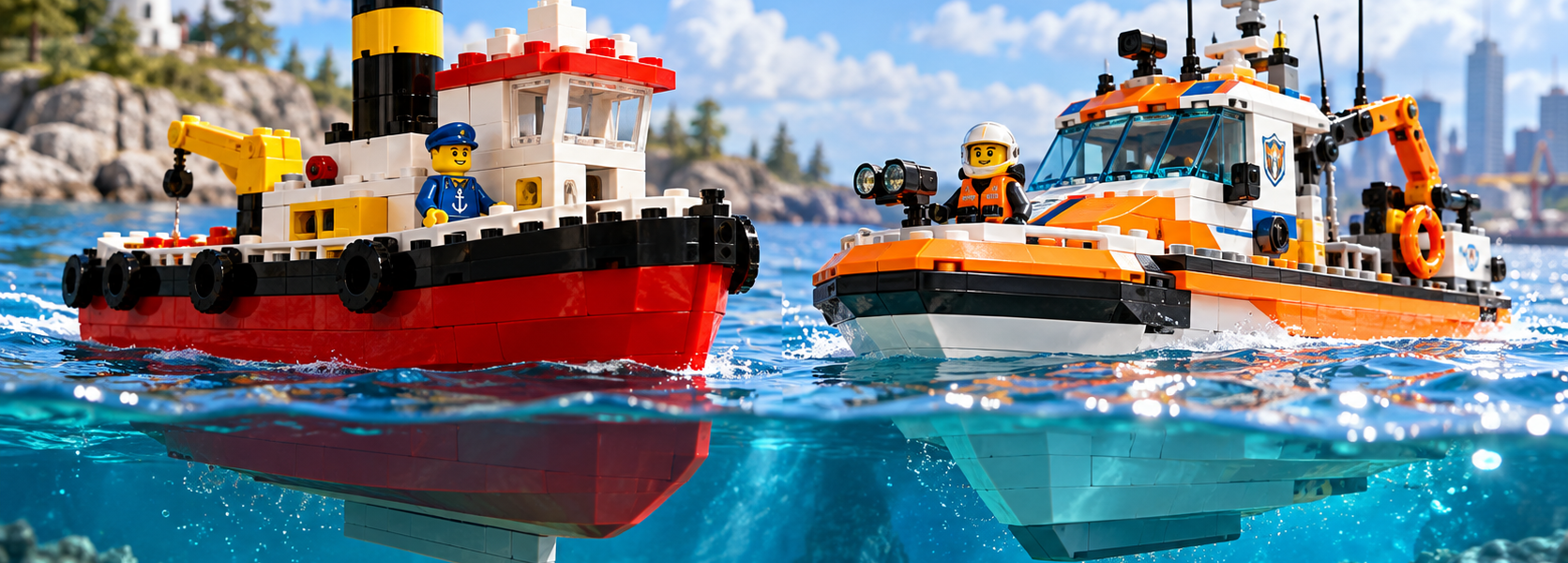
For a current example, consider 60504 Coast Guard Rescue Boat & Helicopter (2026). LEGO describes a large patrol boat with a removable deck, helicopter landing area and two small dinghies. The manufacturer’s claim is unusually precise: all three boats float. That’s the main boat plus the two dinghies—not the helicopter. It is an excellent modern illustration of how much play equipment can sit on top of a purpose-built floating hull.
A detailed model ship is not necessarily a floating LEGO boat
There is one distinction every ship enthusiast should make before taking a model anywhere near water: display accuracy and water performance are separate design goals.
A historical sailing ship might have a beautiful curved hull made from angled bricks, a Technic supporting frame, intricately arranged rigging and accessible interior cabins. Those techniques can be superb for realism and strength without making the structure watertight. Brick Current recently explored precisely that kind of project in our report on the BrickLink Designer Program’s Privateer Frigate Fortuna 910059. The article focuses on historical proportions and construction details, not a verified ability to float.
LEGO’s own customer service advice settles the wider question: standard LEGO bricks generally tolerate water, but most LEGO creations do not float. The company says that some specially designed one-piece boat hulls can float. It’s an important difference between a material surviving contact with water and a whole finished model being engineered for it.
So neither a picture of a ship on the ocean nor a set name containing the word boat should be treated as proof. Check the original product instructions and specifications.
A practical checklist for identifying a vintage floating boat
If you’ve discovered an old hull in a mixed collection, the following sequence is more useful than trying it in a bath immediately:
- Find the likely set number. An early 310, 311 or 312 is a different construction system from a 1980s Town boat or a modern City vessel. Consult the set inventory first.
- Check how the bottom is built. Look for sectional pieces, molded one-piece hulls, a separate keel, or a factory deck assembly. Shape and attachment details matter more than color alone.
- Distinguish weighted keel variants. Compare x149a with x149, paying particular attention to the underside. Do not assume that a motor fits merely because another old LEGO boat used a propeller.
- Preserve factory hull assemblies. For something resembling 2372c01, use exterior details and catalog records instead of taking the hull apart and damaging the internal polystyrene pieces.
- Inventory the rest separately. Minifigures, winches, windscreens, deck rails, stickers and instructions affect collectible completeness, even though they don’t determine the hull’s basic buoyancy.
- Look for a documented floating feature. Manufacturer descriptions, original instructions and relevant catalogs offer better evidence than a seller simply calling the item a ‘LEGO ship’.
These checks help with authenticity and completeness, but they do not guarantee that a particular 40- or 50-year-old specimen remains watertight or behaves exactly as it did when new. We have not carried out hands-on flotation, leak or stability testing of vintage LEGO hulls for this article.
Water-safe bricks are not water-safe electronics
Even with a genuinely floating LEGO boat, the surrounding components matter. LEGO’s official guidance advises keeping motors, sensors, lights and battery boxes out of water. The fact that early LEGO boats could use optional propeller motors does not mean their electrical components can be submerged.
The company also cautions against immersing sealed mechanical assemblies made from multiple internal components, such as Technic gearboxes. Water can remain trapped inside and lead to mold or mildew. Standard bricks can usually be cleaned with water, but a complex boat should be dried carefully according to the manufacturer’s instructions.
There is no reason to use a valuable vintage model as an improvised aquarium ornament. And for a fragile collector’s piece, identifying the hull through its inventory and external design is often a better choice than testing its seaworthiness. When water play is intended, use the correct configuration, follow the instructions, and keep the electronics and any other excluded components dry.
Fifty years of floating LEGO, one very simple question
The 1973 tugboat and a 2026 LEGO City coast guard vessel have little in common above deck. One is a compact pre-minifigure ship assembled from simple pieces; the other is a busy rescue playset with cabins, a landing pad and several craft. But both depend on the same fundamental insight: the part of a toy ship that makes water play possible is often the part you notice least.
Sometimes that meant a weighted keel. Sometimes it meant a molded shell with a concealed buoyant insert. Today it can mean a large ready-to-float hull beneath a complicated deck. Whatever the decade, the important question remains the same: was this ship designed just to look convincing, or was it designed to float?
Sources and reference material
- BrickNerd — Everything You Want to Know About LEGO Model Ships: 1973 boats, optional propeller motor and seven-section Maersk hull.
- BrickLink — Boat sets catalog: historical set records and inventories.
- Brickset — Maersk Line Container Ship (1650): 1974 release and 220 pieces.
- BrickLink — Weighted keel x149a and weighted keel x149: catalog years, tab differences and listed weights.
- Brickset — Collecting Old Sets #3: classic molded-hull Boats models and collector context.
- BrickLink — Floating hull assembly 2372c01: deck, polystyrene inserts and cautions on disassembly.
- Harvard University — Stability in Flotation: buoyancy, hull shapes and low ballast.
- LEGO — Baryonyx Dinosaur Boat Escape (76942): two floating boats.
- LEGO — Arctic Explorer Ship (60368): floatable exploration ship.
- LEGO — Coast Guard Rescue Boat & Helicopter (60504): three floating boats.
- LEGO Help — Are LEGO bricks waterproof?: ordinary bricks, floatable hulls and electronic safety advice.