
LEGO Fabuland: The Forgotten Animal Town That Put Storytelling Before Building

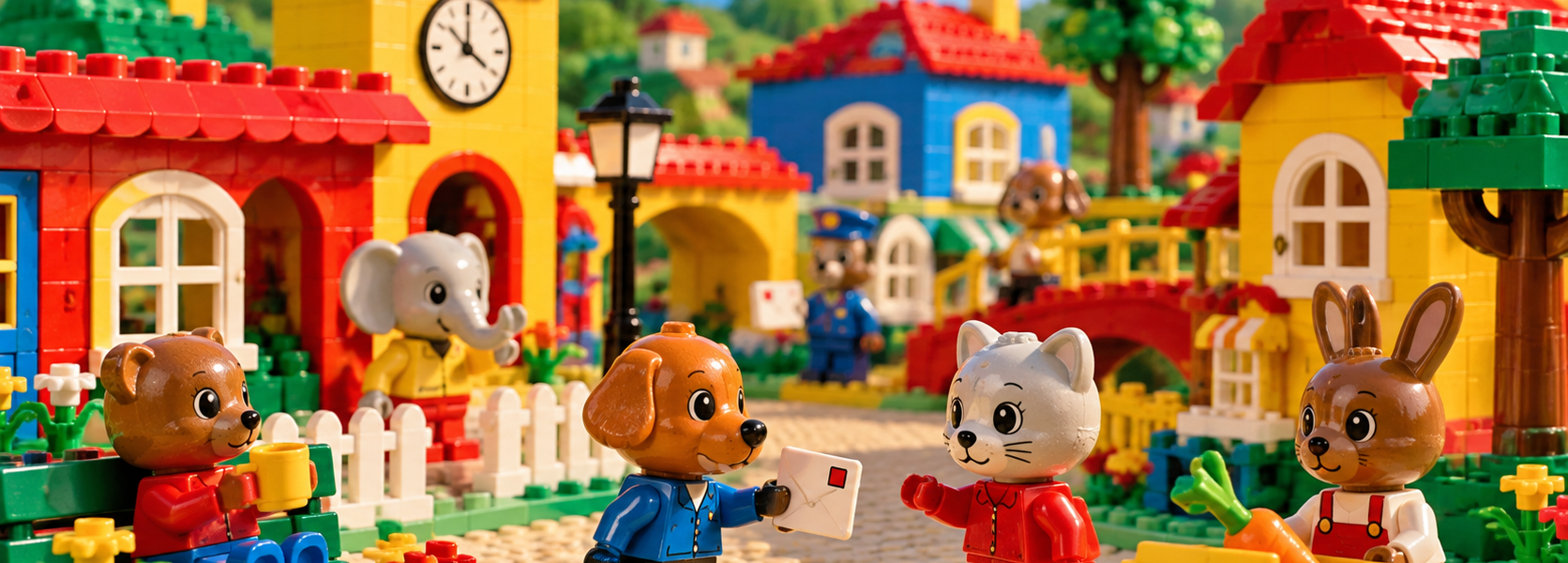
There was a time when a LEGO town might have a lion for a mayor, a crocodile for a neighbour and a rabbit running errands. Its houses were simple, its vehicles looked as though they belonged in an illustrated children’s book, and every resident seemed to have somewhere important to be. Welcome to LEGO Fabuland.
From a distance, the theme can look like an odd footnote to LEGO history: oversized animal heads, modest buildings and a world far removed from the familiar minifigure scale. But look at its storybooks, instructions and characters, and a more interesting picture appears. Fabuland was an early attempt to make the story the child wanted to tell as important as the model the child built.
Released between 1979 and 1989, Fabuland occupies a distinctive place in the company’s history. It was designed for younger builders, yet it also anticipated the character-led approach that would become familiar in much later LEGO themes. This is the story of a little animal town, why it worked differently and why some collectors have never quite left it.
A missing step between DUPLO and LEGO System
Fabuland was introduced in 1979 for children roughly three to seven years old. LEGO’s own history describes its purpose clearly: help children move from the larger, simpler DUPLO products towards the smaller elements and more involved models of LEGO System.
That goal shaped the entire range. Buildings could be assembled relatively quickly using large, easy-to-handle elements, doors, windows and roofs. Children did not need to spend most of a play session constructing an elaborate facade before they could begin the adventure taking place inside it. The buildings also had rooms large enough for the animal characters to move around in.
Fabuland was not an isolated toy system. LEGO’s original guidance to parents explained that its pieces could connect with ordinary LEGO bricks, allowing families to extend both their models and their stories. The relationship with LEGO System was therefore deliberate: easier first steps without closing the door to more complex building.
One could describe that as ‘less building’, but it would miss the point. The design made room for a different kind of creativity. Once a bakery or fire station stood on the floor, the next question wasn’t necessarily how to add another wall. It was what might happen there.
The people of Fabuland just happened to be animals
It is hard to imagine Fabuland without its figures. They had distinctive heads, moving limbs, colourful outfits and personalities that extended beyond the contents of any single box. Unlike an unnamed worker in a generic town, a Fabuland resident might arrive with a name, a profession and the beginnings of a plot.
Lionel Lion, sometimes called Leonard Lion, was the mayor. The early Town Hall set included Buster Bulldog and Freddy Fox, the latter portrayed by LEGO as mischievous but good-hearted. Elsewhere in the village were the daydreaming Edward Elephant, friendly Bonnie Bunny, adventure-loving Max Mouse, nurse Lucy Lamb, florist Hannah Hippopotamus and the accident-prone Clive Crocodile.
Those jobs and personalities mattered. A flower shop, a police station or a delivery vehicle was not merely a collection of parts; it was somewhere a particular character belonged. Even a tiny model could be the beginning of a much larger imaginary episode.
For international collectors, another complication makes this charming world more interesting. Character names were not always consistent between countries. LEGO House notes that Edward Elephant appeared under other names, including Fanfan, Ollie and Eduardo, in different markets. If an old booklet has a name unfamiliar to an English-speaking collector, it need not depict an entirely different animal.
Sometimes the instructions were the story
Perhaps Fabuland’s most original idea lay in the paper materials. Many of its larger sets came with building instructions that also worked as short illustrated stories. A parent could read along while a child followed the pictures and constructed the scene. When the official sequence ended, the child could invent what happened next.
LEGO’s historical archive preserves an example from 3660 Fisherman’s Cottage (1985). The building and the characters were part of a narrative rather than unrelated objects. The concept was even explained in the leaflets supplied to parents: read the story, follow the simple visual guidance, then make up new adventures and build additional models.
It is a subtle shift in emphasis. Conventional instructions answer, ‘Where does this brick go?’ Fabuland’s story-driven instructions also suggest, ‘Why is this character here, and what will they do next?’ The finished model becomes scenery for imaginative play rather than the final achievement.
Not every small Fabuland pack needs to have included a substantial storybook for that principle to matter. The larger sets and accompanying media are sufficient evidence of how seriously the theme took narrative play.
How the little town changed during the 1980s
Fabuland did not spend ten years releasing the same cottage in different colours. Its building style evolved. LEGO points to 350 Town Hall (1979), whose roof used conventional 2×4 bricks, and 3678 (1982), which illustrates the move to larger roof elements that were easier for young children to handle.
The changes are modest by the standards of Technic engineering, but they explain something essential about the target audience. A roof made from fewer, bigger parts is faster to put together and take apart. The resulting houses also acquired a more recognisable, storybook silhouette.
Across the decade, Fabuland offered domestic buildings, shops, cafés, fire and police stations, transport and fairground attractions. A museum description of the range notes its deliberately old-fashioned atmosphere: vintage-looking cars, biplanes and even a paddle steamer. Instead of recreating modern city infrastructure with technical accuracy, the setting offered easily understood places and jobs for a child’s miniature community.
LEGO House reports 99 retail Fabuland sets released between 1979 and 1989. You may encounter different totals in collectors’ databases, which can track promotional releases, regional variants or other catalog entries as well as standard retail products. The figure of 99 should be presented as LEGO House’s stated retail count, not as a universal total for every Fabuland-related item.
1987: Edward Elephant gets a television series
For most of its life, Fabuland was an ensemble world. According to LEGO House, there was no single lead character between 1979 and 1987. The residents collectively carried its stories.
In 1987, that changed with the British animated television series Edward and Friends. Edward Elephant became its central character, bringing the village and its inhabitants onto television screens. The Powerhouse museum in Australia describes the programme as a British clay-animation production, reflecting Fabuland’s journey from a toy-based story world into stop-motion entertainment.
The television programme was named after Edward, but the toys remained branded LEGO Fabuland. The distinction is worth preserving. It wasn’t a new LEGO building theme replacing the old one; it was another medium through which children could recognise and revisit the characters.
The show also demonstrates what made Fabuland different from an assortment of animal figures. The characters had enough identity to move from models and illustrated pages into stories people could watch.
An early LEGO world that extended beyond its boxes
Books, playing cards, clothing and other licensed products accompanied Fabuland. LEGO’s own historical account describes it as its first play theme to extend into such material in support of storytelling, with the television programme becoming a later part of that approach.
Today, a story world with its own merchandise and animation hardly seems unusual. It is familiar from more recent themes such as NINJAGO or Friends. Fabuland existed decades before those properties, however, and shows that LEGO was already experimenting with familiar characters across different media.
That doesn’t prove that every later character-driven theme was directly derived from Fabuland. The narrower, better-supported conclusion is more interesting: storytelling was an explicit part of LEGO’s design ambitions much earlier than many fans might assume. When LEGO House revisited Fabuland in 2025, it highlighted exactly that historical achievement.
A Fabuland childhood preserved in an Australian museum
There is a particularly evocative way to understand the range’s appeal without relying only on advertising material. Australia’s Powerhouse Collection holds a substantial group of Fabuland toys collected by a child, Imogen Cortis-Jones, while growing up in New South Wales.
The museum describes a collection of approximately 60 sets, many still accompanied by their original boxes, together with catalogues and storybooks. It was donated in 2012. The collection includes places and activities ranging from shops and bakeries to vehicles and amusement rides. The museum treats it not only as evidence of 1980s LEGO design, but also as a record of how a young person assembled and cared for a play world.
That context adds something a set-number list cannot. A child wasn’t necessarily thinking about the future rarity of a particular animal figure. They were building a town, keeping its inhabitants together and returning to those stories. Decades later, the surviving boxes, books and figures became objects worth preserving in a museum collection.
It would be an overstatement to claim that every Fabuland child played in the same way. But this documented collection gives us a concrete example of what the theme could become in an ordinary household: a world larger than any individual set.
What collectors should look for today
Fabuland presents a different challenge from completing a standard LEGO Town car. Its animal figures, large accessories, distinctive roofs and story materials are often just as important to the identity of a set as the bricks themselves.
For anyone reconstructing an old model, a sensible starting point is the exact set number. Compare inventories from Brickset and other specialist catalogs, check the relevant characters’ clothing and accessories, and look for the correct building elements rather than assuming any similar roof or window is equivalent. Then check whether the original publication included a storybook or special instruction material.
Figure variations deserve special care. The fan-maintained Unofficial Fabuland Homepage documents differences in eye printing and leg markings. Its contributor notes describe an older eye style used during 1979–1985 and more detailed eyes appearing from 1986, alongside changes in copyright marks on the legs. These are useful collector observations, not a complete official LEGO manufacturing chronology; they should be checked against the specific figure and set under consideration.
Condition matters, too. It is reasonable to inspect articulated limbs, connections, printing and accessories when buying older figures, but we have not physically tested representative Fabuland toys for this article. Nor is there a sound basis here for claiming that every uncommon figure is valuable, or that a specific variation guarantees a higher resale price.
Finally, remember the international name differences. Searching for a familiar character using only one regional name can hide relevant historical material. A figure’s appearance, catalog number and set provenance are often more reliable than the name printed in a single booklet.
Why did Fabuland disappear in 1989?
Fabuland ended as a regular LEGO range in 1989, ten years after its introduction. LEGO’s historical material confirms the date, but does not provide a detailed public account establishing one definitive commercial reason for the decision.
It is tempting to fill that gap with a tidy explanation: perhaps children wanted different models, perhaps the market changed, perhaps the theme had simply run its course. Those possibilities are not verified findings about the discontinuation. Without contemporary sales analysis or a clear company statement, the responsible answer is that the exact business reasoning has not been established by the sources reviewed.
What we can document is the extent of the experiment: a decade of sets, changing building methods, a large cast, story materials, licensed products and a television series. Fabuland was more than a brief novelty.
2025: LEGO House remembers the animals
After decades without a continuing Fabuland toy line, the characters received an official tribute. On 1 March 2025, LEGO House in Billund released 40506 Fabuland Tribute, the sixth product in its exclusive collectible series.
The 1,026-piece set reimagined four characters as larger brick-built display figures: Edward Elephant, Joe Crow, Dr Lucy Lamb and Clive Crocodile. LEGO House Master Builder Stuart Harris and LEGO Senior Designer Markus Rollbühler developed it in collaboration with historians at LEGO Idea House. Its instructions included illustrations in the spirit of the original story-led building experience.
The distribution is crucial to the story. The tribute was created as a LEGO House exclusive, available through the LEGO Store at LEGO House in Billund. It was not a relaunch of the 1979–1989 range, not a return of its original animal figure molds and not evidence of an announced new line of Fabuland sets.
What the tribute did bring back was the original idea: four familiar characters, each with a personality, and a building experience that acknowledged the importance of storytelling. Even the modern celebration was about more than displaying an old logo.
The lesson of a very small animal town
Fabuland is easy to underestimate if you judge a LEGO theme by mechanical complexity, piece count or the scale of its largest building. Its models were meant to be manageable for young children. The village was deliberately approachable, and the animals looked as though they had stepped out of a picture book.
Yet those choices served a precise purpose. They made it easier to reach the moment when a child could give the mayor a problem, send an elephant on an adventure or invent a new customer for the bakery. Building was a way into the story, not a reason to stop playing when the final piece clicked into place.
Fabuland ended in 1989, and its animal figures belong to a particular era of LEGO design. The broader idea remains remarkably easy to recognise: sometimes a few bricks, one familiar character and a story are enough to make an entire world feel alive.
Sources and further reading
- LEGO History — Fabuland: official account of its age range, design, story materials and development from 1979 to 1989.
- LEGO House — Fabuland Tribute (40506): retail set count, characters, 2025 tribute, designers and launch details.
- Powerhouse Collection — Collection of LEGO Fabuland Construction Toys: museum documentation of Fabuland’s setting, television history and an Australian childhood collection.
- Brickset — Fabuland catalog: historical set numbers, dates and variants.
- Unofficial Fabuland Homepage — character reference: fan-maintained descriptions of historical figure variations, including eye styles and leg markings.