
LEGO Daft Punk: How a Fan-Built Alive 2007 Pyramid Got Approved

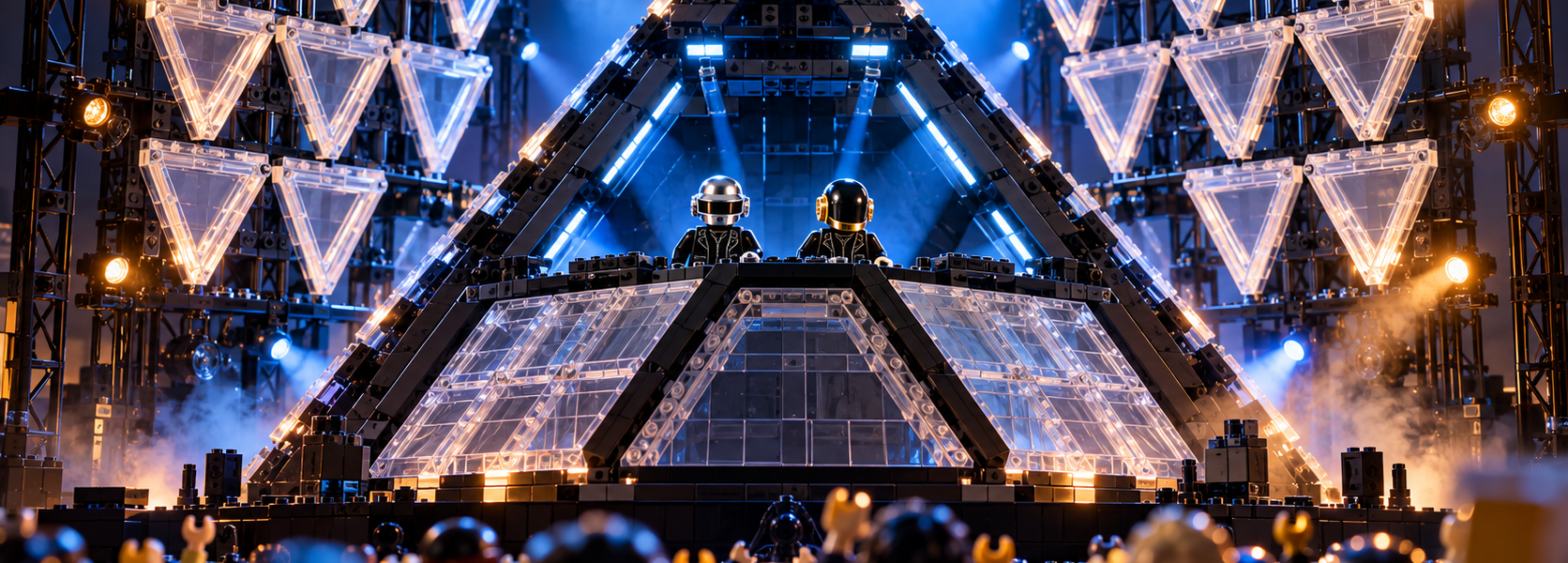
A striking LEGO concert stage, imagined during lockdown by a father and his young son, spent years moving between fan enthusiasm and uncertainty. It won a LEGO Ideas challenge in 2020 but was not chosen for production. The family brought it back to the platform in 2024, attracted 10,000 supporters in 2025 and then watched it sit in the programme’s parking lot. On 22 October 2026, LEGO finally announced that Daft Punk Concert would move forward as an official LEGO Ideas set.
That decision came with a bigger surprise: the LEGO Group and Daft Punk are entering a partnership spanning products, content and brand experiences. The story is not simply that a fan submission secured enough votes. It is about how a persistent community project became the starting point for a collaboration between two creative brands—and how much work still lies between a celebrated fan model and a finished product.
What LEGO and Daft Punk announced on 22 October 2026
In an official statement titled Builders After All, the LEGO Group confirmed that it had approved the fan-created LEGO Ideas project Daft Punk Concert, inspired by the pyramid stage from the duo’s Alive 2007 tour. The announcement described a wider creative partnership rather than an isolated licensing agreement for one box. Its press release was also reproduced in full by Brickset on the day of the announcement.
The reveal film features LEGO-style versions of Thomas Bangalter and Guy-Manuel de Homem-Christo following a holographic red brick through a transforming landscape. It uses Daft Punk’s Voyager from Discovery (2001) and Human After All from the 2005 album. A short teaser during Daft Punk – WDPK 83.7 on 21 October had already offered a clue in the form of an illuminated red 2 × 4 brick.
The distinction between announcement and release is essential. LEGO approved the idea for official development; it did not reveal a finished retail set. The company’s statement promises more information in 2027, but does not give a confirmed sale date, set number, price, final piece count or product feature list. The animated versions of the musicians in promotional content should not be treated as proof of the final minifigure selection.
A family project before it became a commercial proposition
The origins are unusually personal. Patrick Harboun of Luxembourg, who submitted the idea under the username RobotRock, explained in his original LEGO Ideas project description that the model began as a father-and-son collaboration during the 2020 lockdown. His then-eight-year-old son built an early prototype from bricks already at home; Harboun later developed the concept digitally.
Their enthusiasm crossed generations. Harboun recalled growing up with Homework while his son’s early musical favourites included Get Lucky. The shared reference point was the duo’s instantly recognisable Alive 2007 stage: a pyramid carrying performers, music and a spectacular arrangement of light into a single image.
The model won the Grand Prize in LEGO Ideas’ Music to Our Ears! challenge, organised with Universal Music in 2020. But winning that competition did not make the model an official product. A different submission was selected for commercial development, as DJ Mag reported in October 2024. That could have been the end of the project. Instead, its creators preserved the idea and returned to it years later.
The second attempt: 10,000 supporters and a year in the parking lot
The new Daft Punk Concert submission appeared on LEGO Ideas on 4 October 2024. Harboun said that seeing Daft Punk represented in Pharrell Williams’ brick-animated film Piece by Piece helped encourage another attempt. The project retained its central concept while finding a new audience through the standard LEGO Ideas support system.
By April 2025, the submission had crossed the platform’s threshold of 10,000 supporters, as confirmed by DJ Mag on 22 April 2025. That milestone earns a place in a formal review. It does not guarantee production: LEGO still evaluates whether a model can be developed into a suitable commercial product.
The 30 October 2025 LEGO Ideas results brought another delay. Rather than approving or rejecting Daft Punk Concert, the reviewers placed it in the parking lot, a category for concepts still under consideration. Brickset’s contemporary report listed RobotRock’s submission among three newly parked ideas. It remained there during later review announcements before receiving approval in October 2026.
For readers following LEGO Ideas, this part of the story is worth understanding. A project can attract substantial support, fail to secure a decision at its first review and still have a future. The parking lot is not itself an announcement that a product will be made, but neither is it a rejection.
Why the Alive 2007 pyramid is such a compelling LEGO subject
The pyramid is an architectural image as much as a stage prop. Daft Punk’s robotic identities, precise graphics and electronic performances have always depended on a carefully designed visual world. A concert stage turns that identity into something fans can recognise even without hearing the music. That makes the pyramid a powerful candidate for a brick-built display model.
It also makes the engineering difficult. Conventional LEGO construction is comfortable with vertical layers and a regular grid; the recognisable sloping faces of a pyramid require deliberate angle choices and stable connections. The model must communicate the stage’s silhouette while leaving room for its performance area and any details the designer wants to show.
Harboun’s fan design was described as approximately 2,000 pieces. His LEGO Ideas submission also described a motor-driven rotating box made from transparent bricks inside the pyramid, with lights arranged within to evoke the stage effects. These features are valuable evidence of the project’s ambition, but they belong to the fan submission. They are not confirmed functions of the future commercial set.
For LEGO’s designers, any official adaptation will have to balance visual fidelity, structural reliability, build experience and whatever functions ultimately make sense for the product. Those are general design considerations, not insider information about the approved set. We have not tested the original fan model or seen a final LEGO engineering solution.
The partnership may tell us more about LEGO Ideas than the approval alone
The most revealing insight came from Cédric Hervet, Daft Punk’s creative director, in an interview with Jonathan Bell for Wallpaper* on 22 October 2026. Hervet said that people on Daft Punk’s side had approached LEGO several years earlier without making a collaboration happen. In his account, sustained fan support around the project helped make the relationship possible.
Hervet also explained that he worked on the Alive 2007 stage design and watched the performances from beside the pyramid. That personal involvement makes his enthusiasm for a father-and-son reimagining more meaningful than an ordinary endorsement of a licensed product. For him, the LEGO model connects the original performances with a new generation discovering the same visual world.
His testimony is valuable but should be reported for what it is: the perspective of Daft Punk’s creative director, not a complete record of the negotiations or LEGO’s internal approval criteria. We cannot demonstrate that the fan submission was the only reason the companies reached an agreement. We can say that the official announcement identifies the LEGO Ideas community as central to the collaboration and that Hervet independently emphasises the role of its fans.
That distinction makes this story more interesting than a conventional licensed-set announcement. The creative community did not merely react to a marketing campaign after it launched. In this case, a fan project preceded the public partnership and gave it a concrete, recognisable centrepiece.
A timeline from a living-room prototype to official approval
| Date | Milestone | Why it matters |
|---|---|---|
| 2020 | Harboun and his son build the concept; it wins Music to Our Ears! | Competition success, but no retail-set approval |
| 4 October 2024 | Daft Punk Concert returns to LEGO Ideas | A second attempt under RobotRock’s account |
| April 2025 | 10,000 supporters reached | The submission qualifies for review |
| 30 October 2025 | Moved into the Ideas parking lot | Decision postponed, project still under consideration |
| 22 October 2026 | LEGO × Daft Punk partnership and set approval announced | Fan project proceeds toward official development |
| 2027 | Further information promised | Not a confirmed retail release date |
What is confirmed—and what buyers should not assume
| Detail | Status as of 22 October 2026 |
|---|---|
| Official LEGO × Daft Punk partnership | Confirmed by the LEGO Group |
| Approval of the Daft Punk Concert LEGO Ideas concept | Confirmed, with development still ahead |
| Alive 2007 pyramid as the inspiration | Confirmed |
| Retail release date or preorder window | Not announced |
| Set number, regional prices and availability | Not announced |
| Final piece count | Not announced; roughly 2,000 belongs to the fan model |
| Motorised rotating structure or lighting | Unconfirmed for the official set |
| Final minifigures and accessories | Unconfirmed; promotional animation is not a box inventory |
| More details in 2027 | Announced, without a firm release schedule |
These differences matter because fan-project renders can circulate online for months or years beside reports of official approval. An image of the submitted concept, however attractive, is not a product photo. Similarly, a projected launch year in an article should not be confused with a LEGO-confirmed release date.
Can a fan project really open the door to a larger brand collaboration?
This case suggests that it can—but not that it usually will. Most LEGO Ideas submissions never become retail sets, and a successful review does not normally mean that the underlying intellectual-property owner will enter a broad partnership with LEGO. Daft Punk’s instantly recognisable stage, an existing fan community and years of visible support made this an unusual convergence of interests.
There is a further cultural reason the subject has staying power. Daft Punk disbanded as a performing duo in 2021, yet the music and robotic personas remain familiar to listeners who discovered them through different albums, films and interactive media. The approved concept is therefore not tied to promoting a current concert tour. It translates an established piece of music history into an object that can be built, displayed and interpreted by fans.
That is our editorial reading of the announcement, not a sales forecast. We cannot predict the final set’s price, commercial success or detailed construction from what has been released so far.
The fan project has won its place; the product still has to be built
From the family’s lockdown prototype to the official partnership announcement, the journey took roughly six years. It involved a contest win that did not lead to production, a second LEGO Ideas submission, thousands of supporters and a long review process. The biggest development on 22 October 2026 is that LEGO publicly committed to bringing the concept forward.
The next important question is no longer whether the idea will be considered. It is how the LEGO designers will reinterpret Harboun’s glowing, geometrically challenging pyramid for a real consumer set. Until official product details appear, that remains open. The central achievement is already clear: a family MOC inspired by a concert became the focal point of a new LEGO and Daft Punk collaboration.
Sources and further reading
- The LEGO Group — Builders After All, partnership announcement, 22 October 2026: official confirmation of partnership, LEGO Ideas approval and planned 2027 updates.
- Brickset — LEGO DAFT PUNK confirmed for 2027!, 22 October 2026: complete reproduction of the LEGO Group’s press release, not independent proof of a 2027 retail date.
- LEGO Ideas — Daft Punk Concert by RobotRock, submitted 4 October 2024: creator’s original description and proposed features.
- DJ Mag — Daft Punk’s Alive 2007 LEGO recreation submitted to ideas platform, 7 October 2024: first contest and resubmission.
- DJ Mag — project advances to review, 22 April 2025: 10,000-supporter milestone.
- Brickset — LEGO Ideas results announced, 30 October 2025: parking-lot decision.
- Jonathan Bell, Wallpaper* — Lego gets lucky with its latest creative collaboration, 22 October 2026: interview with Cédric Hervet on the partnership, the original stage and the role of fans.