

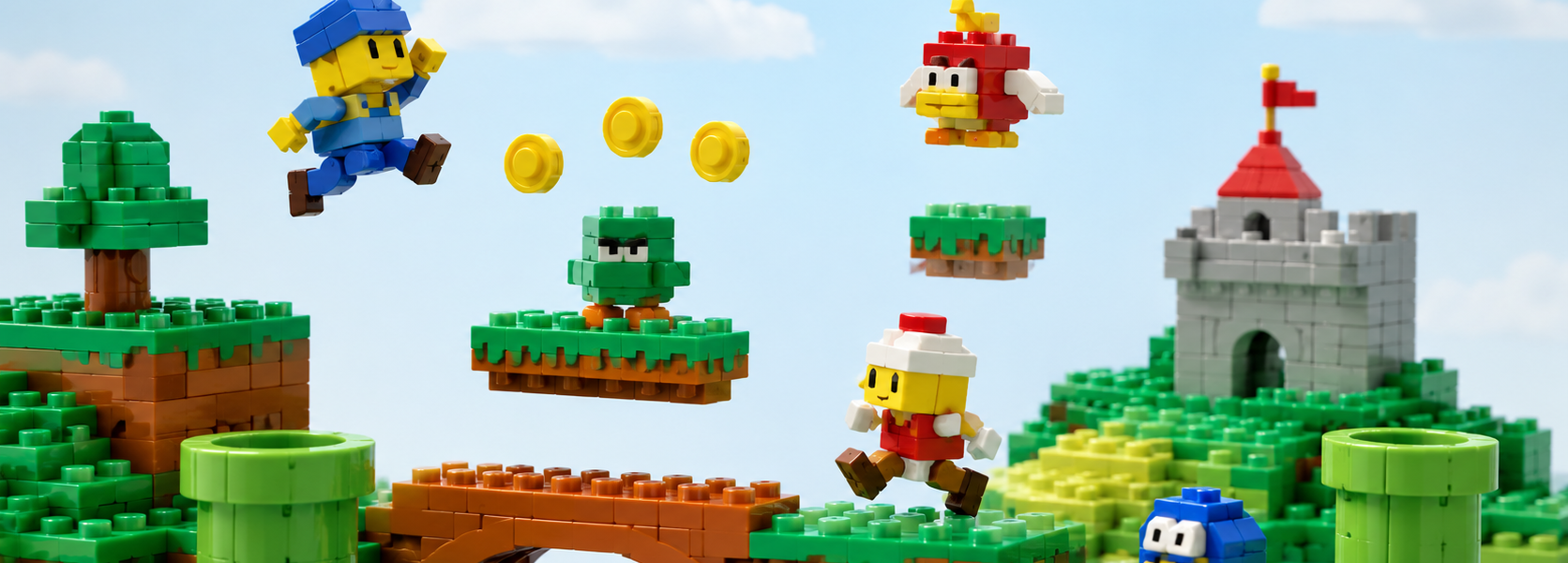
LEGO Super Mario’s Minifigure Era Starts With Eight Sets in January 2027

LEGO Super Mario is entering a new phase in 2027. The move toward a more traditional minifigure-scale format was first announced on Mario Day in March, but the first full wave of actual retail sets has now been revealed.
Eight sets are scheduled for release on January 1, 2027, giving a much clearer picture of how LEGO plans to reshape the theme after years built around large electronic interactive characters.
Mario starts at just €9.99
The most accessible set in the wave is 72052 Mario’s Pipe Jump, with 61 pieces and a price of €9.99. That makes the core Mario character available in a very small set rather than locking him behind a premium starter product.
That pricing matters because the original LEGO Super Mario system, launched in 2020, revolved around larger interactive figures and expandable course-building sets. The 2027 assortment moves much closer to the conventional play pattern LEGO fans are used to across other character-driven themes.
Eight sets arrive on January 1, 2027
The wave covers several price points and scales. 72056 Luigi & Bowser Jr.’s Race contains 104 pieces and is priced at €29.99, while 72057 Yoshi at Mario’s House has 147 pieces at €39.99.
72058 Bowser’s Rumbling Race increases the scale to 409 pieces at €59.99, while the largest fully revealed set, 72060 Fire Mario & Bowser’s Castle, contains 850 pieces and is priced at €99.99.
All eight fully revealed sets share the same launch date: January 1, 2027.
A broader cast in a more traditional scale
The new wave includes familiar Nintendo characters such as Mario, Luigi, Peach, Yoshi and Bowser Jr., alongside Toad characters and others from the Super Mario universe.
Not every character uses a standard minifigure body format, though. Bowser, for example, has a larger custom construction. It is therefore more accurate to describe the 2027 range as a shift toward a more traditional minifigure-scale character system rather than saying every character is now a conventional minifigure.
The biggest structural change since the theme launched
LEGO Super Mario originally stood apart from most LEGO themes because its play system was centered on digital interaction. Mario, Luigi and Peach used larger electronic figures that reacted to course elements and connected the different expansion sets.
The 2027 line shows a clear move toward smaller character-based sets, conventional scene building and a format that should fit more naturally alongside typical LEGO minifigure-scale displays and playsets.
For collectors, that could be especially significant. Fans have wanted traditional versions of Nintendo characters for years, and the fact that Mario is available at the lowest price point suggests the new format is not being positioned only for premium collectors.
What about set 72059?
Industry listings also reference 72059, described as an 18+ set with 755 pieces. It has not been included in the main group of eight here because it has not received the same complete reveal and its price is still listed as TBC.
Until fuller official information appears, it is safer to treat 72059 as a separate unresolved part of the 2027 lineup.
A new chapter for LEGO Super Mario
The important point is not simply that more Nintendo characters are appearing in brick form. The revealed wave suggests a fundamental change in how LEGO Super Mario is structured: smaller entry sets, a more familiar character scale and a lineup that is easier to collect in the way fans collect other LEGO themes.
After six years dominated by interactive electronic figures, January 2027 looks set to mark the beginning of a distinctly different era for LEGO Super Mario.