
LEGO Speed Champions 2015–2026: From Racing Cars to Movie Icons

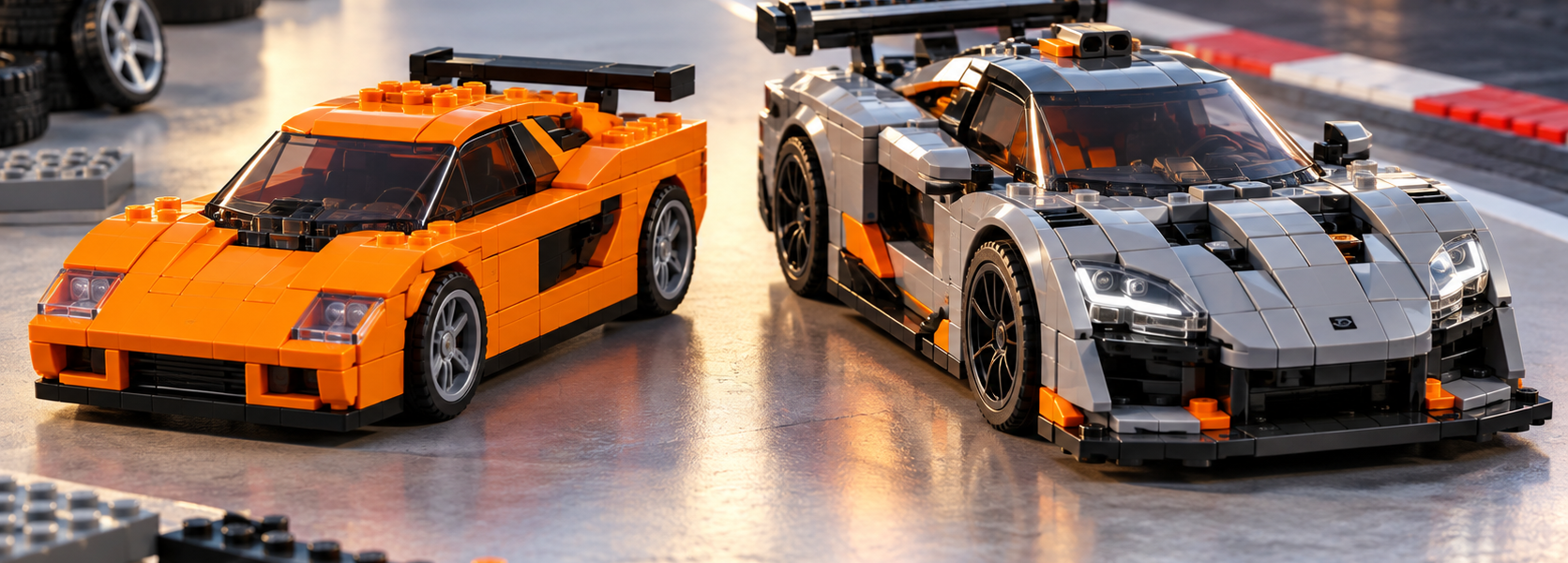
Place the 2015 LEGO Speed Champions McLaren P1 next to the 2026 Lightning McQueen and the difference is about more than eleven years of new pieces. One recreates a road-going hypercar in the compact proportions of an early LEGO racing toy. The other is an instantly recognisable animated character, complete with the number 95 and movie-inspired decoration. Both belong to Speed Champions.
That contrast raises a useful question: has the theme drifted away from the racetrack, or has its idea of a collectible car become broader? The evidence points to the second explanation. A major redesign in 2020 improved the models’ display appeal; film-inspired cars arrived in 2022; and a full grid of Formula 1 teams followed in 2025. By 2026, real racing machinery and fictional vehicles were sharing the same small-scale collecting space.
2015: recognisable cars, constrained proportions
Speed Champions launched in March 2015, drawing on names such as Ferrari, Porsche and McLaren. Its early cars generally used a six-stud-wide body. The McLaren P1 (75909), a 168-piece set, captures the idea well: a famous supercar reduced to a compact build that could be driven around the floor, displayed alongside similar cars and fitted with a minifigure driver.
Six studs offered several advantages. The finished cars occupied little shelf space, felt approachable as toys and could sit more naturally alongside the vehicles and streets many builders already used in LEGO city layouts. The compromise was visual precision. Narrow windscreens, wheel arches, cabin widths and the contours of modern performance cars were difficult to reproduce faithfully within those dimensions.
Those limitations were not evidence of poor design. They reflected a particular set of priorities: recognisability and playability within a small footprint. But as the audience collected more models and compared them with real vehicles, the tension between toy proportions and automotive accuracy became harder to ignore.
The 2020 shift to eight studs was a design decision, not just a size increase
In 2020, Speed Champions moved to cars built around an eight-stud-wide format. Two extra studs represent a one-third increase in nominal body width, although that does not mean every finished car grew by an identical percentage in all dimensions. The important gain was usable design space.
In a 2020 interview with New Elementary, Speed Champions design lead Christopher Stamp explained that authenticity and fan feedback drove the redesign. With more space available, designers could reproduce selected exterior details using bricks rather than depending entirely on stickers. The new chassis and cockpit arrangements also opened up different proportions and seating possibilities.
The 1985 Audi Sport quattro S1 (76897), released in 2020 with 250 pieces, makes a useful case study. Its boxy rally-car silhouette, wide stance and prominent rear spoiler suit a format in which the body can be shaped more deliberately. The eight-stud generation could also support more ambitious building techniques and increasingly detailed interiors. In a follow-up interview published in 2021, Stamp discussed both those opportunities and the team’s intention to make a more compelling display collection.
There was a genuine trade-off. Eight-stud cars take up more space, and they do not blend as easily with road widths or garages created around smaller LEGO City vehicles. A shelf of older six-wide cars and newer eight-wide cars can look inconsistent. For collectors who value a recognisable silhouette, the extra width is usually an advantage; for fans building a tightly scaled city, it may be the opposite. That distinction matters more than declaring one format universally superior.
2022: Hollywood joined the garage
The 2022 arrival of the 007 Aston Martin DB5 (76911) and the Fast & Furious 1970 Dodge Charger R/T (76912) marked an important change in how Speed Champions could attract an audience. Neither car needed to be introduced solely through lap times, horsepower or racing heritage. Film audiences knew the vehicles through James Bond and Dominic Toretto.
In a 2022 New Elementary interview, Stamp described the movie-and-TV direction as an extension of an eight-module-wide licensed vehicle collection. That is a more revealing framing than the idea that LEGO had abandoned racing. The unifying subject was still the vehicle; what changed was the reason a fan might care about it.
Consider the DB5. The 298-piece model has an identity beyond the shape of an Aston Martin: its associated Bond minifigure and alternative movie-style licence plates strengthen its screen connection. The Charger speaks both to muscle-car enthusiasts and Fast & Furious fans. Someone building a display of famous cinema vehicles now had a reason to follow the same theme as someone collecting race cars.
This broadened the collecting logic. A Speed Champions shelf no longer needed to follow a single manufacturer or motorsport championship. It could instead feature automotive engineering, fictional storytelling or a mixture of both.
2025: the Formula 1 collection argues against a move away from motorsport
If Hollywood had replaced motorsport as the theme’s focus, 2025 would be difficult to explain. Through its partnership with Formula 1, LEGO released Speed Champions cars representing all ten teams on the grid at the time. The collection used team identities and liveries based on the 2024 cars, even though the wave arrived in 2025.
This was a different kind of collecting proposition from a standalone McLaren or Ferrari road car. Fans could assemble something resembling a complete field, compare related designs side by side and choose a favourite team or attempt the whole set. As Formula 1’s original announcement and LEGO’s design feature made clear, the partnership extended across several product lines; Speed Champions became the home for the individual team cars.
The 2025 wave also exposed a design challenge: when ten cars share broadly similar contemporary F1 proportions, colour schemes, aerodynamic details and printed or stickered features have to work particularly hard to establish identity. The collection’s appeal therefore came partly from consistency and completeness, not only from the individuality of one vehicle.
Rather than choosing between racing and popular culture, LEGO was allowing distinct collecting habits to coexist within Speed Champions.
2026: Lightning McQueen changes what counts as a car icon
Lightning McQueen (77255) is arguably the clearest example of that expanded definition. Released for the 20th anniversary of Disney and Pixar’s Cars, the 270-piece model translates a fictional, character-driven vehicle into Speed Champions form. The number 95, sponsor decoration and face-like details are as important to recognition as the car’s proportions.
There is a small but telling detail in LEGO’s own presentation. The US product listing is filed under Disney, yet the description explicitly identifies Lightning McQueen as a Speed Champions model. The two labels are not contradictory: one reflects the story franchise, and the other the building and collecting line. LEGO also highlights its detailed underside as a distinctive feature of this model.
Compare that with the 357-piece Time Machine from Back to the Future (77256). It remains a car-shaped model, but the design is tied to scenes from two films: builders can configure details from the first movie or rebuild it in flying mode with sideways wheels inspired by the sequel. Marty McFly and Doc Brown minifigures make the narrative connection explicit.
The broader 2026 Speed Champions line-up illustrates a further overlap. Alongside real-world Ferraris and McLarens are vehicles such as the fictional APXGP race car from F1 The Movie and the Bugatti Vision GT, a design with strong links to video-game culture. Motorsport, automotive branding, films and games are no longer mutually exclusive routes into this range.
Five models, five snapshots of the theme
Selected sets help map the timeline, but their piece counts need careful interpretation:
| Set | Year | Pieces | What it illustrates |
|---|---|---|---|
| McLaren P1 (75909) | 2015 | 168 | Compact six-wide supercar |
| 1985 Audi Sport quattro S1 (76897) | 2020 | 250 | More accurate eight-wide shaping |
| 007 Aston Martin DB5 (76911) | 2022 | 298 | Real automotive icon with a film identity |
| Lightning McQueen (77255) | 2026 | 270 | Animated character as collectible vehicle |
| Time Machine (77256) | 2026 | 357 | Movie vehicle with alternate configurations |
These are deliberately chosen examples, not a representative sample of every release. The count does not climb neatly from one model to the next; nor should it. More pieces do not automatically mean better accuracy, greater value or a more rewarding build. Complex bodywork, unusual functions, accessories and the way a model uses its elements all matter.
What international collectors should take from the change
For someone collecting across generations, the most practical choice is whether to keep a consistent scale or collect by subject. A six-wide-only display preserves the compact appearance of the original line. An eight-wide collection offers more visual consistency among modern models. A screen-cars collection can mix Bond, Fast & Furious, Pixar and Back to the Future, but it follows a storytelling theme rather than a single class of real-world car.
Regional shopping also complicates comparisons. Recommended retail prices can differ across countries and currencies, and a retired 2015 model bought from a secondary-market seller is not directly comparable with a 2026 set sold at its local official retail price. Condition, missing stickers, minifigures, packaging and shipping charges can outweigh a simple price-per-piece calculation. The examples above are a design-history comparison, not a ranking of financial returns.
It is also worth remembering that Speed Champions does not include every type of LEGO vehicle and that a product can be organised differently within regional store categories. Checking the actual set number is more reliable than assuming a particular store menu tells the whole story.
Did Speed Champions become a better theme?
On design flexibility, the case for the eight-stud format is strong: it creates room for better proportions, more intricate builds and more satisfying display models. But the older small cars still have advantages for city layouts, space-limited collections and the distinctive simplicity of the theme’s early years.
The larger transformation is not only technical. Between 2015 and 2026, Speed Champions evolved from a compact celebration of sports and racing cars into a collection of vehicles people recognise for different reasons. The 2025 Formula 1 grid confirms that motorsport remains central. Lightning McQueen and the Back to the Future car show how far beyond the circuit that central idea can now travel.
For builders and collectors, that is the real achievement: Speed Champions has expanded its garage without needing to stop being about cars.
Sources and further reading
- LEGO — Speed Champions theme history
- New Elementary — Christopher Stamp on eight-wide, 2020
- New Elementary — Christopher Stamp on collectors and proportions, 2021
- New Elementary — Christopher Stamp on film vehicles, 2022
- LEGO — McLaren P1 75909
- LEGO — Aston Martin DB5 76911
- LEGO — F1 collection design feature
- Formula 1 — 2025 LEGO collection announcement
- LEGO — Lightning McQueen 77255
- LEGO — Time Machine 77256
- LEGO — 2026 Speed Champions line-up